The bow tie effect is one of the most common concerns buyers have when shopping for oval diamonds, especially for engagement rings. It refers to the dark, bow tie-shaped shadow that can appear across the center of the stone when light does not reflect evenly. In some oval diamonds, that shadow is subtle. In others, it is very noticeable and can make the diamond look less bright from certain angles.
If you are researching how to avoid bow tie effect in oval diamonds, the most important thing to know is that this is not a flaw in every oval diamond. It is a normal optical feature that comes from the oval shape itself. The goal is not to find an oval with absolutely no bow tie, because that is rarely realistic. The goal is to choose an oval diamond where the bow tie is minimal, balanced, and not distracting in everyday wear.
Understanding how the bow tie effect works can help you make a much better buying decision. It can also help you compare lab grown diamonds and natural diamonds more confidently, since the shape behavior is the same regardless of origin. A well-cut oval can look bright, elegant, and elongated. A poorly proportioned one can show a large dark band that reduces its visual appeal.
Quick Answer
To avoid a strong bow tie in an oval diamond, focus on cut quality, shape proportions, and real-world visual inspection rather than just carat weight or certificate details. Look for an oval with a balanced length-to-width ratio, even brightness across the center, and minimal dark areas in videos and side views. A small amount of bow tie is common, but a heavy one usually means the diamond’s facets are not reflecting light evenly.
In practical terms, the best way to reduce bow tie risk is to compare several oval diamonds side by side, review high-quality videos, and pay attention to how the center looks under different lighting. If possible, use a trusted grading report and work with a seller who can explain the stone’s light performance clearly. For lab grown diamonds, this process is the same, and many buyers like that they can often access a larger selection at a lower price point.
What Is the Bow Tie Effect in an Oval Diamond?
The bow tie effect is a dark area that stretches across the middle of an oval diamond, resembling the shape of a bow tie. It appears because of the way the diamond’s facets, shape, and angle interact with light. When some parts of the stone reflect light back to the eye and others do not, the center may look shadowed.
This effect is especially common in elongated shapes such as ovals, marquises, pears, and some radiants. It is not the same as an inclusion or a chip. Instead, it is an optical shadow created by the way the diamond handles light.
Some bow tie is normal. In fact, nearly every oval diamond has at least a mild one under certain lighting conditions. The real issue is degree. A faint bow tie may be barely noticeable and acceptable to many buyers. A strong bow tie can make the stone look uneven or less lively, particularly in bright, direct light.
Why oval diamonds show bow ties more often
Oval diamonds have an elongated shape, which means light enters and exits the stone at different angles across the length of the diamond. The center area is often the most challenging zone to keep bright because the facets there can reflect light away from the viewer in a way that creates a dark band.
This is one reason oval diamonds can look very different from one stone to another, even when they have the same carat weight and color grade. Two ovals with identical lab reports may perform differently in person depending on their proportions and cutting style.
How the Bow Tie Effect Happens
The bow tie effect is mainly about light performance. A diamond sparkles because its facets reflect light. In an oval shape, some facet arrangements can create strong brightness and contrast, while others can create a central area that appears dark.
Three factors matter most: proportions, facet alignment, and viewing conditions. If the diamond is too shallow, too deep, or unevenly proportioned, light may escape from the wrong angles. If the crown and pavilion angles are not balanced well, the center can appear less bright. Even a well-cut oval can show a mild bow tie under certain lighting, but better cutting usually minimizes it.
Lighting also matters. A diamond may look fine in soft indoor light and show a more obvious bow tie under spotlights or direct overhead lighting. That is why relying only on one still photo can be misleading. Video and in-person viewing are much more useful.
Key Characteristics of a Good Oval Diamond
Not all oval diamonds are cut with the same philosophy, and there is no universal cut grade for oval shapes like there is for round brilliants. That means buyers need to evaluate more than a certificate. Paying attention to shape, brightness, symmetry, and proportion can make a meaningful difference in how the diamond looks on the hand.
Length-to-width ratio
The length-to-width ratio tells you how elongated or squarish an oval appears. Most buyers prefer something around 1.30 to 1.50, though personal taste varies. Lower ratios create a wider oval. Higher ratios create a longer, slimmer look.
This ratio does not directly determine bow tie strength, but it can affect overall appearance. Very elongated ovals sometimes draw more attention to the center area, where bow tie is most visible. Moderately proportioned ovals often look balanced and flattering on the finger.
Face-up spread
Face-up spread refers to how large the diamond looks when viewed from above. Ovals often face up larger than round diamonds of the same carat weight because of their shape. This is one reason many buyers consider ovals appealing, especially in engagement rings.
However, if the cut is too deep, the diamond may carry hidden weight below the surface, making it look smaller than expected. A stone with good spread and even brightness usually offers a better visual result than one that is simply large on paper.
Symmetry and balance
Good symmetry helps the diamond reflect light more evenly. In an oval, you want the ends to taper smoothly and the outline to appear balanced from left to right. Uneven symmetry can contribute to patchy brightness and more noticeable bow tie effects.
That said, symmetry alone does not guarantee strong light performance. A diamond can have a pleasing outline but still show a dark center if the faceting pattern is not well executed.
Facet pattern
The facet pattern is the arrangement of the small polished surfaces that create sparkle. In oval diamonds, different facet patterns can create different levels of contrast and brilliance. A well-crafted facet pattern helps distribute light more evenly across the stone, which can reduce the appearance of a bow tie.
Buyers often hear the term “crushed ice” when discussing some fancy shapes. Ovals are not always described this way, but the idea is similar in that facet style affects the kind of sparkle you see. Some ovals show broad flashes of light. Others show more fragmented sparkle. Neither is automatically better, but one may be more forgiving of bow tie than the other.
Appearance and Visual Performance
When people ask how to avoid bow tie effect in oval diamonds, they are usually asking a visual question. They want to know which diamond will look bright, balanced, and attractive in everyday wear. Visual performance matters more than technical measurements alone.
Brightness
Brightness is the amount of white light a diamond reflects back to the eye. In a good oval, brightness should feel even across the stone, with no large dead zones in the center. A mild shadow can add contrast, but a heavy dark band can interrupt the look of the diamond.
Brightness is often easiest to judge in motion. A diamond that looks slightly shadowed in one still image may brighten up as it moves. This is why videos are more informative than a single photograph.
Fire
Fire refers to colored flashes of light, usually seen as rainbow-like sparks. Ovals can show attractive fire, but it depends on facet arrangement and lighting conditions. Strong direct lighting tends to show more fire. Soft lighting may show less.
A bow tie does not necessarily reduce fire everywhere in the stone, but a darker center can make the diamond feel less lively overall. Buyers who want more visible fire should pay close attention to the stone’s light performance, not just its shape.
Scintillation
Scintillation is the pattern of sparkle that appears as the diamond moves. In oval diamonds, good scintillation creates lively flashes across the stone rather than one static dark band. If the bow tie is too strong, the movement of sparkle can seem uneven.
Many buyers prefer ovals because they offer a softer, more elegant sparkle than a round brilliant. The best examples still feel lively without looking overly busy or dim in the center.
Contrast
Some contrast is useful. It helps the eye see sparkle more clearly. The problem occurs when contrast becomes too concentrated in the center, creating a pronounced bow tie. A balanced oval should have contrast that enhances the stone rather than dominating it.
Think of it as visual rhythm. Too little contrast can make a diamond look flat. Too much can make it look patchy. The goal is a balanced pattern that remains attractive from different angles.
How to Avoid Bow Tie Effect in Oval Diamonds
There is no single trick that guarantees a bow tie-free oval diamond, but several buying steps can greatly reduce the odds of choosing a stone with an obvious dark center. These steps are useful whether you are buying a natural diamond or a lab grown diamond.
1. Prioritize cut quality over carat weight alone
Cut quality is the most important factor in how an oval diamond looks. A larger diamond with poor proportions may show more bow tie than a slightly smaller stone with better light performance. Buyers sometimes focus too heavily on carat weight because it is easy to compare on paper, but appearance depends more on cut.
If you are comparing stones, ask yourself which diamond looks brighter and more balanced rather than which one is simply bigger. In many cases, that question leads to a better purchase decision.
2. Review high-quality videos, not just still photos
Videos reveal how the diamond handles light as it moves. A still photo may freeze the stone at an angle that exaggerates or hides the bow tie. A video can show whether the dark center is persistent or only visible at certain angles.
Look for videos taken in neutral lighting, preferably with some rotation. You want to see how the diamond performs when it is tilted and turned, because that is closer to how it will be seen in real life.
3. Examine the center under different lighting
The center is where bow tie is most noticeable, so pay close attention to that area. A slight contrast pattern is normal. What you want to avoid is a wide, dark band that stays visible across multiple lighting conditions.
If the diamond looks bright in one setting but dark in another, ask for additional images or videos. A trustworthy seller should be able to provide them.
4. Look for balanced proportions
Very shallow or very deep stones can be more likely to show uneven light behavior. While there is no perfect ratio that works for every oval, a balanced depth and table size often supports better brightness. This is especially important in lab grown diamonds, where shoppers may find very large stones but still need to check cut performance carefully.
When proportions are too extreme, the diamond may look less lively. Good proportions support even reflection across the length of the stone.
5. Choose a reputable seller with transparent imagery
The best sellers provide magnified images, video, and clear measurements. They may also explain whether the stone has strong bow tie contrast or more even light distribution. Transparency matters because oval diamonds can vary widely.
If a seller only gives a basic certificate and a stock photo, that is not enough information to judge visual performance with confidence.
6. Use your own eyes whenever possible
If you can view the stone in person, inspect it under different lighting conditions. Move it under soft indoor light, brighter light, and near a window. A good oval should remain attractive in several environments, not only under showroom lights.
Do not rely on one perfect angle. A diamond should look pleasing from normal viewing distances and common everyday angles.
What to Look for in a Grading Report
Grading reports are useful, but they do not tell the full story for oval diamonds. Reports from labs such as GIA or IGI can confirm identity, measurements, color, clarity, and other details. They are important, but they do not directly grade bow tie effect.
This means the report is a starting point, not the whole evaluation. You can use the report to narrow your choices, but visual inspection is still necessary for oval diamonds.
Measurements that matter
The report will usually list length, width, depth, and table percentage. These measurements can help you identify whether the stone is likely to be well balanced. A very deep oval may look smaller than expected. A very shallow one may face up large but lack attractive light return.
None of these numbers alone determines bow tie strength. Still, they are useful clues when combined with video and images.
Clarity and color are still important
While bow tie is a cut-related issue, clarity and color also affect overall appearance. In an oval, inclusions near the center can be more noticeable if the stone has contrast or a large dark area. Likewise, color can seem more visible in the body of the diamond if the stone is not bright enough overall.
If you are learning more about diamond clarity grades or diamond color grades, it helps to think about how those factors interact with shape. A well-cut oval can be forgiving, while a poorly cut one may make inclusions or tint stand out more.
Advantages of Oval Diamonds
Despite the bow tie concern, oval diamonds remain popular for good reasons. They combine a flattering shape with strong face-up size and a softer look than a round brilliant. For many buyers, the advantages outweigh the need to carefully screen for cut quality.
Elegant finger coverage
Oval diamonds often appear larger than round diamonds of the same carat weight because of their shape. This can create strong finger coverage, which many engagement ring shoppers appreciate. The elongated outline can also make the finger look slightly slimmer.
Classic but distinctive look
Ovals feel familiar, yet they are less conventional than rounds. They offer a balance between timelessness and individuality. That combination is part of why the shape has remained popular in modern engagement rings.
Good value potential
Compared with round diamonds, ovals often cost less per carat because they are not as heavily standardized in demand and cutting requirements. That can allow buyers to prioritize size, color, or clarity within a given budget. In the lab grown diamond market, this advantage can be even more noticeable.
Flattering on many hand sizes
The elongated shape works well on a wide range of finger lengths and ring styles. It can look refined in solitaire settings, halo settings, and three-stone designs. Because of its versatility, it is a common choice for engagement rings.
Disadvantages of Oval Diamonds
The main drawback of oval diamonds is inconsistency. Unlike round brilliants, which have highly standardized cut expectations, ovals vary more from stone to stone. That means buyers have to be more selective.
Bow tie effect can be distracting
For some buyers, even a mild bow tie is bothersome. If you want a diamond that looks evenly bright from all angles, an oval may require more searching than a round brilliant or some other shapes.
Cut quality is harder to evaluate
Because there is no universal oval cut grade, buyers often need to judge the stone visually. That can be challenging for beginners. Measurements and certificates help, but they do not solve the issue entirely.
Color and clarity can be more noticeable depending on the cut
If an oval is cut in a way that reduces brightness, color tint or inclusions may stand out more. This is not always a problem, but it makes the buying process a little more nuanced than for some other shapes.
How Oval Diamonds Compare to Other Popular Shapes
Comparing oval diamonds with other shapes can help explain why bow tie matters and how shape affects visual performance. Some shapes are naturally more forgiving, while others prioritize different kinds of sparkle.
| Shape | Bow Tie Risk | Sparkle Style | Face-Up Size | Buying Notes |
|---|---|---|---|---|
| Round brilliant | Low | Strong brilliance and balanced sparkle | Moderate | Most standardized cut quality, easiest to evaluate |
| Oval | Moderate to high, depending on cut | Bright flashes with elongated shape | Often looks large for its carat weight | Needs careful review of proportions and video |
| Pear | Moderate | Similar to oval with pointed end | Good spread | Can show bow tie and is more shape-sensitive |
| Marquise | Moderate to high | Brilliant with dramatic length | Very strong spread | Points need protection and symmetry matters a lot |
| Emerald cut | Low bow tie, but different light pattern | Step-cut reflections, less sparkle but more clarity view | Can look large and elegant | Shows inclusions more easily, requires cleaner clarity |
This comparison shows an important point. Oval diamonds are not the only shape where light performance matters, but they are one of the shapes where buyers most often need to inspect the stone visually. If you prefer a brighter, more predictable look, a round brilliant may be easier to buy. If you prefer the elongated style of an oval, careful screening can still produce an excellent result.
Lab Grown Diamonds and the Bow Tie Effect
Lab grown diamonds can absolutely show bow tie effects in oval shapes. The optical behavior is the same because the shape and faceting are what create the visual result, not whether the diamond formed in the earth or in a laboratory.
For buyers, the benefit of lab grown diamonds is often selection and value. You may be able to compare more oval diamonds within your budget, which can make it easier to find one with better proportions and less noticeable bow tie. That does not guarantee a better outcome, but it can expand your options.
It is still important to use the same evaluation process you would use for natural diamonds. Review videos, check proportions, and compare several stones. If you are studying lab grown diamonds in general, oval shape selection follows the same visual rules as natural stones.
Important Buying Considerations
When shopping for an oval diamond, the bow tie effect should be one part of the decision, not the only one. You want a diamond that looks bright, balanced, and attractive in daily wear.
1. Balance bow tie against overall beauty
A tiny amount of center contrast can actually help the diamond sparkle. What matters is whether the bow tie feels distracting. If the stone still looks lively and bright, a mild bow tie may be acceptable. If the center stays dark in most views, it likely is not the right stone.
2. Do not rely on one number
Carat weight, length-to-width ratio, table size, and depth all matter, but none of them alone tells you whether the oval will look good. Buyers sometimes try to follow rigid formulas, but oval diamonds are better judged as individual stones.
3. Consider ring setting design
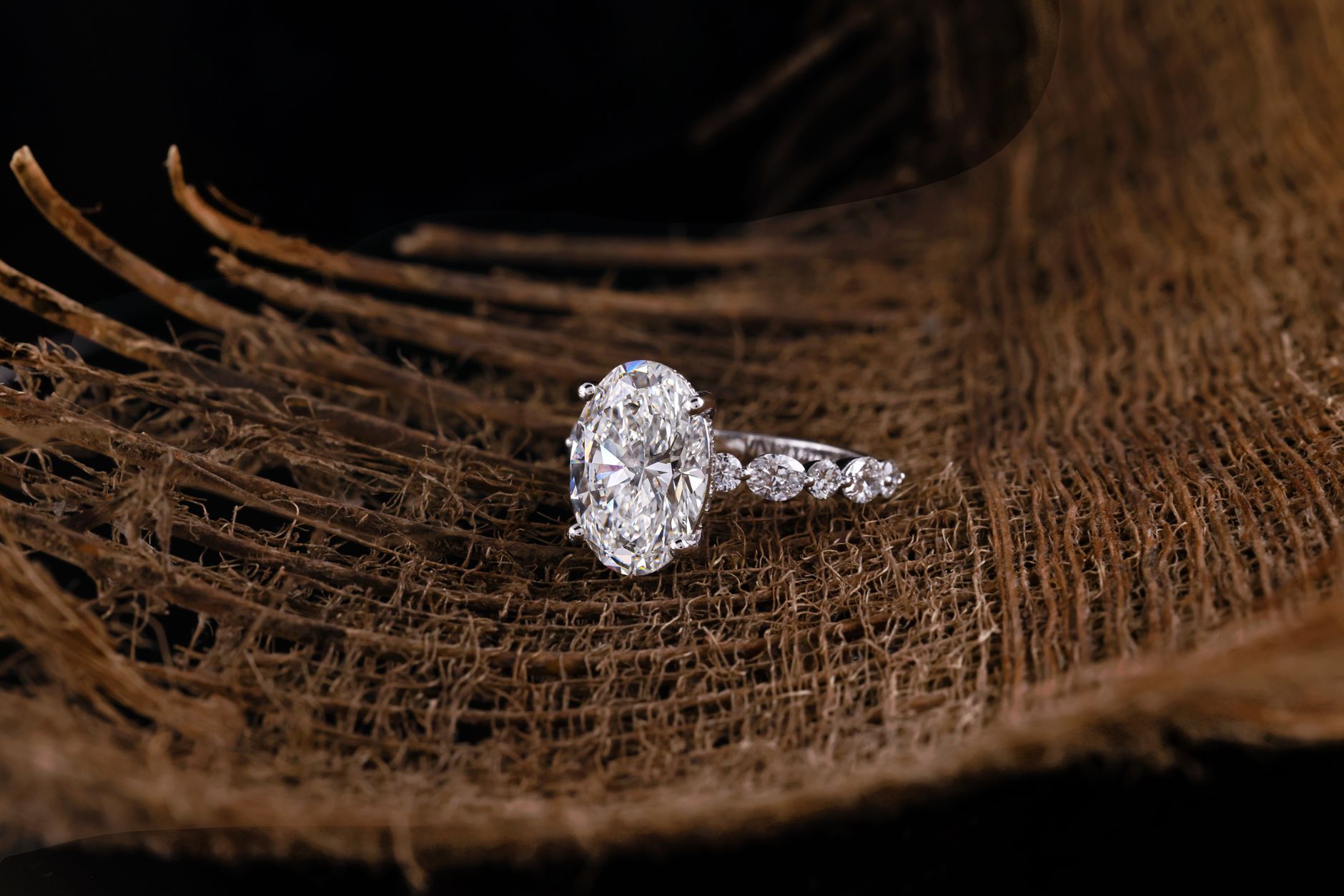
The setting can influence how the diamond appears. A thin halo or bright side stones may make the center look more lively, while a dark metal setting can sometimes emphasize contrast. The prongs and basket should also support the stone without blocking too much light.
If you are planning an engagement ring, it is worth thinking about how the setting, band metal, and accent stones will interact with the oval’s appearance.
4. Think about daily lighting conditions
If the ring will be worn in office lighting, restaurants, or outdoor daylight, the stone should look good in a variety of environments. Some ovals perform well in soft light but show stronger bow tie under bright spotlights. That is why everyday viewing matters more than showroom sparkle alone.
5. Choose the right clarity and color balance
For many oval diamonds, slightly lower clarity grades can still be perfectly acceptable if the inclusions are not visible to the eye. Color preferences vary by setting and personal taste. If the bow tie is strong, however, additional color tint or visible inclusions may become more noticeable because the stone has less even brightness to disguise them.
If you are comparing options, articles about diamond cut, diamond color, and diamond clarity can help you understand how these factors work together.
6. Use trusted grading information, but do not overvalue it
A grading report is useful for confirming measurements and quality factors, but it cannot tell you how pleasant the diamond will look in person. That matters especially for fancy shapes like ovals. A report should support your decision, not replace your eyes.
7. Ask about return and viewing policies
Because bow tie is best judged in real life, it helps if the seller allows inspection at home or offers a sensible return period. That gives you time to view the diamond under your own lighting, which is often the most reliable way to judge whether the stone’s center looks too dark.
Common Proportions Buyers Compare
While there is no single formula for the perfect oval, a few proportion ranges are often discussed because they tend to produce pleasing results more often. These are starting points, not rules.
| Measurement | Common Buyer Preference | Why It Matters |
|---|---|---|
| Length-to-width ratio | About 1.30 to 1.50 | Creates a balanced elongated look without appearing too narrow or too round |
| Depth | Often around the mid-50% to low-60% range, depending on the stone | Extremely shallow or deep stones may affect brightness and apparent size |
| Table size | Often moderate, not extreme | Very large or very small tables can influence sparkle style and overall balance |
These numbers should be treated as guidelines rather than pass or fail standards. Two oval diamonds with similar measurements can still look very different because of the way the facets are arranged and how the stone returns light.
Common Mistakes Buyers Make
Many bow tie issues come from rushing the purchase or relying on incomplete information. Knowing the common mistakes can help you avoid disappointment later.
Buying based on carat weight alone
A larger oval with poor light performance can look worse than a smaller oval with better proportions. Bigger is not always better if the center is dark and distracting. Buyers should compare appearance first and size second.
Ignoring video or in-person viewing
Photos can hide problems. They can also exaggerate them depending on angles and editing. If you cannot see the stone in person, ask for unedited video under neutral lighting.
Assuming all ovals with the same numbers look the same
Two ovals can share the same measurements and still look very different. Faceting pattern, symmetry, and craftsmanship all influence the final result. That is especially important for lab grown diamonds, where price may make it tempting to focus only on size and color grade.
Expecting zero bow tie
This is one of the most common misconceptions. A completely bow tie-free oval is uncommon. The real objective is to find an oval where the bow tie is minimal and does not reduce the diamond’s overall beauty.
Not checking the stone in motion
Oval diamonds can change a lot as they move. A stone that looks balanced in one still frame may reveal a more obvious dark band when rotated. Motion is essential to judging performance accurately.
Overlooking the impact of the setting
The setting can change how light reaches the stone and how much contrast your eye notices. Heavy metal around the diamond or dark side elements can make the center shadow feel stronger. This is worth considering before you finalize the ring design.
Who Oval Diamonds Are Best For
Oval diamonds are a strong choice for buyers who want an elongated, elegant shape with good finger coverage and a slightly unique look. They suit people who like sparkle but do not necessarily want the standard appearance of a round brilliant.
They are also a practical option for buyers who want a diamond that often looks larger for its carat weight. In the lab grown market, that can be especially appealing because it may allow more room for choosing a better cut or a larger size within budget.
However, oval diamonds are best for buyers who are willing to spend time evaluating individual stones. If you want the easiest possible shopping process, a round brilliant may be simpler. If you enjoy comparing shapes and light performance, an oval can be a rewarding option.
Oval diamonds may also suit buyers who want a shape that works in a range of settings, from simple solitaires to more decorative designs. Because the silhouette is soft and versatile, it remains one of the most practical fancy shapes for everyday wear.
Frequently Asked Questions
Can you eliminate bow tie effect completely in an oval diamond?
Usually, no. Most oval diamonds show at least some degree of bow tie under certain lighting. The goal is to minimize it so the center still looks bright and attractive in everyday wear.
Is a bow tie effect the same as a flaw?
No. A bow tie is an optical effect caused by light reflection, not a physical defect like a chip or inclusion. It becomes a concern only when it is strong enough to reduce the diamond’s beauty.
Does a higher price mean less bow tie?
Not always. Price can reflect carat weight, color, clarity, and brand factors, but it does not guarantee better oval cut performance. You still need to evaluate the stone visually.
Are lab grown oval diamonds less likely to have bow tie?
No. Lab grown and natural oval diamonds can both show bow tie because the effect comes from the shape and cut, not the origin. Lab grown diamonds may simply offer more budget flexibility, which can make it easier to choose a better-performing stone.
What length-to-width ratio is best for avoiding bow tie?
There is no single best ratio. Many buyers like ratios between 1.30 and 1.50 because they look balanced, but bow tie depends more on the quality of the cut and how the facets handle light.
Should I avoid oval diamonds if I do not want a bow tie?
Not necessarily. If you like the shape, you can still find an oval with only mild bow tie. You just need to inspect the stone carefully and accept that some contrast is normal in this shape.
Does the setting affect bow tie appearance?
Yes, sometimes. A bright setting may reduce contrast around the center, while a dark metal or heavy setting design can make the shadow appear more noticeable. The setting should be considered as part of the overall look.
Is a bow tie more noticeable in larger ovals?
It can be. Larger ovals often give your eye more room to notice contrast patterns, especially in the center. That said, a well-cut larger oval can still look excellent if the proportions and light return are balanced.
Conclusion
Knowing how to avoid bow tie effect in oval diamonds comes down to understanding that the issue is largely about light performance, not simply size or certificate details. A bow tie is common in oval shapes, but it should not dominate the stone’s appearance. The best ovals usually have balanced proportions, strong brightness, and a center that remains visually appealing in different lighting conditions.
If you are shopping for an oval diamond, focus on individual stone performance rather than relying on one rule. Review videos, compare several stones, and pay attention to how the center behaves as the diamond moves. That approach is just as important for lab grown diamonds as it is for natural diamonds.
For many buyers, the oval shape offers an attractive mix of elegance, size appearance, and modern style. When chosen carefully, it can be a beautiful and practical option for an engagement ring or other fine jewelry piece. The key is to judge the diamond as a whole, not just by the numbers on the report.