When buying a lab grown diamond, certification matters just as much as the diamond itself. A grading report determines how accurately a diamond’s cut, color, clarity, and carat weight are evaluated—and those factors directly influence both price and visual performance.
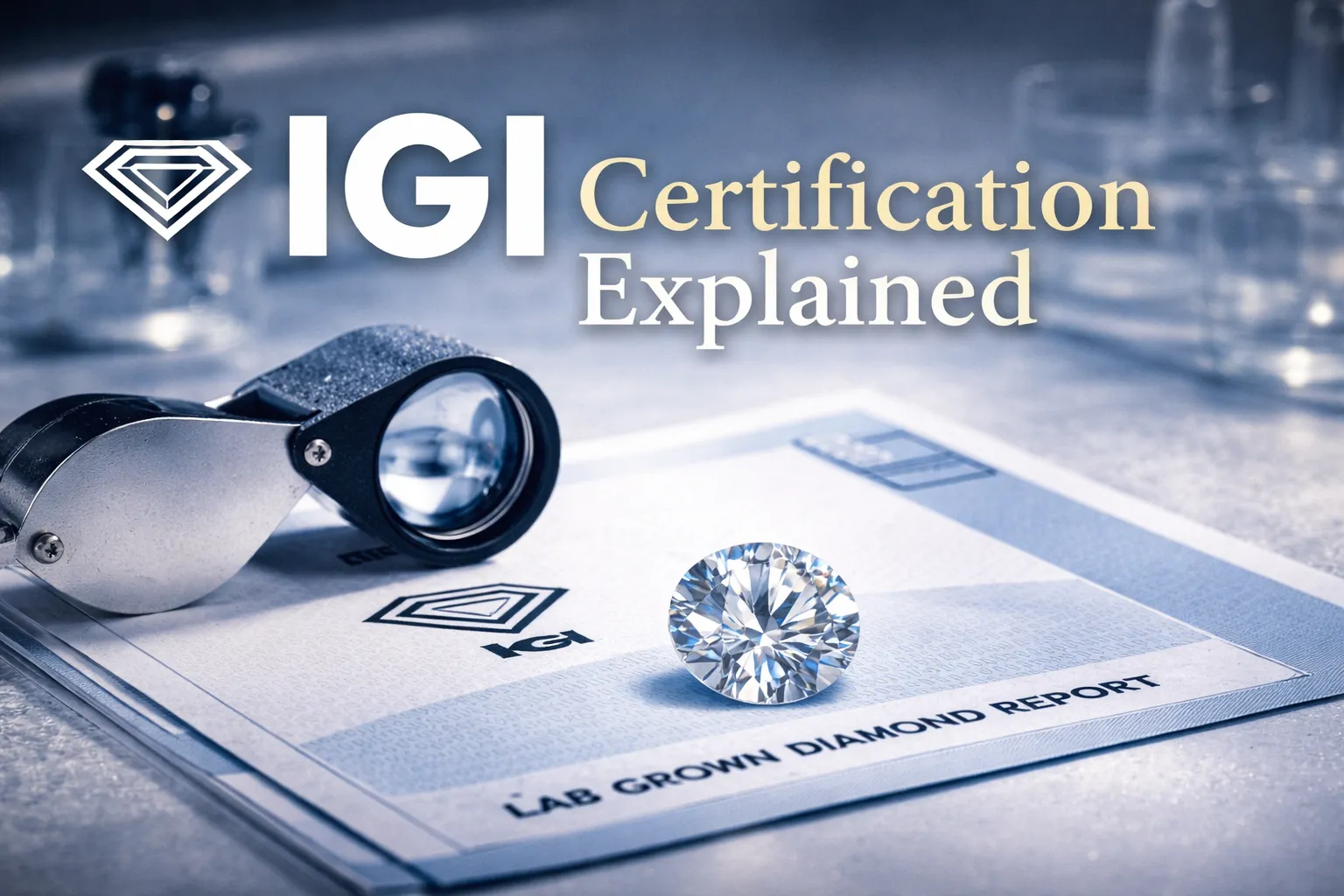
One name appears frequently in lab grown diamond listings: the International Gemological Institute (IGI).
But what exactly is IGI?
Is IGI reliable for lab grown diamonds?
And how does it compare to other major grading institutions like the Gemological Institute of America (GIA)?
This guide breaks down everything you need to know before making a purchase.
What Is IGI?
The International Gemological Institute (IGI) is one of the largest independent gemological laboratories in the world, specializing in diamond and gemstone grading. Founded in 1975 in Antwerp, Belgium—a historic center of the global diamond trade—IGI has grown into a multinational institution with laboratories operating across North America, Europe, the Middle East, and Asia.
Unlike retailers or jewelry brands, IGI functions as a third-party grading authority. Its role is not to sell diamonds, but to evaluate them according to standardized gemological criteria and issue detailed grading reports. These reports are intended to provide objective information about a diamond’s measurable characteristics.
Today, IGI provides certification for:
-
Natural diamonds
-
Lab grown diamonds
-
Colored gemstones
-
Finished jewelry pieces
Its grading reports assess the traditional “4Cs” framework:
-
Cut – proportions, symmetry, polish, and light performance
-
Color – degree of colorlessness based on standardized scales
-
Clarity – presence and visibility of internal and external characteristics
-
Carat weight – precise measurement of mass
In addition to the 4Cs, IGI reports may also include:
-
Diamond measurements (depth, table percentage, girdle thickness)
-
Proportion diagrams
-
Fluorescence analysis
-
Laser inscription verification
-
Growth method disclosure for lab grown diamonds (CVD or HPHT)
-
Confirmation of whether the diamond is laboratory-created
This level of detail is what transforms a diamond from a visually appealing object into a verifiable asset with documented specifications.
Why Third-Party Certification Matters
Without independent certification, a diamond’s quality claims rely entirely on the seller’s description. Two diamonds that appear similar in photos can differ significantly in measurable quality—and therefore price.
Certification introduces:
-
Standardization – objective grading criteria rather than subjective marketing language
-
Comparability – ability to compare diamonds across retailers
-
Transparency – documented proof of quality claims
-
Consumer protection – reduced risk of overpaying for misrepresented specifications
For example, terms like “high quality” or “near flawless” have no standardized meaning in retail language. In contrast, a clarity grade such as VVS1 or VS2 is defined within a grading scale and corresponds to specific inclusion visibility criteria under magnification.
Certification does not guarantee beauty—but it establishes a consistent technical baseline.
IGI’s Role in the Modern Diamond Market
Over the past two decades, IGI has become particularly prominent in the lab grown diamond sector. As laboratory-created diamonds entered the mainstream jewelry market, IGI was among the earliest major laboratories to issue dedicated grading reports for them at scale.
This early integration positioned IGI as one of the most frequently seen certifications in online lab grown diamond listings today.
However, it is important to understand that certification itself does not determine desirability. A grading report documents measurable attributes—it does not enhance them. A poorly cut diamond remains poorly cut, even with certification. Conversely, a well-cut diamond benefits from certification because its specifications can be independently verified.
How IGI Differs From Retail Branding
One common misconception is that certification acts as a brand endorsement. It does not.
IGI does not manufacture diamonds.
It does not sell jewelry.
It does not control pricing.
Its function is analytical and diagnostic rather than promotional.
The value of certification lies in documentation and verification—not in prestige alone.
For consumers navigating the lab grown diamond market—where supply is abundant and pricing varies significantly—having a third-party report helps anchor purchasing decisions in measurable data rather than purely visual marketing.
Summary
In essence, IGI is:
-
A long-established independent grading institution
-
A major global certifier of lab grown diamonds
-
A provider of standardized 4Cs documentation
-
A tool for transparency and comparison
Understanding what IGI is—and what it is not—forms the foundation for evaluating whether IGI certification is sufficient for your specific buying goals.
Why Is IGI So Common in Lab Grown Diamonds?
If you browse online listings for lab grown diamonds, one pattern quickly becomes obvious: IGI certification appears everywhere.
This prevalence is not accidental. It is the result of structural changes in the diamond industry over the past decade.
Early Institutional Adoption
When lab grown diamonds began gaining commercial traction, the Gemological Institute of America (GIA) was still primarily focused on natural diamonds. Although GIA eventually expanded into lab grown grading, its early positioning centered around maintaining the traditional natural diamond market.
In contrast, the International Gemological Institute (IGI) moved more quickly to grade laboratory-created diamonds at scale. IGI developed report formats specifically tailored for lab grown stones and actively collaborated with manufacturers and retailers entering the emerging segment.
This early engagement gave IGI first-mover advantage.
When lab grown supply expanded rapidly, IGI was already integrated into production pipelines.
Supply Chain Efficiency
Lab grown diamonds are manufactured in higher volumes and distributed through global wholesale networks. Manufacturers need grading labs that can:
-
Process large quantities efficiently
-
Provide consistent turnaround times
-
Operate internationally
-
Offer pricing structures compatible with high-volume production
IGI’s global lab network and scalable grading infrastructure aligned well with these needs.
As a result, many producers standardized around IGI certification for operational efficiency. Once that standard became common upstream in the supply chain, it naturally became common downstream in retail listings.
Retail Standardization
E-commerce accelerated IGI’s visibility.
Online retailers depend heavily on standardized data fields:
-
Cut grade
-
Exact measurements
-
Clarity plotting
-
Laser inscription verification
IGI reports provide structured documentation that integrates smoothly into online product databases. Because lab grown diamonds are often compared side-by-side across platforms, standardized certification supports price transparency.
Over time, IGI effectively became the “default” certification option for many online lab grown inventories.
This does not mean retailers are avoiding other laboratories. It means IGI became embedded in the operational backbone of the lab grown distribution model.
Market Perception vs. Market Reality
It is important to separate frequency from superiority.
IGI is common in lab grown diamonds because:
-
It adopted early
-
It scaled quickly
-
It aligned with manufacturing growth
-
It integrated efficiently with digital retail
It is not necessarily more prestigious than GIA.
It is not inherently more accurate.
It is simply more structurally integrated into the lab grown ecosystem.
In other words, IGI’s dominance in lab grown certification reflects industry logistics more than quality hierarchy.
What This Means for Buyers
For consumers, the widespread presence of IGI has two implications:
-
It increases comparability.
When many diamonds share the same certification body, comparing specifications becomes easier.
-
It normalizes IGI in the lab grown segment.
Buyers should not interpret IGI’s prevalence as a red flag. It reflects market evolution rather than compromised standards.
Understanding why IGI is common helps buyers avoid misinterpreting frequency as a marketing tactic. Instead, it can be viewed as a natural outcome of how the lab grown industry scaled globally.
Is IGI Reliable for Lab Grown Diamonds?
The short answer: Yes — IGI is generally reliable for lab grown diamonds.
But that answer requires nuance.
Reliability in diamond certification does not mean perfection. It means consistency, transparency, and usable grading standards that allow buyers to make informed comparisons.
To evaluate whether IGI is reliable, we need to look at three dimensions:
-
Grading methodology
-
Inter-lab consistency
-
Practical consumer impact
1. Grading Accuracy and Methodology
The International Gemological Institute evaluates lab grown diamonds using structured grading criteria aligned with the traditional 4Cs framework.
An IGI grading report for a lab grown diamond typically includes:
-
Exact millimeter measurements
-
Table and depth percentages
-
Crown and pavilion angles (for round diamonds)
-
Cut grade (for round brilliant stones)
-
Polish and symmetry grades
-
Clarity plotting diagrams
-
Fluorescence description
-
Laser inscription verification
-
Growth method disclosure (CVD or HPHT)
-
Confirmation of laboratory origin
The technical structure of the report is comprehensive. From a documentation standpoint, IGI provides detailed measurable data rather than vague descriptors.
For most buyers, this information is sufficient to:
-
Compare diamonds across sellers
-
Verify listed specifications
-
Evaluate proportional quality
-
Cross-check visual expectations
In practical retail environments, IGI grading is considered consistent enough for price benchmarking.
2. The Question of Leniency
Where debate sometimes arises is not about whether IGI grades diamonds—but whether its grading is as strict as other institutions, particularly the Gemological Institute of America (GIA).
Industry professionals occasionally observe that IGI may be slightly more permissive in certain grading categories, particularly:
-
Color
-
Clarity
The variance, when present, is typically small—often within one grade.
For example:
-
A diamond graded F color by IGI might receive a G from GIA.
-
A diamond graded VS1 by IGI might be categorized as VS2 under stricter interpretation.
It is important to understand what this means—and what it does not mean.
This does not imply that IGI fabricates grades.
It does not suggest reports are unreliable.
It reflects that grading involves human assessment within defined tolerance ranges.
Color grading, for instance, relies on comparison against master stones under controlled lighting. Slight interpretive differences between labs can produce minor grade shifts, especially near boundary thresholds (e.g., F/G or VS1/VS2).
In gemology, grading is not purely mathematical—it includes controlled observational evaluation.
3. Does a One-Grade Difference Matter?
For most lab grown diamond buyers, a one-grade variance in color or clarity has limited visible impact.
Why?
Because:
-
The difference between F and G color is subtle and often indistinguishable to the untrained eye.
-
The difference between VS1 and VS2 clarity is typically invisible without magnification.
In everyday lighting, cut quality influences appearance far more than minor color or clarity shifts.
A well-cut IGI-graded VS2 diamond can look more brilliant than a poorly cut higher-clarity stone from any laboratory.
This is why reliability must be understood in context:
Certification provides technical classification.
Visual beauty depends primarily on cut precision.
4. Consistency Within the Lab Grown Segment
In the lab grown diamond market specifically, IGI reports are widely used across manufacturers and retailers.
This widespread adoption actually enhances functional reliability:
-
Pricing models often align around IGI grades
-
Retail inventories are calibrated to IGI standards
-
Buyers compare like-for-like within the same grading system
In other words, even if grading philosophy differs slightly between labs, consistency within a single grading framework allows for rational market comparison.
From a consumer perspective, reliability often means “internally consistent within its ecosystem.”
IGI achieves that within the lab grown segment.
5. Reliability vs. Prestige
Another distinction worth making:
Reliability is not the same as prestige.
GIA may carry stronger brand prestige in natural diamond resale markets. But that does not automatically invalidate IGI’s grading reliability for lab grown diamonds.
For buyers purchasing lab grown stones primarily for:
-
Engagement rings
-
Stud earrings
-
Custom jewelry
The practical reliability of IGI certification is typically sufficient for informed purchasing decisions.
Bottom Line on Reliability
IGI is reliable for lab grown diamonds when:
-
You understand grading tolerance exists
-
You prioritize cut quality
-
You compare diamonds within the same certification system
-
You are not relying on resale value as your primary goal
Certification establishes technical parameters.
It does not override supply dynamics, resale realities, or aesthetic preferences.
Reliability, in this context, means:
IGI provides structured, transparent, and generally consistent grading that most lab grown diamond buyers can confidently use for decision-making.
For a deeper discussion of market depreciation and supply dynamics, see our full analysis on whether lab grown diamonds have resale value.
IGI vs GIA: What’s the Difference?
Comparing IGI and GIA helps clarify expectations.
Global Reputation
GIA is widely considered the gold standard in diamond grading. Its strict grading standards and long history give it extremely strong brand recognition.
IGI, while highly respected, does not carry quite the same prestige in resale markets.
Lab Grown Focus
IGI has been deeply integrated into the lab grown diamond industry from early stages. GIA entered the lab grown space later but has expanded significantly in recent years.
Grading Strictness
In general:
-
GIA is perceived as slightly stricter
-
IGI is viewed as consistent but sometimes marginally more flexible
For buyers focused on lab grown diamonds specifically, the difference often has minimal real-world impact—especially if the diamond is well cut.
Does Certification Affect Sparkle?
The short answer: No grading laboratory creates sparkle.
Certification does not enhance brilliance. It does not improve fire. It does not change how light moves inside a diamond.
What certification does is document measurable characteristics.
What creates sparkle is optical physics.
Understanding this distinction is critical.
Sparkle Comes From Light Performance
A diamond sparkles because of how it interacts with light.
When light enters a diamond, it can:
-
Reflect internally off pavilion facets
-
Return to the viewer’s eye (brilliance)
-
Separate into spectral colors (fire)
-
Create flashes during movement (scintillation)
All of these visual effects are primarily determined by cut precision, not by certification.
A grading report may list color and clarity as high grades, but if proportions are off—too shallow, too deep, misaligned facets—the diamond can leak light rather than reflect it efficiently.
The result: a technically high-grade diamond that looks flat or lifeless in real-world lighting.
Why Cut Matters More Than Color or Clarity
Consider two diamonds:
Diamond A:
-
D color
-
VVS1 clarity
-
Poor cut
Diamond B:
-
G color
-
VS2 clarity
-
Excellent cut
In most everyday environments, Diamond B will appear more brilliant and lively.
Why?
Because:
-
The difference between D and G color is subtle face-up
-
The difference between VVS1 and VS2 clarity is usually invisible without magnification
-
The difference between poor and excellent cut is immediately noticeable
Light return dominates visual impact.
This is why even within IGI certification—or any certification—cut grade should be prioritized over minor improvements in color or clarity.
What Certification Actually Contributes
Certification contributes indirectly to sparkle in one way:
It allows you to verify whether the diamond’s proportions support strong light performance.
For example, an IGI report will list:
-
Table percentage
-
Depth percentage
-
Crown angle
-
Pavilion angle
-
Symmetry grade
-
Polish grade
These measurable values influence how efficiently light reflects inside the stone.
However, certification does not guarantee ideal optical performance. It documents measurable geometry. True visual beauty still depends on how those proportions interact with light in motion.
Practical Buying Priorities
When evaluating an IGI certified lab grown diamond, prioritize:
-
Excellent cut grade (especially for round brilliants)
-
Strong symmetry and polish
-
Balanced depth and table percentages
-
Eye-clean clarity rather than extreme clarity grades
If your goal is maximum sparkle, it is often wiser to:
-
Choose slightly lower color
-
Choose slightly lower clarity
-
Allocate more budget toward superior cut
This approach typically produces better visual results per dollar spent.
Certification Verifies. Cut Creates.
Certification is documentation.
Cut is engineering.
A grading report confirms measurable attributes.
Facet alignment and proportions determine how light behaves.
For lab grown diamonds—where color and clarity are often already high—cut becomes even more decisive. Many lab grown stones naturally achieve strong clarity grades, so visual differences are increasingly driven by precision rather than purity.
The Bottom Line
Certification does not create brilliance.
It helps you verify the structural potential for brilliance.
If sparkle is your primary priority, choosing an excellent cut becomes more important than marginal improvements in color or clarity. You can see real examples in our guide to the best excellent cut lab grown diamonds.
Understanding this difference can prevent overpaying for technical grades that have little visible impact.
How IGI Certification Affects Pricing
IGI certification influences pricing—but not in the way many buyers assume.
Certification does not automatically make a diamond more expensive. Instead, it affects how the diamond is positioned within the broader market structure.
To understand pricing, we need to separate three factors:
-
Certification cost
-
Market perception
-
Long-term liquidity
1. Certification and Market Standardization
In the lab grown diamond segment, IGI certification has become widely adopted. Because many manufacturers and retailers operate within the IGI grading ecosystem, pricing benchmarks are often built around IGI standards.
This creates:
-
Large certified inventory pools
-
Strong price transparency
-
Easier side-by-side comparison
When certification is standardized across a large supply base, competition increases. Increased competition typically leads to narrower margins and more competitive pricing.
In practical terms, IGI certification supports price efficiency within the lab grown category.
2. IGI vs GIA Pricing Differences
In some cases, IGI certified lab grown diamonds may be priced slightly lower than comparable stones certified by the Gemological Institute of America (GIA).
There are several reasons for this:
-
GIA certification fees can be higher
-
GIA carries stronger brand prestige
-
Some buyers perceive GIA grading as stricter
-
Resale markets tend to favor GIA branding
Because of these perception factors, GIA-certified stones may command a modest premium.
However, the actual visual difference between an IGI and GIA lab grown diamond of similar measurable quality is often minimal. The premium reflects brand positioning more than optical superiority.
For value-focused buyers, an excellent-cut IGI certified lab grown diamond can represent rational price efficiency—provided proportions and light performance are strong.
3. The Role of Supply Expansion
Pricing of lab grown diamonds is influenced less by certification and more by supply dynamics.
Unlike natural diamonds, lab grown diamonds are produced in controlled environments. As production technology improves and manufacturing capacity expands, wholesale prices have historically trended downward.
This means:
-
Certification does not shield lab grown diamonds from price compression
-
Even GIA-certified lab grown stones are subject to supply-driven depreciation
-
Long-term price stability is influenced by production scalability
In other words, certification affects grading credibility—not supply economics.
4. Short-Term Value vs Long-Term Value
For many buyers, the relevant pricing question is:
Are you buying for enjoyment or for resale?
If the goal is:
-
Engagement symbolism
-
Personal wear
-
Aesthetic value
-
Budget optimization
Then IGI certification often provides sufficient transparency without paying extra for brand premium.
If the goal is:
-
Long-term resale
-
Auction market liquidity
-
Brand-driven prestige
Then certification type may carry more weight—particularly in natural diamonds.
However, in the lab grown segment specifically, resale value is typically limited regardless of certifier. Expanding production reduces scarcity, which in turn reduces secondary-market demand.
Certification does not override this structural reality.
5. What Buyers Should Focus On
Instead of asking whether IGI makes a diamond “cheaper,” a more useful question is:
Does the certification allow you to compare measurable quality accurately within your budget?
If the answer is yes, then pricing becomes a function of:
-
Cut precision
-
Carat weight
-
Color and clarity balance
-
Retail markup
Certification facilitates comparison—but it does not create intrinsic value.
Bottom Line on Pricing
IGI certification:
-
Supports competitive pricing within the lab grown market
-
Enables transparent comparison across retailers
-
May cost slightly less than GIA-certified equivalents
-
Does not prevent supply-driven depreciation
For most lab grown buyers, the financial advantage of IGI lies in price efficiency rather than long-term investment stability.
Understanding this distinction prevents overpaying for prestige when practical performance is the primary goal.
What About Resale Value?
Resale value is one of the most misunderstood aspects of diamond purchasing—especially in the context of lab grown stones.
To evaluate resale realistically, we need to separate three markets:
-
Retail market
-
Secondary resale market
-
Wholesale trade market
These operate under very different pricing dynamics.
1. Retail Price vs. Market Value
When a diamond is purchased at retail, the price includes:
-
Manufacturing costs
-
Certification fees
-
Brand positioning
-
Marketing expenses
-
Retail markup
-
Profit margin
The secondary market does not reimburse those layers.
Even natural diamonds—regardless of certification—often resell for significantly less than their original retail price.
Certification influences liquidity, but it does not eliminate retail-to-resale spread.
2. Why Natural Diamonds Often Resell More Predictably
Resale markets historically favor natural diamonds, particularly those certified by the Gemological Institute of America(GIA).
There are several reasons:
-
Established auction demand
-
Perceived rarity
-
Long-term supply constraints
-
Strong global brand recognition of GIA
Natural diamonds benefit from geological scarcity. Supply growth is limited by mining output, which cannot scale infinitely.
Because of this structural limitation, resale markets tend to assign more consistent liquidity to high-quality natural stones.
3. Why Lab Grown Resale Is Different
Lab grown diamonds, including those certified by the International Gemological Institute (IGI), operate under different supply conditions.
They are produced in controlled environments. As technology improves:
-
Production efficiency increases
-
Manufacturing costs decline
-
Market supply expands
When supply expands faster than demand, prices typically compress over time.
This dynamic affects wholesale pricing first, and eventually resale pricing.
Certification cannot counteract supply scalability.
An IGI-certified lab grown diamond remains a technically documented stone—but resale markets primarily respond to supply fundamentals.
4. What “Limited Resale Value” Actually Means
Limited resale value does not mean “worthless.”
It means:
-
The resale price is often substantially below original retail price
-
Liquidity may be lower compared to natural GIA-certified diamonds
-
Buyers in secondary markets negotiate based on current wholesale equivalents
In practice, many lab grown diamonds resell closer to contemporary wholesale pricing rather than historical retail purchase price.
That gap can be significant.
5. Reframing the Purchase Decision
If resale value is a primary concern, then:
-
Natural diamonds—especially GIA certified—may offer stronger long-term liquidity.
If the goal is:
-
Maximizing visual size per dollar
-
Achieving high color and clarity within budget
-
Prioritizing ethical sourcing
-
Reducing initial purchase cost
Then lab grown diamonds are often better understood as consumption purchases rather than investment assets.
Most lab grown buyers prioritize:
-
Beauty
-
Budget efficiency
-
Immediate visual impact
Rather than long-term capital appreciation.
6. The Investment Misconception
Diamonds in general are not liquid investment vehicles in the way stocks, bonds, or real estate are.
Even natural diamonds:
-
Have wide bid-ask spreads
-
Depend on condition and certification
-
Require specialized resale channels
Lab grown diamonds amplify this effect due to technological scalability.
Understanding this prevents unrealistic expectations and supports more rational decision-making.
Bottom Line on Resale
Certification influences trust and documentation.
It does not guarantee price stability.
Natural GIA-certified diamonds may offer stronger resale positioning due to scarcity and brand recognition.
Lab grown IGI-certified diamonds typically offer stronger upfront value efficiency—but weaker secondary-market recovery.
Choosing between them depends on whether you prioritize:
-
Long-term liquidity
or
-
Immediate size, sparkle, and cost optimization
Clarity about your goal is more important than the certification label alone.
When Is IGI a Good Choice?
IGI certification is not universally better or worse.
It is situationally appropriate.
The key question is not “Is IGI good?”
It is “Does IGI align with your purchase priorities?”
IGI certification tends to make the most sense under the following conditions:
1. You Are Buying a Lab Grown Diamond
IGI is deeply integrated into the lab grown diamond supply chain. Because many lab grown stones are graded under the same system, comparison becomes easier.
When most inventory in your search results carries IGI reports, evaluating like-for-like specifications becomes more straightforward. Pricing benchmarks are clearer, and you are operating within a standardized ecosystem.
In the lab grown category specifically, IGI is widely accepted and operationally normal.
2. You Want Structured, Documented Specifications
If your priority is transparency—knowing exact measurements, proportions, clarity characteristics, and growth method—IGI certification provides that documentation.
It offers:
-
Standardized 4Cs grading
-
Proportion diagrams
-
Laser inscription verification
-
Clear lab-grown disclosure
For buyers who value measurable data over marketing language, this level of documentation supports rational comparison.
3. You Prioritize Visual Performance Over Prestige
If your primary goal is maximizing sparkle per dollar spent, IGI certification is often sufficient—especially when paired with excellent cut quality.
Most visual differences between diamonds are driven by cut precision, not small variations in color or clarity grades. In this context, paying extra solely for branding prestige may not produce noticeable aesthetic improvement.
If you are choosing based on:
-
Face-up brilliance
-
Balanced proportions
-
Eye-clean clarity
-
Budget efficiency
IGI certification typically meets those needs.
4. You Prefer Competitive Pricing and Budget Optimization
Because IGI-certified lab grown diamonds are widely available, retail competition tends to be strong. This can result in:
-
Narrower pricing spreads
-
Transparent comparison across sellers
-
Greater flexibility within a fixed budget
If your objective is to allocate more of your budget toward carat weight or cut quality rather than certification prestige, IGI often aligns with that strategy.
5. You Are Purchasing for Wear, Not for Investment
For engagement rings, stud earrings, pendants, or custom jewelry projects intended for long-term personal wear, IGI certification is generally sufficient for informed decision-making.
In these cases, the emotional and aesthetic value of the piece outweighs secondary-market considerations.
However, if your goal centers heavily on:
-
Auction-level resale potential
-
Long-term brand-driven liquidity
-
Market perception in formal resale channels
You may want to consider certification reputation more carefully—particularly in natural diamonds.
A Practical Rule of Thumb
IGI is a good choice when:
-
You are buying lab grown
-
You understand grading tolerances
-
You prioritize cut quality
-
You are optimizing for beauty and cost efficiency
It is less about the logo on the report and more about how the certification fits into your overall purchase objective.
Choosing wisely begins with clarity about your goals.
When Might GIA Be Preferable?
While IGI plays a major role in the lab grown diamond market, there are scenarios where certification from the Gemological Institute of America (GIA) may be preferable.
The distinction is not about right or wrong—it is about priorities.
GIA certification tends to make more sense under the following circumstances:
1. You Are Purchasing a Natural Diamond
GIA has historically been regarded as the benchmark authority in natural diamond grading.
Its long-standing reputation, conservative grading philosophy, and deep integration with auction houses, wholesalers, and legacy retailers give it strong institutional credibility in the natural diamond segment.
If you are purchasing a mined diamond and want maximum market-wide recognition of grading standards, GIA certification is often considered the safest choice.
2. Brand Prestige Matters to You
In some cases, certification carries symbolic value beyond technical grading.
GIA’s name recognition is exceptionally strong among:
-
Traditional jewelers
-
High-end retailers
-
Estate buyers
-
Auction markets
If you value the psychological assurance that comes from a widely recognized global authority—or if the recipient of the jewelry places importance on brand prestige—GIA certification may provide additional comfort.
This is particularly relevant in luxury positioning contexts.
3. Resale Potential Is a Key Consideration
Resale markets tend to show greater liquidity for natural diamonds with GIA certification.
Why?
Because:
-
Buyers trust consistent grading
-
Auction houses recognize GIA reports readily
-
Secondary market participants are accustomed to GIA documentation
This does not mean resale is guaranteed. But if secondary-market positioning is part of your long-term consideration, GIA may offer marginally stronger acceptance.
In lab grown diamonds, however, resale dynamics are primarily driven by supply expansion rather than certification label.
4. You Prefer the Most Conservative Grading Standard
GIA is widely perceived as maintaining a conservative grading approach.
Some buyers prefer this conservatism because:
-
It reduces the likelihood of grade inflation
-
It offers tighter tolerance interpretation
-
It may provide greater cross-market consistency
For buyers who want the strictest possible grading framework—particularly at high carat weights or high price points—GIA certification can provide additional reassurance.
5. You Are Buying at Higher Price Tiers
At very high price levels, even small differences in grading interpretation can translate into meaningful monetary differences.
For example:
-
A shift from F to G color
-
A shift from VS1 to VS2 clarity
At larger carat sizes, these changes can influence thousands of dollars.
In those price brackets, some buyers prefer the grading conservatism associated with GIA.
Lab Grown Consideration
For lab grown diamonds specifically, the practical difference in everyday visual appearance between IGI and GIA certification is often minimal—particularly when cut quality is strong.
Because lab grown stones are abundant and pricing is supply-driven, certification prestige plays a smaller role in long-term value retention compared to natural diamonds.
In other words:
For lab grown purchases focused on sparkle and budget efficiency, IGI is usually sufficient.
For natural diamonds or prestige-driven purchases, GIA may offer stronger institutional alignment.
The Decision Comes Down to Priorities
If your priority is:
-
Maximum resale positioning
-
Traditional luxury branding
-
Conservative grading philosophy
GIA may be preferable.
If your priority is:
-
Lab grown value efficiency
-
Strong light performance
-
Transparent documentation without added brand premium
IGI is often entirely appropriate.
The certification choice should reflect your goals—not marketing pressure.
Frequently Asked Questions
Is IGI certification real and legitimate?
Yes. IGI is an internationally recognized independent grading laboratory with decades of experience.
Are IGI lab grown diamonds real diamonds?
Yes. Lab grown diamonds have the same chemical and physical properties as natural diamonds. Certification confirms grading—not origin legitimacy.
Is IGI worse than GIA?
Not necessarily. GIA is often viewed as stricter and more prestigious, but IGI remains widely accepted, especially for lab grown diamonds.
Should I avoid IGI certified diamonds?
No. IGI certified lab grown diamonds are commonly sold by reputable retailers. The key is to evaluate cut quality alongside certification.
Final Verdict: Is IGI Reliable?
Yes—IGI certification is reliable for lab grown diamonds in most consumer scenarios.
But reliability should be understood in context.
IGI provides:
-
Structured and standardized grading
-
Transparent documentation of measurable attributes
-
Global retail recognition
-
Strong integration within the lab grown supply chain
-
Pricing alignment across competitive inventories
For buyers purchasing lab grown diamonds, IGI certification is widely accepted and operationally normal. It allows meaningful comparison between stones and supports rational budgeting decisions.
However, certification is not the same as prestige—and prestige is not the same as performance.
The Gemological Institute of America may carry stronger resale recognition in the natural diamond market. For buyers prioritizing long-term liquidity or conservative grading philosophy, GIA can offer additional reassurance.
But in the lab grown segment specifically, supply dynamics—not certification logos—drive long-term pricing behavior.
For most consumers, the real decision framework looks like this:
-
If you prioritize sparkle, choose excellent cut first.
-
If you prioritize budget efficiency, IGI certification is typically sufficient.
-
If you prioritize resale positioning, natural GIA-certified diamonds may align better.
-
If you prioritize ethical sourcing and visual impact per dollar, lab grown IGI-certified stones often represent strong value.
Certification verifies measurable characteristics.
It does not manufacture brilliance.
It does not create scarcity.
It does not override market economics.
What determines how a diamond actually looks on the hand is light performance—driven primarily by cut precision.
What determines long-term value is supply and demand—not paperwork.
When evaluated within realistic expectations, an excellent cut IGI certified lab grown diamond can be a rational, transparent, and satisfying choice for modern buyers.
Understanding the limits of certification is not skepticism—it is clarity.
And clarity leads to better buying decisions.