A twinning wisp inclusion can sound more serious than it usually is. In diamond reports, the term describes a pattern of tiny internal features that formed during the diamond’s growth, often in a wispy or streak-like arrangement. In lab grown diamonds especially, this is a fairly common clarity characteristic, and in many stones it has little to no effect on what you see with the naked eye.
For buyers, the more useful question is not what the term means in gemological language, but whether it changes the diamond’s appearance, durability, or value. A twinning wisp can be completely harmless in one stone and worth a closer look in another. The difference usually comes down to size, density, location, and how well the diamond is cut.
That is why twinning wisps matter in practical buying decisions. They are not always a red flag, but they are also not something to ignore automatically. If you are comparing lab grown diamonds, understanding this inclusion can help you separate meaningful visual differences from report details that may never be noticed in real life.
Quick Answer
A twinning wisp inclusion is a grouped internal pattern of tiny growth-related features inside a diamond. It often appears as a faint line, cloud, or thread-like area made up of several small inclusions rather than one single obvious flaw. This inclusion type is seen frequently in lab grown diamonds.
In many stones, a twinning wisp is not visible without magnification and does not change the diamond’s everyday appearance. If the diamond is well cut and the inclusion is faint, it may still look eye-clean and attractive on the hand. For a lot of buyers, that means the inclusion is more of a grading note than a real-world problem.
The key is to check whether the twinning wisp causes haze, sits under the table, or becomes noticeable in face-up view. If it does not affect the way the diamond looks in normal lighting, it may be perfectly reasonable to buy. If it does, the clarity grade alone will not tell you enough.
Many buyers also want to understand the broader question of whether lab grown diamonds have inclusions before worrying about a specific feature like a twinning wisp.
Understanding What a Twinning Wisp Inclusion Is
To understand a twinning wisp, it helps to know that diamonds are crystals, and crystals grow in structured patterns. During that growth, small changes can create tiny internal features. A twinning wisp is not a single object like a crystal or feather. It is usually a grouping of very small features arranged in a wispy pattern.
The word twinning refers to a change or interruption in the crystal growth direction. The word wisp describes the soft, streaky appearance of the inclusion group. In plain English, it is best thought of as a faint internal growth pattern rather than a hard, distinct flaw.
Because it is a pattern, a twinning wisp can look different from one diamond to another. In one stone, it may be barely noticeable even under magnification. In another, it can form a more visible cloudy zone or a subtle line through the center of the diamond.
Why twinning wisps are common in lab grown diamonds
Twinning wisps are especially common in certain lab grown diamonds because of how the crystal develops during growth. This does not automatically make the diamond lower quality. It usually means the stone developed a recognizable growth-related feature while being formed in the lab.
Many lab grown diamonds with twinning wisps still receive strong clarity grades and look very clean in normal viewing. That is why this inclusion should be evaluated visually, not just by the name on the grading report. A term that sounds technical is not always a practical concern.
How a twinning wisp differs from a single inclusion
Some inclusions are straightforward. A crystal is a single mineral object inside the diamond. A feather is a crack-like internal feature. A twinning wisp is different because it usually represents a cluster or line of tiny features grouped together.
This makes it harder to judge from the report alone. Two diamonds can both list a twinning wisp, but one may be nearly invisible while the other has a mild haze or a faint line that is easier to spot. The grading label does not show that difference by itself.
Why Twinning Wisps Matter to Diamond Buyers
Most buyers care about clarity for practical reasons. They want to know whether the diamond will look clean, whether it will sparkle well, and whether they are paying more for something they cannot see. Twinning wisps matter because they can influence all three, depending on the stone.
For many shoppers, the biggest concern is appearance rather than durability. A faint twinning wisp off to the side may not matter at all. A denser one running through the center of the diamond may reduce transparency slightly or create a soft look, especially if the cut is not excellent.
Twinning wisps also matter because they can sometimes create value opportunities. A diamond with a lower clarity grade because of a twinning wisp may still look excellent. In that case, the buyer may be getting a cleaner-looking diamond at a lower price than a higher-clarity stone with no visible advantage.
How a Twinning Wisp Affects Appearance
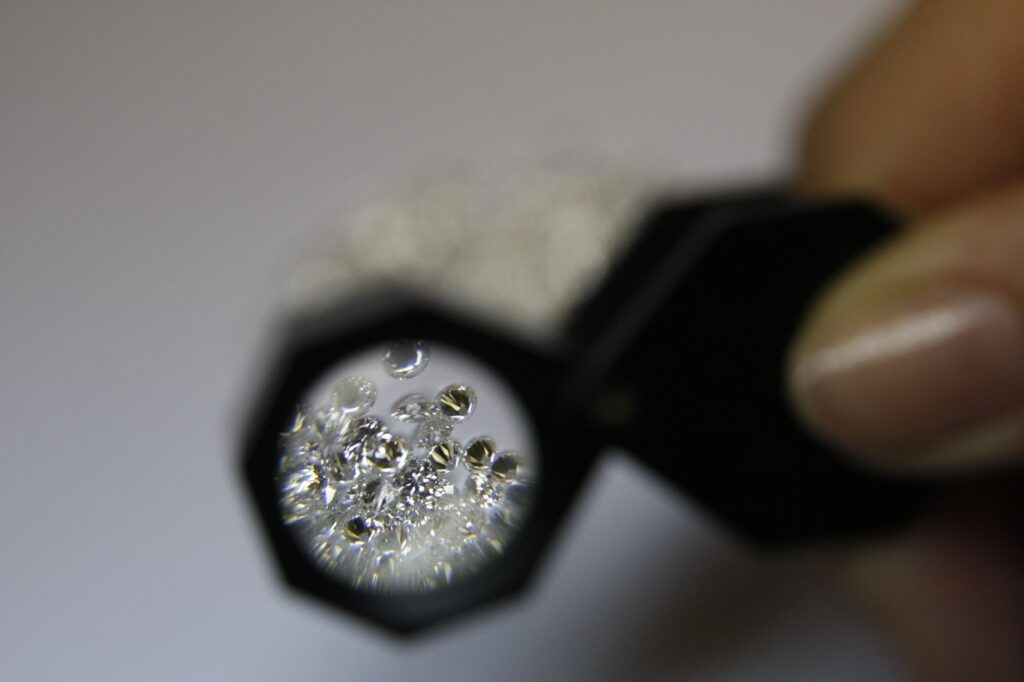
The real buying question is simple: can you see it? In many diamonds, the answer is no, at least not in normal viewing conditions. Under magnification, the inclusion pattern may be visible, but that is very different from seeing it in a ring on the hand.
A twinning wisp can affect appearance in a few ways. It may show up as a faint line, a cloudy patch, or a soft internal texture. In some diamonds it has no noticeable visual effect at all. In others, it can slightly interrupt brilliance if it is dense or sits where light passes through the stone most directly.
Eye-clean vs visibly included
A diamond is considered eye-clean when inclusions cannot be seen without magnification during normal viewing. That is the standard most buyers care about. A twinning wisp can absolutely be part of an eye-clean diamond if it is too faint or too small to see face-up.
If the wisp causes a noticeable haze, dark streak, or texture in the center of the diamond, then the stone may no longer look eye-clean. This is why two diamonds with the same clarity grade can appear very different in person.
Can a twinning wisp reduce sparkle?
Sometimes, but not always. Sparkle depends mainly on cut quality, but a dense or centrally located twinning wisp can slightly interfere with light return. The diamond may look a little less crisp or less lively where the inclusion sits.
That said, buyers sometimes blame clarity when the real issue is cut. If a diamond looks dull, weak, or lifeless, cut quality should be checked first. A well-cut diamond with a minor twinning wisp will often look better than a cleaner stone with poor proportions.
Does location matter?
Yes, location matters a great deal. A twinning wisp near the edge of the diamond is often less concerning than one directly under the table, which is the large flat top facet.
Inclusions under the table are more likely to be visible face-up. Inclusions nearer the girdle or toward the outer parts of the diamond are often easier to live with, especially once the stone is set in jewelry.
How a Twinning Wisp Affects Value
Clarity affects price, but not always in a way that matches what the eye can see. Buyers often pay significantly more for higher clarity grades even when the visible difference is tiny or nonexistent. A twinning wisp can help explain why some lower-clarity diamonds still look excellent and may offer better value.
If the twinning wisp does not affect appearance, paying extra for a higher clarity grade may not give you much in return. In that case, the money might be better spent on better cut quality, a slightly larger carat weight, or a setting you prefer.
When paying more makes sense
Spending more on clarity can make sense if you are particularly sensitive to imperfections, if you want maximum peace of mind, or if you are shopping for a larger diamond where inclusions are easier to spot. Bigger diamonds give the eye more surface area to inspect, so some buyers want extra clarity margin.
It can also make sense if the twinning wisp is centered and creates a visible softness or cloudiness. In that case, a cleaner clarity grade may provide a real visual improvement rather than just a better report label.
When the premium may not be worth it
For many buyers, moving from an eye-clean VS2 or SI1 to a much higher grade like VVS1 or VVS2 may not change the appearance in any meaningful way. If the diamond already looks clean to the naked eye, the extra cost may be hard to justify.
This is especially true in lab grown diamonds, where high-clarity stones are relatively common and pricing can still rise quickly as clarity improves. It is usually smarter to review the actual diamond, or at least images and videos, than to assume a higher grade automatically means better visual value.
What Buyers Actually See in Real-World Conditions
One of the most important things to understand about clarity is that a diamond is not usually viewed under a microscope in daily life. It is seen in a ring, in indoor lighting, in daylight, and during occasional close inspection. That is the real-world test that matters.
A twinning wisp that looks noticeable in a magnified photo may be invisible at arm’s length. On the other hand, a faint haze that seems minor on paper may be easier to spot in bright, even lighting. This is why visual review is so important.
Typical viewing distances
At normal social distance, roughly 12 to 18 inches away, many small or moderate twinning wisps are not visible at all. At closer range, especially under bright white lighting, a buyer may notice a little softness if the inclusion is dense or located in the center.
If you are comparing diamonds in person, look at them from a normal distance first, then closer up under different lights. A diamond that looks clean in a showroom spotlight should still look clean in daylight and in more everyday conditions.
Why cut can hide or reveal a twinning wisp
Cut changes how light moves through the diamond and how much the eye focuses on the center. A well-cut diamond can make small inclusions harder to notice because the brilliance draws attention away from them. A poorly cut diamond can make the same inclusion seem more obvious.
This is one reason clarity should always be evaluated alongside cut. A diamond with excellent cut and a faint twinning wisp may look better than a higher-clarity diamond with weaker proportions and less sparkle.
Practical Examples of Twinning Wisp Scenarios
It is easier to understand twinning wisps by looking at real buying scenarios rather than only by reading the definition. The same inclusion type can lead to very different results depending on the stone.
VS2 with a faint twinning wisp
A VS2 diamond with a faint twinning wisp may be a very practical choice if the inclusion is off-center and the cut is strong. In many cases, it will look eye-clean and offer excellent value. Most buyers would not notice the difference between this and a higher clarity grade in daily wear.
This is often the kind of stone that gives a good balance of appearance and price, especially when the report and images confirm that the inclusion is not in a distracting position.
SI1 with an eye-clean twinning wisp
An SI1 diamond can still be a smart buy if the twinning wisp is light and not visible face-up. The grade may sound lower, but the real-world appearance can still be excellent. In some cases, this is where buyers find the best value.
The important step is confirming that the diamond is actually eye-clean and that the inclusion is not causing haze. Not all SI1 diamonds are the same, and twinning wisps can range from harmless to noticeable.
SI1 with a dense central twinning wisp
A different SI1 diamond may have a denser twinning wisp running through the center, which can create a soft or hazy look. Even if the grade is acceptable on paper, the stone may not appear as bright and crisp as expected.
In this case, a buyer might reasonably prefer a cleaner diamond or negotiate based on the visual effect. This is a good example of why inclusion type and placement matter as much as the grade itself.
VVS clarity with a twinning wisp
In VVS diamonds, inclusions are extremely difficult to see under magnification. A twinning wisp in this category is usually so subtle that most buyers will never notice it. For many people, the extra price of VVS clarity brings little practical benefit over a clean-looking VS stone.
Some buyers still prefer the peace of mind that comes with a very high clarity grade. That is a personal preference. From a visual standpoint, though, the difference over a good VS diamond is often minimal.
Advantages of a Diamond with a Twinning Wisp
A twinning wisp is not automatically a negative feature. In many diamonds it is simply part of the stone’s growth history and does not interfere with beauty or durability.
- It can be invisible to the naked eye. Many twinning wisps do not affect normal viewing.
- It may improve value. A diamond with a minor twinning wisp can cost less than a higher-clarity stone with no visible advantage.
- It is common in lab grown diamonds. Buyers can often find attractive stones with this inclusion type without sacrificing appearance.
- It can be a practical trade-off. If the stone is eye-clean, there may be no reason to pay for unnecessary clarity.
In the right diamond, a twinning wisp is mostly a report detail rather than a visual concern. That is especially true when cut quality is strong and the inclusion is light.
Disadvantages and Limitations
The downside is that twinning wisps are not always harmless. Their impact depends on the individual diamond, and some can be more noticeable than buyers expect.
- They can create haze. A dense twinning wisp may reduce transparency.
- They can be hard to judge from the report alone. Two stones with the same note may look different in person.
- They may be more visible in larger diamonds. As carat size increases, clarity features are easier to spot.
- They can be misunderstood. Buyers may overestimate or underestimate their impact without viewing the actual diamond.
The main limitation is uncertainty. A grading report can tell you what is present, but it does not always tell you how the diamond will look in daily wear. That is why images, videos, and expert review are useful.
How Twinning Wisps Compare With Other Inclusions
Buyers often see a list of inclusion types on a report and wonder how twinning wisps compare with more familiar features. The answer is that each inclusion type affects appearance differently, and some are more of a visual concern than others.
| Inclusion Type | What It Usually Looks Like | Visibility to the Eye | Buyer Concern |
|---|---|---|---|
| Twinning wisp | Wispy line or clustered internal pattern | Often not visible unless dense or centered | Moderate, depending on placement and density |
| Crystal | Small mineral crystal inside the diamond | Sometimes visible if dark or large | Moderate |
| Feather | Internal fracture or crack-like feature | May be visible if large | Can matter for durability if significant |
| Cloud | Cluster of tiny inclusions creating haze | Can affect transparency | Important if it lowers brightness |
| Pinpoint | Very tiny dot | Usually not visible individually | Low concern unless numerous |
Twinning wisps are often more about pattern than a single obvious object. That can make them less concerning than a prominent crystal or feather, but more important than a few isolated pinpoints if they create a cloudy effect.
Does a Twinning Wisp Affect Durability?
Most twinning wisps do not create a major durability issue. They are generally internal growth features, not surface damage. If they are faint, they are usually more of an appearance issue than a structural one.
That said, if a twinning wisp includes or is associated with a feather, cavity, or other weaker feature near the edge, durability deserves closer attention. The inclusion type alone is not enough. You also need to consider where it is located and whether it reaches the surface.
For everyday buyers, the practical rule is simple. If the diamond is graded by a reputable laboratory and the inclusion is internal and minor, durability concerns are often limited. If you are unsure, ask a jeweler to explain whether the specific inclusion pattern changes the stone’s resistance to chipping or breakage.
Buying Considerations for Lab Grown Diamonds
Lab grown diamonds deserve special attention because twinning wisps appear frequently in this category. They are part of the normal growth process and do not automatically make the diamond undesirable. In fact, many shoppers choose lab grown diamonds because they can get a larger, attractive stone with minor clarity characteristics at a lower price than natural diamonds of similar appearance.
Still, the same rules apply. Look at the stone, not just the report. A lab grown diamond with a twinning wisp can be an excellent choice if it is eye-clean, but a dense wisp that creates cloudiness can reduce the visual benefit.
What lab grown buyers should check
- Whether the twinning wisp is visible in face-up photos or videos
- Whether the stone looks crisp and bright, or slightly hazy
- How the inclusion is positioned relative to the table
- Whether the clarity grade reflects a real visual difference
- Whether you are paying extra for clarity you cannot see
In lab grown diamonds, clarity is often less of a limitation than in natural diamonds because higher clarity stones are more common. That makes it even more important to focus on visual performance and value rather than chasing the highest grade by default.
Clarity Grades and Twinning Wisps
The effect of a twinning wisp can vary depending on the clarity grade assigned to the diamond. The grade tells you how easy it is for a trained grader to find the inclusion, but it does not always tell you how the diamond will look in everyday use.
What buyers usually see at different clarity levels
| Clarity Range | Typical Buyer Experience | How Twinning Wisps Often Present |
|---|---|---|
| IF to VVS | Usually extremely clean to the naked eye | Very subtle, often only visible under magnification |
| VS1 to VS2 | Often eye-clean, depending on size and placement | May be visible only under close inspection |
| SI1 | Can be eye-clean or slightly visible | Needs careful review for haze or central placement |
| SI2 and below | Inclusions are more likely to be noticeable | May affect appearance more often |
These are broad guidelines, not guarantees. A well-placed SI1 can look cleaner than a poorly placed VS2. That is why viewing the actual diamond is so important.
Common Buyer Mistakes
Many clarity mistakes happen because buyers rely too heavily on the report label. Twinning wisps are a good example of why that approach can lead to confusion.
- Overpaying for invisible improvement. Some buyers move up several clarity grades even though the visible difference is minimal.
- Ignoring inclusion placement. A twinning wisp under the table deserves more attention than one near the edge.
- Assuming all SI diamonds look the same. SI diamonds vary widely in appearance and quality.
- Focusing only on the grade label. The report does not show how the diamond looks in normal lighting.
- Confusing clarity with sparkle. A dull-looking diamond may have a cut issue rather than a clarity issue.
A more careful buyer asks how the twinning wisp affects the diamond visually, not just what the lab called it.
How to Evaluate a Diamond With a Twinning Wisp
If you are comparing diamonds and one has a twinning wisp, use a simple, practical process. Start with the report, then move to visual inspection, then compare value.
Step 1: Read the report carefully
Look at the clarity plot and any inclusion comments. Check whether the twinning wisp is listed alone or alongside other features. A report can help you understand what else is present, but it should not be the only factor.
Step 2: Review magnified images or videos
Ask whether the diamond has face-up photos or video. Look for any haze, darkening, or texture in the center of the stone. If the inclusion is difficult to spot even in magnified media, that is usually a good sign for everyday wear.
Step 3: Ask about eye-clean status
Do not assume a grade tells you whether the diamond is eye-clean. Ask whether the stone appears clean to the naked eye at a normal viewing distance. This is one of the most useful questions a buyer can ask.
Step 4: Compare against cut and price
If two diamonds look equally clean, compare cut quality and price before paying more for a higher clarity label. In many cases, a well-cut diamond with a minor twinning wisp offers stronger overall value than a higher-clarity stone with no visible advantage.
How Twinning Wisps Compare With Other Common Clarity Features
It can help to compare twinning wisps with other clarity features buyers often see on diamond reports. The goal is not to memorize gemology terms, but to understand which inclusions usually matter most in real-world viewing.
| Inclusion Type | What Buyers Usually Need to Know | Typical Buyer Concern |
|---|---|---|
| Twinning wisp | Often a pattern of tiny features; may be invisible if faint | Moderate, mainly if it causes haze or is centered |
| Feather | Can be harmless or a durability concern if near the surface | Moderate to high depending on size and position |
| Cloud | Can affect transparency and make the diamond look soft | Moderate to high if dense |
| Crystal | May be visible if dark, reflective, or large | Moderate |
| Needle | Often tiny and subtle, sometimes part of a larger pattern | Usually low unless numerous |
| Pinpoint | Very small dot, often not visible individually | Usually low unless heavily clustered |
Twinning wisps are often more meaningful than isolated pinpoints, but less concerning than a large feather or a dense cloud that visibly affects transparency. The specific stone still matters more than the category name.
Advantages of a Diamond with a Twinning Wisp
A twinning wisp is not automatically a negative feature. In many diamonds, it is simply part of the growth history and does not interfere with beauty or durability.
- It can be invisible to the naked eye. Many twinning wisps do not affect normal viewing.
- It may improve value. A diamond with a minor twinning wisp can cost less than a higher-clarity stone with no visible advantage.
- It is common in lab grown diamonds. Buyers can often find attractive stones with this inclusion type without sacrificing appearance.
- It can be a practical trade-off. If the stone is eye-clean, there may be no reason to pay for unnecessary clarity.
In the right diamond, a twinning wisp is mostly a report detail rather than a visual concern. That is especially true when cut quality is strong and the inclusion is light.
Disadvantages and Limitations
The downside is that twinning wisps are not always harmless. Their impact depends on the individual diamond, and some can be more noticeable than buyers expect.
- They can create haze. A dense twinning wisp may reduce transparency.
- They can be hard to judge from the report alone. Two stones with the same note may look different in person.
- They may be more visible in larger diamonds. As carat size increases, clarity features are easier to spot.
- They can be misunderstood. Buyers may overestimate or underestimate their impact without viewing the actual diamond.
The main limitation is uncertainty. A grading report can tell you what is present, but it does not always tell you how the diamond will look in daily wear. That is why images, videos, and expert review are useful.
Does a Twinning Wisp Affect Durability?
Most twinning wisps do not create a major durability issue. They are generally internal growth features, not surface damage. If they are faint, they are usually more of an appearance issue than a structural one.
That said, if a twinning wisp includes or is associated with a feather, cavity, or other weaker feature near the edge, durability deserves closer attention. The inclusion type alone is not enough. You also need to consider where it is located and whether it reaches the surface.
For everyday buyers, the practical rule is simple. If the diamond is graded by a reputable laboratory and the inclusion is internal and minor, durability concerns are often limited. If you are unsure, ask a jeweler to explain whether the specific inclusion pattern changes the stone’s resistance to chipping or breakage.
Buying Considerations for Lab Grown Diamonds
Lab grown diamonds deserve special attention because twinning wisps appear frequently in this category. They are part of the normal growth process and do not automatically make the diamond undesirable. In fact, many shoppers choose lab grown diamonds because they can get a larger, attractive stone with minor clarity characteristics at a lower price than natural diamonds of similar appearance.
Still, the same rules apply. Look at the stone, not just the report. A lab grown diamond with a twinning wisp can be an excellent choice if it is eye-clean, but a dense wisp that creates cloudiness can reduce the visual benefit.
What lab grown buyers should check
- Whether the twinning wisp is visible in face-up photos or videos
- Whether the stone looks crisp and bright, or slightly hazy
- How the inclusion is positioned relative to the table
- Whether the clarity grade reflects a real visual difference
- Whether you are paying extra for clarity you cannot see
In lab grown diamonds, clarity is often less of a limitation than in natural diamonds because higher clarity stones are more common. That makes it even more important to focus on visual performance and value rather than chasing the highest grade by default.
Clarity Grades and Twinning Wisps
The effect of a twinning wisp can vary depending on the clarity grade assigned to the diamond. The grade tells you how easy it is for a trained grader to find the inclusion, but it does not always tell you how the stone will appear in everyday use.
What buyers usually see at different clarity levels
| Clarity Range | Typical Buyer Experience | How Twinning Wisps Often Present |
|---|---|---|
| IF to VVS | Usually extremely clean to the naked eye | Very subtle, often only visible under magnification |
| VS1 to VS2 | Often eye-clean, depending on size and placement | May be visible only under close inspection |
| SI1 | Can be eye-clean or slightly visible | Needs careful review for haze or central placement |
| SI2 and below | Inclusions are more likely to be noticeable | May affect appearance more often |
These are broad guidelines, not guarantees. A well-placed SI1 can look cleaner than a poorly placed VS2. That is why viewing the actual diamond is so important.
Common Buyer Mistakes
Many clarity mistakes happen because buyers rely too heavily on the report label. Twinning wisps are a good example of why that approach can lead to confusion.
- Overpaying for invisible improvement. Some buyers move up several clarity grades even though the visible difference is minimal.
- Ignoring inclusion placement. A twinning wisp under the table deserves more attention than one near the edge.
- Assuming all SI diamonds look the same. SI diamonds vary widely in appearance and quality.
- Focusing only on the grade label. The report does not show how the diamond looks in normal lighting.
- Confusing clarity with sparkle. A dull-looking diamond may have a cut issue rather than a clarity issue.
A more careful buyer asks how the twinning wisp affects the diamond visually, not just what the lab called it.
How to Evaluate a Diamond With a Twinning Wisp
If you are comparing diamonds and one has a twinning wisp, use a simple, practical process. Start with the report, then move to visual inspection, then compare value.
Step 1: Read the report carefully
Look at the clarity plot and any inclusion comments. Check whether the twinning wisp is listed alone or alongside other features. A report can help you understand what else is present, but it should not be the only factor.
Step 2: Review magnified images or videos
Ask whether the diamond has face-up photos or video. Look for any haze, darkening, or texture in the center of the stone. If the inclusion is difficult to spot even in magnified media, that is usually a good sign for everyday wear.
Step 3: Ask about eye-clean status
Do not assume a grade tells you whether the diamond is eye-clean. Ask whether the stone appears clean to the naked eye at a normal viewing distance. This is one of the most useful questions a buyer can ask.
Step 4: Compare against cut and price
If two diamonds look equally clean, compare cut quality and price before paying more for a higher clarity label. In many cases, a well-cut diamond with a minor twinning wisp offers stronger overall value than a higher-clarity stone with no visible advantage.
Frequently Asked Questions
Is a twinning wisp bad in a diamond?
Not necessarily. Many twinning wisps are minor and do not affect how the diamond looks in daily wear. They become more of a concern only if they are dense, centrally located, or create a cloudy appearance.
Can you see a twinning wisp without a loupe?
Often, no. Many twinning wisps are only visible under magnification. Whether you can see one with the naked eye depends on the size, density, location, and overall cut of the diamond.
Are twinning wisps common in lab grown diamonds?
Yes, they are relatively common in lab grown diamonds because of how the crystal grows. Their presence does not automatically mean the diamond is poor quality. It simply means the stone developed a recognizable growth pattern.
Does a twinning wisp affect diamond durability?
Usually not much, if at all. Most twinning wisps are internal and primarily affect appearance. If the feature is connected to a surface-reaching weakness or another inclusion near the edge, then durability should be evaluated more carefully.
Should I avoid a diamond with a twinning wisp?
Not by default. Many diamonds with twinning wisps are attractive and eye-clean. You should only avoid one if the inclusion is visible, creates haze, or is in a position that bothers you when you inspect the stone.
Is an eye-clean SI1 with a twinning wisp better value than a VVS diamond?
For many buyers, yes. If both diamonds look equally clean in normal viewing, the SI1 may offer better value because you are paying less for a difference that is not visible. The better choice depends on your priorities and the individual stone.
Can a twinning wisp make a diamond look cloudy?
It can, if the wisp is dense enough or grouped tightly in the center of the diamond. Many twinning wisps do not cause cloudiness, but some can slightly reduce transparency and make the stone look less crisp.
How important is inclusion location compared with clarity grade?
Very important. A lower clarity grade with a well-placed, invisible twinning wisp may look better than a higher grade with an inclusion sitting under the table. Location can matter as much as, or more than, the label.
Conclusion
A twinning wisp inclusion is a growth-related pattern of tiny internal features that is common in some diamonds, especially lab grown diamonds. In many stones, it has little or no effect on appearance and does not change the way the diamond looks in everyday wear.
The real question is not whether a twinning wisp exists, but whether it is visible, whether it creates haze, and whether it sits in a place that affects the diamond’s face-up appearance. If the stone is eye-clean and well cut, the inclusion may be little more than a report detail.
For buyers, the smartest approach is to balance clarity with the other factors that affect beauty and value, especially cut quality, inclusion location, and overall transparency. In many cases, an eye-clean VS or SI diamond with a minor twinning wisp can be a more practical purchase than paying extra for a much higher clarity grade with no visible improvement.