F color sits in an interesting part of the diamond color scale. It is technically in the colorless range, but in real-world shopping it often behaves like a premium near-top grade that most people cannot distinguish from the highest grades once the diamond is set. That makes the question less about gemological purity and more about whether the added cost produces a visible benefit.
For many buyers, the short answer to Is F Color Worth It is: sometimes, but not always. F color can be a smart choice if you want a bright, icy appearance and still want to spend less than you would on D or E. It is often a less compelling purchase if your goal is simply to get a diamond that looks white in everyday wear.
Quick Answer: Is F Color Worth It?
F color is worth it when you want a diamond that falls in the colorless range without paying the highest premium for D or E. Visually, F diamonds usually look very white to most buyers, especially once they are set in a ring. In many real-life settings, the difference between F and higher grades is subtle or not noticeable at all.
Whether it is worth the money depends on your priorities. If you are highly focused on top-tier grading and want extra margin for a white appearance, F can be a reasonable choice. If your goal is value, many buyers can save money by choosing a slightly lower grade, especially in lab grown diamonds where color improvements often come at a lower price than in natural diamonds but still may not be visible enough to justify the increase.
What F Color Means
Diamond color is graded on a scale that usually runs from D to Z. D is the highest grade and represents a completely colorless appearance under grading conditions. As you move down the scale, diamonds show increasing amounts of warmth, usually a faint yellow or brown tint depending on the stone.
F is the third grade on the scale and is part of the colorless range, which includes D, E, and F. These grades are meant to appear essentially colorless when compared face-up under controlled lighting. In practical terms, F is still a premium grade, but it is not the very top of the grading system.
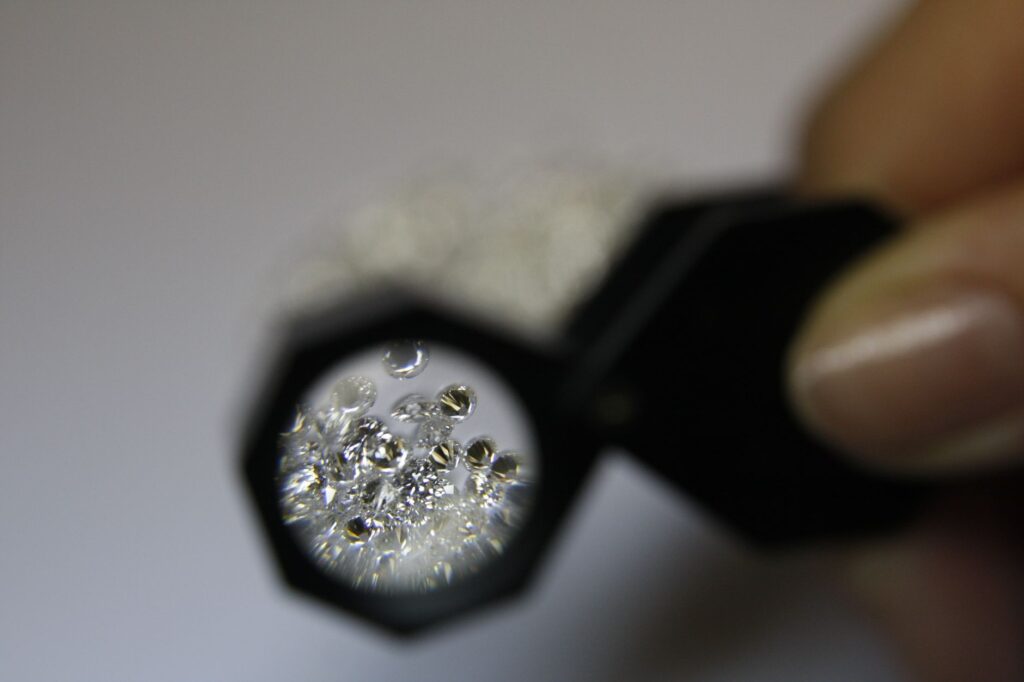
It helps to remember that color grading is done by trained graders viewing loose diamonds under specific lighting and comparison standards. That is very different from how most buyers see a diamond in a ring, where setting style, metal color, lighting, and viewing distance all affect what is visible.
Where F Fits in the Color Scale
| Color Grade | Color Range | General Appearance |
|---|---|---|
| D | Colorless | Highest color grade, very rarefied look |
| E | Colorless | Extremely white, very close to D |
| F | Colorless | Still colorless, usually white to the eye |
| G-H | Near-colorless | Often still looks white when set |
| I-J | Near-colorless | May show slight warmth in some settings |
This table is useful because it shows that F is already inside the top category for color. The real buying question is not whether it is good enough. It is whether the premium over adjacent grades gives you a meaningful visual improvement.
What F Color Actually Looks Like
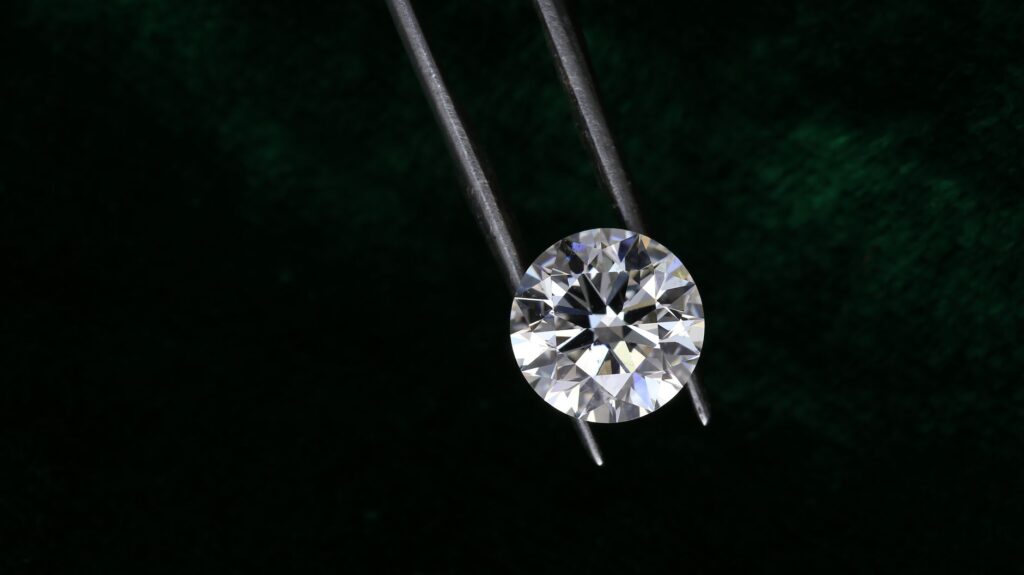
In most face-up viewing situations, an F color diamond looks white or nearly white. On its own, without side-by-side comparison to D or E, it is often difficult for a typical buyer to identify as anything other than a high-color diamond. That is especially true in smaller stones and well-cut diamonds that return strong sparkle.
The subtlety of the grade is important. F is not usually about dramatic differences. It is about fine distinctions that may be visible only to trained observers, under controlled conditions, or in direct comparison with other stones.
In practical terms, F color usually means:
- A bright, clean appearance face-up
- Very little visible warmth in most lighting
- Strong compatibility with white metal settings
- Limited but sometimes detectable difference from D or E in expert comparison
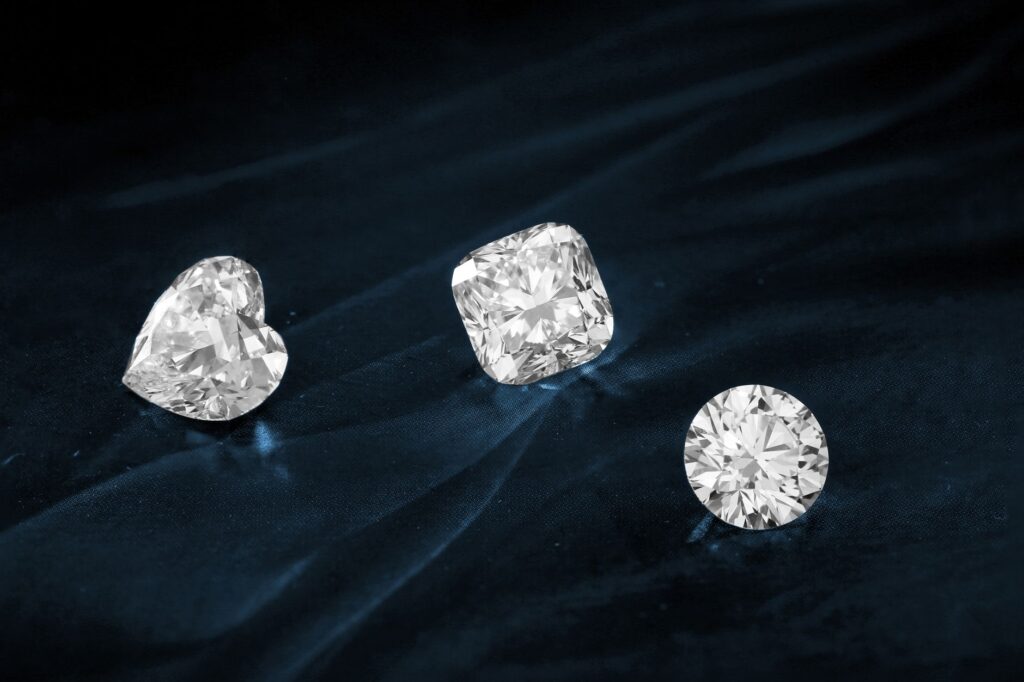
That said, the actual appearance of any diamond is influenced by cut quality. A well-cut diamond reflects light efficiently and can appear brighter and whiter than a poorly cut diamond of a higher color grade. This is one reason shoppers should always consider diamond cut alongside color.
Can Most People See the Difference?
For most buyers, the difference between F and higher color grades is not obvious in everyday wear. In a loose diamond lab or in a side-by-side comparison with D and E stones, a trained eye may notice differences. But when a diamond is mounted in a ring and viewed from a normal distance, those differences often become much harder to detect.
The biggest visibility factor is comparison. A single F color diamond on its own usually reads as bright and white. The eye becomes more sensitive when you place it next to a D or E stone, especially in neutral lighting. Even then, the change is usually subtle rather than dramatic.
Everyday Visibility
In normal use, most people will not see a clear difference between F and the grades above it. Friends, family, and casual observers are unlikely to notice. Even many diamond shoppers have trouble identifying the difference unless they know exactly what to look for.
That makes F a grade that can feel “safer” to some buyers. It gives reassurance that the diamond belongs to the colorless category, but the visibility advantage over E is often small in real-world settings.
Professional vs Consumer Perception
Professionals trained to evaluate diamonds may distinguish F from D or E under ideal viewing conditions. Consumers usually evaluate diamonds in a much less controlled environment. Lighting varies, settings affect perception, and the stone is often viewed at an angle rather than perfectly face-up.
This is why grading report logic and buyer perception can diverge. A grading certificate may show a clear hierarchy, but the visual difference in a ring can be minimal. Buyers should not assume that a higher grade automatically means a noticeable improvement.
Viewing Distance Matters
At normal viewing distances, especially from an arm’s length or more, F color is typically very difficult to separate from the grades above or below it without direct comparison. The closer you get to the stone, the more subtle hue differences may become visible. But most jewelry is not evaluated from close inspection for long periods in everyday life.
For engagement rings, the practical question is usually simple: will it look white on the hand? In most cases, F color will.
How F Color Looks in Different Metals
Metal color affects how a diamond’s color is perceived. This is especially important when deciding whether F color is worth paying for. A diamond that looks perfectly white in one setting may reveal a touch more warmth in another, even if the stone itself has not changed.
White Gold and Platinum
F color performs very well in white gold and platinum. These metals are often chosen for diamonds because they support a crisp, clean look. In these settings, an F diamond usually appears bright and well matched.
Because white metals do not add warmth, they can make slight body color more noticeable than yellow gold might. Even so, F color is generally more than adequate for a white-metal setting. The diamond will usually look colorless to the eye, especially once mounted.
Yellow Gold
Yellow gold can make color differences less noticeable because the metal itself introduces warmth. In this setting, F color often looks especially white, but the practical advantage over slightly lower grades may shrink. Buyers sometimes pay for high color in yellow gold without gaining much visible benefit.
If you are planning a yellow gold ring, it is worth asking whether F is more color grade than you actually need. In many cases, a near-colorless diamond can still look excellent in yellow gold and may offer better value.
Rose Gold
Rose gold has a warmer tone that can similarly mask small amounts of body color. F color will still look bright and balanced, but the difference between F and lower grades may be even less obvious here than in white metals.
For buyers using rose gold, the color premium for F may be harder to justify unless they strongly prefer the security of a colorless grade or want a more neutral look in the center stone.
How F Color Looks in Different Lighting
Diamond color is not fixed in the way many shoppers assume. It can look different depending on the light source, the angle, and surrounding colors. F color is stable enough that it generally remains white across a wide range of lighting environments, but the way people perceive it can still change.
Daylight
Daylight is one of the most revealing environments for diamond color. In natural light, especially diffuse daylight near a window or outdoors in open shade, subtle warmth can become easier to detect. Even then, F color usually appears white to most eyes.
This is also a good environment for comparison shopping. If you compare multiple stones side by side, differences may be easier to spot. A standalone F diamond, however, will still usually read as colorless.
Indoor Lighting
Most indoor lighting is less harsh than daylight and can help a diamond appear brighter. F color generally looks excellent under common indoor light sources such as ceiling lights, lamps, and retail displays. Sparkle often draws the eye more than body color does.
That said, store lighting can be deceptive. Jewelry stores often use lighting designed to maximize brilliance, which can make color differences harder to see than they would be in a broader range of environments.
Warm Lighting
Warm lighting, such as incandescent-style bulbs, can make diamonds appear slightly warmer overall. In this kind of environment, even higher color grades may not look perfectly neutral. F color usually holds up well, but buyers should not rely on warm display lighting alone when judging color.
If you care deeply about a diamond’s whiteness, ask to see it in more than one lighting condition if possible. This helps prevent overestimating the visible benefit of a grade upgrade.
Cool Lighting
Cool or daylight-balanced lighting tends to show a diamond’s true color more clearly. F color still looks white in these conditions, but so do many diamonds in the near-colorless range. This is part of why color grading should not be interpreted too literally as a direct predictor of everyday appearance.
In cooler light, the difference between F and D or E may be visible under comparison but usually remains subtle.
F Color in Lab Grown Diamonds
Lab grown diamonds often reach higher color grades more frequently than many natural diamonds, especially in larger sizes and in certain production categories. That means F color is common in the lab grown market and is often available at a lower premium than it would command in the natural diamond market. Still, the same visual principles apply.
Color behaves the same way in lab grown and natural diamonds from a buyer’s perspective. The grading standards are meant to evaluate the stone’s appearance, not its origin. What matters is how white the diamond looks, how it is cut, and how it is set.
Because lab grown diamonds can offer strong value in higher grades, some buyers feel more comfortable choosing F or above. In practice, that can be sensible when the price difference is modest. But it is still worth asking whether the extra cost produces a meaningful visual improvement or simply a better number on the grading report.
For many lab grown buyers, the sweet spot is often finding a balance between color, cut, size, and clarity rather than automatically maximizing color. If the diamond is well-cut and faces up white, a slightly lower color grade may be the more practical choice.
Price Premium vs Visual Benefit
The central question behind Is F Color Worth It is whether the premium is justified by what you can actually see. In many cases, the answer depends on how the diamond compares to nearby grades and how much extra you are paying.
As color grades rise, price differences do not always track visual differences evenly. The change from one grade to the next can be subtle, while the price increase can still be meaningful. This is especially true near the top of the color scale, where premiums often rise faster than visible benefits.
Diminishing Returns Near the Top
F is a classic example of diminishing returns. You are paying for a diamond that is already within the top color range, so the improvement over lower grades is partly about peace of mind and partly about measurable, but often very small, visual refinement.
If you compare F to E or D side by side, there may be a difference. The issue is whether that difference matters enough to justify the cost. For many buyers, the answer is no. For some buyers who want a top-grade stone and are not highly price-sensitive, the answer may be yes.
Cost Awareness in Real Buying
One practical mistake is to focus only on the color grade and ignore the overall value of the ring. A slightly lower color grade combined with better cut, a more suitable carat weight, or stronger clarity can sometimes create a more beautiful overall result than spending extra to move from E to F or D to F.
That trade-off becomes even more important in lab grown diamonds because buyers often have more room to balance priorities. In other words, a small shift in color may not matter as much as a better cut or a larger face-up size.
Who Should Consider Paying for F Color?
F color can make sense for buyers who want a stone firmly in the colorless category and who value that top-end feel. It can also be a good fit for those who prefer white-metal settings and want additional reassurance that the diamond will look neutral in a wide range of lighting conditions.
You may want to consider F color if:
- You want a diamond that is still technically colorless
- You are comparing a small price jump from E to F
- You are especially sensitive to warmth in diamonds
- You prefer a white gold or platinum setting
- You want a comfortable margin for a very white appearance
These are preference-based reasons rather than necessity-based reasons. F is not required for beauty. It is a choice for buyers who value a specific standard of whiteness.
Who Can Save Money by Choosing Lower Color
Many buyers can confidently move below F without sacrificing visible beauty. This is especially true if they are buying a well-cut diamond, choosing a yellow or rose gold setting, or shopping in sizes where color is less noticeable face-up.
You can often save money by choosing a lower grade if:
- You are not comparing stones side by side
- The diamond will be set in yellow or rose gold
- You want the best balance of size, cut, and price
- You are comfortable with a diamond that still looks white, but is not top graded
- You are buying a lab grown diamond and want stronger overall value
In many engagement ring purchases, the better value may come from choosing a slightly lower color and using the savings to improve cut quality or size. That often creates a more noticeable effect than paying for the difference between F and the grades just below it.
Common Buyer Mistakes
Color grading is easy to overthink because the scale looks precise. The actual visual impact is less straightforward. Buyers often make expensive decisions based on assumptions that do not hold up once the diamond is mounted and worn.
Overpaying for Invisible Upgrades
One common mistake is paying extra for a grade upgrade that is too subtle to notice in real life. If you cannot tell the difference between F and E without a controlled side-by-side comparison, the added cost may not be a practical improvement.
This does not mean the higher grade has no value. It means the value is personal and not always visual. Some buyers care deeply about the top grade itself, while others care more about what the diamond looks like on the hand.
Ignoring the Metal Color
Another mistake is choosing color without considering the ring setting. White metals generally make color differences more important. Yellow and rose gold can reduce the visible need for higher color.
A buyer who chooses F for a yellow gold ring may be paying for a level of whiteness that the setting already helps conceal. That money may be better used elsewhere in the diamond or the mounting.
Assuming the Report Tells the Whole Story
A grading report is useful, but it does not show how a diamond will look in your ring under your lighting conditions. It does not account for cut quality, which strongly affects brightness and perceived whiteness. It also does not show how the stone interacts with surrounding metal or other design elements.
This is why buyers should use grading reports as a starting point rather than the final word. A beautifully cut G or H can look better in practice than a poorly cut F.
F Color Compared With Nearby Grades
Sometimes the best way to judge F is to compare it with grades just above and below it. The differences are easiest to understand in context. In many cases, the actual visual gap is smaller than the price gap.
F vs D Color
D is the highest color grade, while F is still colorless but slightly lower. In controlled side-by-side comparison, D may appear a touch more icy or more color-neutral. In real life, the difference is usually subtle.
If you are deciding between F and D, the question is often whether you are paying for the very top of the scale or for an appearance that most people will see as essentially the same. For many buyers, D is a prestige choice rather than a visible necessity.
F vs E Color
E is the grade immediately above F and is also in the colorless range. This comparison is especially relevant because both grades usually look very white. The difference between them is often extremely difficult to see outside controlled conditions.
If two otherwise similar diamonds are priced differently, the E stone may justify the higher cost only if you specifically want the stronger grading position. Visually, F is often close enough that many shoppers would not notice the gap.
F vs G Color
G is the first grade in the near-colorless range, but it is still commonly considered a strong choice, especially in well-cut diamonds. Compared with F, G may show a slight hint of warmth under close inspection, but many people will still see a white-looking diamond once it is mounted.
In terms of value, G often becomes interesting because it may offer a better price-to-appearance balance than F while still looking excellent in most settings.
F vs H Color
H is another near-colorless grade that can still look very attractive, especially in yellow gold or with an excellent cut. Compared with F, H has a slightly higher chance of showing warmth in some conditions, but the difference is often small in everyday wear.
For buyers who are focused on visual value rather than top grading, H can be a practical alternative if the diamond is well chosen.
What Matters More Than F Color
It is easy to focus heavily on color because it is a simple letter grade. But appearance is the result of several factors working together. In many cases, some of those factors matter more than color does.
Cut Quality
Cut is often the most important factor in how white and brilliant a diamond appears. A superior cut returns more light to the eye, which can make the diamond look livelier and cleaner. A poor cut can make even a higher-color diamond look less impressive.
If you are deciding where to allocate budget, cut is usually the first place to protect. A well-cut diamond can minimize the need to chase the highest color grade.
Carat Size
Color can become more noticeable in larger diamonds because there is more surface area and more depth for body color to show. In smaller stones, F color may be overkill for many buyers. In larger stones, the premium may be more defensible if you are especially sensitive to color.
This is why carat weight and color should be evaluated together. A 1.00 carat F may feel different from a 2.50 carat F in terms of visible whiteness and overall value.
Clarity and Transparency
Clarity does not directly determine color, but a clean diamond often looks more crisp and appealing. In some cases, inclusions can affect the way light moves through the stone and how “clean” it appears to the eye. That is one reason buyers should consider diamond clarity as part of the whole package.
Transparency also matters. A diamond can have a high color grade and still look less lively if it is not well cut or has other optical limitations.
Is F Color Worth It for Different Buyers?
The answer depends on how you define worth. For some buyers, worth means maximum color quality. For others, it means the best visible result per dollar. F color can satisfy the first definition more easily than the second.
F Color May Be Worth It If You Are:
- Buying with a strong preference for colorless grades
- Choosing a white metal setting and want extra confidence in whiteness
- Comparing a small price increase from E to F
- Shopping for a larger diamond where color differences may be slightly more noticeable
- Prioritizing top-tier grading as part of the purchase
F Color May Not Be Worth It If You Are:
- Trying to maximize beauty per dollar
- Willing to choose a slightly lower grade that still looks white
- Using yellow or rose gold, where the metal reduces color visibility
- Buying a lab grown diamond and want to balance size and cut first
- Not likely to compare the diamond against a higher-color stone
Frequently Asked Questions
Does F color look white?
Yes. F color generally looks white or very close to white, especially once it is set in jewelry. It sits in the colorless range, so most buyers will see a bright, clean appearance rather than obvious warmth.
Is F color better than G?
Technically, yes. F is a higher color grade than G. In actual appearance, the difference is often subtle and may not be visible in everyday wear, particularly in well-cut stones and when set in a ring.
Can you see the difference between F and D?
Sometimes, but usually only in controlled side-by-side comparison. Most people cannot easily distinguish F from D in normal wear. The difference is small and often more meaningful on a grading report than on the hand.
Is F color good for an engagement ring?
Yes. F color is an excellent engagement ring grade for buyers who want a diamond firmly in the colorless range. It is especially attractive for those who prefer white gold or platinum and want a very white appearance.
Should I buy F color in a lab grown diamond?
It can be a sensible choice, but it is not automatically the best value. Lab grown diamonds often offer high color grades at more accessible prices, so you may have room to choose F without much penalty. Still, a slightly lower grade may look just as good if the diamond is well cut.
Does ring metal change how F color looks?
Yes. White gold and platinum can make color differences more important, while yellow and rose gold can reduce the need for a very high color grade. F looks excellent in all of these metals, but the value of the upgrade changes depending on the setting.
Is F color worth the extra money over E?
That depends on the price difference and your personal preferences. Visually, the difference is often extremely small. If the premium is modest and you want a top-end color grade, F can be reasonable. If the price jump is meaningful, many buyers would get better value elsewhere.
What is the best color grade for value?
There is no universal best grade, but many buyers find strong value in the near-colorless range, especially when the diamond is well cut and set thoughtfully. F is premium and attractive, but it is not always the most efficient use of budget.
Final Takeaway
F color is a high-quality, colorless diamond grade that usually looks white to the naked eye. In real-world wear, the difference between F and the grades above it is often very small, and the jump in price may not always produce a visible improvement.
If you want a diamond with strong whiteness and a reassuringly high grade, F can be worth it. If your goal is the best value, you may be able to choose a slightly lower color without seeing a meaningful difference, especially in a well-cut diamond or a warmer metal setting. The smartest choice is the one that balances color, cut, size, setting, and budget in a way that fits how you will actually wear the stone.