When shoppers ask what is a good length to width ratio for oval diamonds, they are usually trying to answer a more practical question: Which oval shape looks balanced and appealing on the hand? The length-to-width ratio affects how elongated or round the diamond appears, and that visual balance can change the entire feel of an engagement ring or pendant.
There is no single ratio that is right for everyone. Some buyers prefer a classic, slightly elongated oval, while others want a more slender look that creates the impression of a larger, longer stone. The best choice depends on personal taste, finger shape, ring style, and how the diamond performs face up in real life.
For most buyers, a good length to width ratio for oval diamonds falls somewhere around 1.30 to 1.50. That range is often considered balanced, flattering, and versatile. However, excellent-looking ovals can fall outside that range, especially when the diamond has attractive proportions, good symmetry, and minimal bow tie effect.
Quick Answer
If you want the short version, a length-to-width ratio of 1.35 to 1.45 is often a safe starting point for oval diamonds. It usually creates the classic oval shape most people expect, with enough elongation to look elegant without appearing too narrow.
That said, a ratio by itself does not tell the whole story. Two oval diamonds with the same ratio can look very different depending on their cut quality, table size, depth, outline shape, and how the faceting handles light. A visually pleasing oval is about more than a single number.
For buyers who want a more rounded oval, ratios closer to 1.25 to 1.35 may work well. For those who want a noticeably elongated look, ratios around 1.50 to 1.60 can be attractive, especially on shorter fingers or in designs where a longer silhouette is preferred.
What the Length to Width Ratio Means
The length-to-width ratio is a simple calculation: the diamond’s length divided by its width. For example, if an oval diamond measures 10.0 mm long and 7.0 mm wide, its ratio is 1.43. This tells you how elongated the diamond appears when viewed face up.
In oval diamonds, the ratio strongly influences the overall style. A lower ratio gives a fuller, rounder shape. A higher ratio creates a longer, slimmer outline that can look more dramatic and can sometimes make the diamond appear larger from top view.
This matters because oval diamonds do not have a fixed ideal shape in the same way some shoppers think of round diamonds. Instead, the “best” ratio is the one that matches the look you want and complements the rest of the ring design.
Why Oval Diamond Ratios Matter So Much
Oval diamonds are one of the most shape-sensitive diamond cuts. A small change in proportions can noticeably alter the look of the stone. Unlike a round diamond, where face-up shape is always circular, an oval can look elegant, chunky, stretched, narrow, soft, or slightly uneven depending on its ratio and cut style.
The ratio also affects how the diamond sits on the finger. A more elongated oval can draw the eye lengthwise, which some people find flattering. A fuller oval can look softer and more compact, which may feel more traditional or easier to pair with certain settings.
Because oval diamonds are popular for engagement rings, ratio also becomes part of the overall buying decision alongside diamond cut, diamond color, and diamond clarity. Buyers often compare several stones that all look good on paper, then choose the one whose shape feels best in person.
Understanding the Typical Oval Ratio Range
There is no strict industry standard for the perfect oval ratio, but most oval diamonds on the market fall between about 1.25 and 1.60. Within that range, certain proportions are more commonly preferred.
| Length-to-Width Ratio | General Look | Common Buyer Impression |
|---|---|---|
| 1.20 to 1.30 | Rounder oval, shorter outline | Soft, fuller, less elongated |
| 1.30 to 1.40 | Balanced oval | Classic, versatile, natural-looking |
| 1.40 to 1.50 | Moderately elongated oval | Elegant, slightly slimmer, popular choice |
| 1.50 to 1.60 | Longer, narrower oval | Stylish, dramatic, more length emphasis |
| Above 1.60 | Very elongated oval | Distinctive, less common, more trend-driven |
These descriptions are general, not absolute. An oval with a 1.42 ratio can look very different from another 1.42 ratio diamond if their depth, table, and faceting patterns differ. That is why buyers should always evaluate the actual diamond, not just the ratio.
What Makes a Good Oval Shape Beyond the Ratio
1. Balanced outline
A good oval diamond should look even from end to end, without pinched sides, bulging shoulders, or a lopsided silhouette. The outline should feel graceful and symmetrical when viewed from above.
Symmetry matters because the eye notices shape balance quickly. If one end looks too pointed or the sides appear uneven, the diamond can seem off even if the ratio itself is within a popular range.
2. Appealing face-up spread
Face-up spread refers to how large the diamond looks from above. Oval diamonds often face up larger than round diamonds of the same carat weight because they spread the weight across a longer shape. This is one reason many buyers consider oval diamonds when comparing carat sizes and overall value.
A very deep oval may carry weight below the surface, which reduces visible size. A well-proportioned oval balances depth and width so that the diamond looks substantial without wasting carat weight.
3. Minimal bow tie effect
The bow tie effect is the dark area that can appear across the center of many oval diamonds. It is caused by how the facets reflect light, and it can range from barely noticeable to very visible.
Some bow tie is common in ovals, but a strong dark band can distract from sparkle. This is why ratio alone is not enough. A beautifully proportioned oval can still have a visible bow tie if the faceting or depth is not well balanced.
4. Strong light performance
Oval diamonds are cut in a brilliant style, which means they are designed to maximize sparkle. A good oval should show bright flashes of light, good contrast, and lively movement when it moves.
Light performance matters because even a diamond with a flattering ratio can look flat if the cut is poor. For buyers comparing stones, a well-cut oval with slightly less ideal ratio may look better than a more “perfect” ratio diamond with weak sparkle.
Appearance and Visual Performance
How the ratio changes the look on the finger
The length-to-width ratio affects how an oval diamond interacts with the hand. A more elongated oval can create a slimming visual effect and may look especially attractive on shorter fingers. A shorter oval can feel more balanced on longer fingers or when paired with a bold setting.
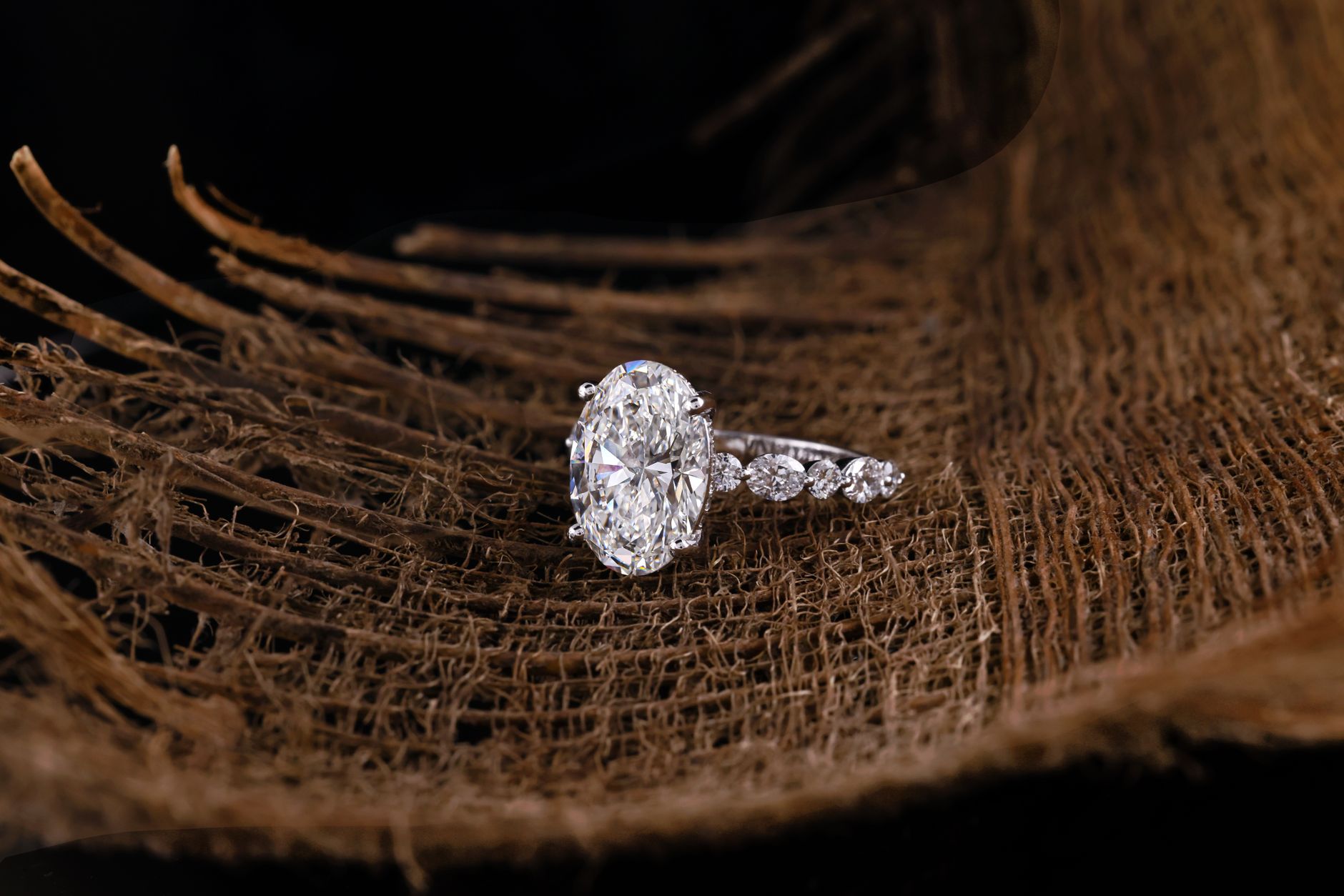
Because ovals stretch across the finger, they often appear elegant and large for their weight. This is one reason they are popular in engagement rings, especially for shoppers who want visual size without automatically moving to a much larger carat weight.
How ratio influences perceived style
Rounded ovals tend to feel softer and more classic. Elongated ovals can feel more contemporary or fashion-forward. Neither is inherently better. The right choice depends on whether the buyer wants a subtler shape or a more dramatic silhouette.
Settings also change the look. A thin solitaire band can make an oval appear even longer, while side stones or a wider halo can make the shape feel fuller. Buyers should think about the whole ring, not just the loose diamond.
Bow tie and ratio are not the same thing
Buyers sometimes assume that a certain ratio automatically prevents bow tie. That is not true. Ratio only describes the outline. Bow tie is about how the facets interact with light.
Two ovals with the same ratio can differ dramatically in performance. One may look bright and lively, while the other shows a dark center. This is why viewing the diamond in different lighting is so important.
Advantages of Oval Diamonds With a Good Ratio
- Elegant shape: Ovals offer a graceful outline that many buyers find flattering.
- Good face-up size: They often look larger than round diamonds of equal carat weight.
- Versatile styling: A balanced ratio works well in solitaire, halo, vintage, and three-stone settings.
- Finger-lengthening effect: Elongated shapes can visually lengthen the hand.
- Popular but not overly trendy: Ovals have broad appeal and relatively strong long-term style acceptance.
These advantages are part of why the oval remains one of the most requested diamond shapes. It combines a traditional feel with a slightly more distinctive outline than a round diamond.
Disadvantages and Trade-Offs to Know
- Bow tie risk: Many ovals show some degree of bow tie effect.
- Shape variation: Ovals can look quite different even when the ratio is similar.
- Clarity concerns at the ends: The elongated shape can draw attention to imperfections near the tips or center.
- No universal ideal: Buyers may spend more time comparing stones because proportion preferences are subjective.
- Less standardized than round diamonds: Oval quality is harder to judge by numbers alone.
These trade-offs do not make ovals a poor choice. They simply mean buyers need to evaluate more than a grading report. Visual inspection is especially valuable when choosing a diamond shape that does not have one universally accepted “ideal” cut formula.
Who Oval Diamonds Suit Best
Oval diamonds are a strong option for buyers who want a shape that feels elegant, flattering, and a little different from a round diamond. They are often appealing to people who value a larger-looking stone without necessarily increasing carat weight dramatically.
A balanced oval ratio is especially suitable for shoppers who want a classic look with enough elongation to feel special. It is also a practical choice for those comparing natural and lab grown diamonds, because the oval shape can make a diamond look larger relative to its price point.
Oval diamonds may be a particularly good fit for:
- buyers who like an elongated shape but do not want a marquise
- those who want a diamond that flatters many hand shapes
- shoppers who prioritize visible size and style versatility
- people looking for a ring that feels classic but not overly common
They may be less ideal for someone who wants a perfectly symmetrical shape with highly predictable performance. In that case, a round brilliant may be easier to shop and compare.
How Oval Diamonds Compare to Other Popular Shapes
One of the best ways to judge what is a good length to width ratio for oval diamonds is to compare ovals with other shapes. Shape preference is personal, but the comparison helps explain why ratio matters so much.
| Shape | Visual Character | Typical Buyer Appeal | Buying Consideration |
|---|---|---|---|
| Round | Perfectly circular, highly symmetrical | Classic, timeless, maximum brilliance | Easier to compare cut quality |
| Oval | Elongated round-like outline | Elegant, flattering, size-efficient | Ratio and bow tie matter a lot |
| Cushion | Soft square or rectangular outline | Romantic, vintage-inspired | Face-up shape can vary widely |
| Pear | Tear-drop shape | Distinctive, elongated, feminine | Asymmetry makes orientation important |
| Marquise | Pointed ends, very elongated | High-length visual effect | Tips are more vulnerable to damage |
| Radiant | Rectangular or square with trimmed corners | Strong sparkle and modern style | Shape depends heavily on proportions |
Oval vs round brilliant
Round diamonds have the strongest standardization and are often easier to evaluate by grading formulas. Ovals, by contrast, require more attention to shape and ratio.
Round diamonds tend to maximize consistent brilliance, while ovals offer a more elongated outline and often a larger face-up appearance. Buyers who want a unique yet still familiar look often choose oval.
Oval vs pear shape
Pear diamonds are also elongated, but they have one pointed end and one rounded end. That makes the visual effect more directional and sometimes more fashion-forward.
Oval diamonds generally feel more balanced because both ends are rounded. If a buyer wants elongation without a dramatic point, oval is often the simpler choice.
Oval vs cushion cut
Cushion diamonds usually have a softer square or rectangular outline. They can feel vintage and plush, but the shape is generally less elongated than an oval unless the cushion is specifically cut in a rectangular style.
Buyers deciding between these shapes should think about whether they want a softer square impression or a longer, oval silhouette on the finger.
How Length to Width Ratio Affects Other Quality Factors
Clarity visibility
Oval diamonds can sometimes hide minor inclusions well because the brilliant faceting breaks up reflections. However, elongated shapes can also draw the eye toward certain areas, especially near the center of the diamond.
That is why clarity should still be considered carefully. A buyer does not always need flawless clarity, but they should make sure inclusions are not obvious to the naked eye. This is especially important if the stone is graded lower on the diamond clarity scale.
Color visibility
Longer ovals can sometimes make body color a little more noticeable than in some other shapes, especially near the tips and edges. This is not always a problem, but it can matter more in larger stones or in very white metal settings.
For buyers comparing diamond color grades, it is useful to consider the full ring design. A warm metal can soften the appearance of color, while a white metal may emphasize it more.
Durability
Ovals are generally durable for daily wear because they do not have sharp pointed corners like marquise or pear shapes. That said, the ends are still areas of focus during setting and wear, so the ring should be protected by a well-designed setting.
Ratio does not directly change durability, but very elongated shapes may have slightly more surface area exposed, which makes good prong placement important. For engagement rings worn every day, setting quality is just as important as diamond shape.
Important Buying Considerations for Oval Diamonds
Do not rely on ratio alone
A ratio can help narrow your search, but it should not be the only factor. Shape outline, light performance, symmetry, and bow tie all affect the final look. A diamond that checks every ratio box may still disappoint if its visual performance is weak.
If possible, compare videos or view stones side by side. This is especially helpful when shopping online for diamond buying research or comparing lab grown options with different price points.
Look for a ratio that fits the setting
The ideal ratio can change depending on the ring style. A cathedral setting may make the diamond appear more vertical, while a bezel can make the shape feel more compact. A hidden halo or side stones can also change how the oval reads on the hand.
For a solitaire, many buyers prefer a ratio that feels naturally balanced because there are no other design elements to distract from the diamond itself. For more complex settings, a slightly more elongated or more rounded ratio may work just as well.
Check the diamond in motion
Oval diamonds can look very different in still images versus real life. Movement reveals sparkle, contrast, and any dark areas across the center. A diamond that looks appealing in one static photo may show more bow tie in another lighting environment.
This is why videos and actual viewing matter more for ovals than many buyers expect. The best-looking stone is often the one that performs well in a variety of lighting conditions, not just on paper.
Consider lab grown diamonds for proportion flexibility
Lab grown diamonds can be a practical option for shoppers who want more room to prioritize shape and appearance. Because they often cost less than natural diamonds of comparable size and quality, buyers may have more flexibility to choose an oval with a better ratio, higher color, or stronger clarity.
That does not mean every lab grown diamond is a better value automatically. It does mean buyers may be able to focus on the visual details that matter most, including a preferred length-to-width ratio and a pleasing face-up look.
Use certifications as a starting point, not the whole answer
A grading report from a respected lab can help confirm measurements, proportions, and quality grades. Still, for oval diamonds, certification should be treated as a starting point rather than the final word.
Reports help with comparison shopping, but they do not fully capture whether a diamond has a graceful outline or an attractive bow tie. Buyers should read certifications alongside images and videos.
Common Mistakes Buyers Make
Choosing the wrong ratio for the hand
Some buyers select a ratio because it is popular, not because it suits the wearer. A very elongated oval may look wonderful on one hand and feel too narrow on another. Personal proportions matter.
Trying on different shapes, or at least comparing hand photos, can help prevent regret. What looks balanced in a display case may appear different once it is worn.
Ignoring bow tie
Bow tie is one of the most common reasons shoppers reject an oval diamond after seeing it in person. A visible dark center can reduce the stone’s overall liveliness, even if the ratio is appealing.
Buyers should ask for images and videos that show the diamond in both bright and softer lighting. That gives a better sense of whether the bow tie is mild or distracting.
Assuming a higher ratio always looks bigger
A longer oval can create the impression of size, but only up to a point. If the stone becomes too narrow, it may look stretched rather than elegant. Also, if depth is excessive, the diamond may not actually face up as large as expected.
Size perception comes from a combination of length, width, depth, and visual balance. Ratio alone cannot guarantee the biggest-looking stone.
Overlooking setting design
The setting can change the appearance of the ratio more than many buyers realize. A slim band may emphasize elongation, while a wide band may reduce it. The same diamond can feel different once mounted.
If the ring will be customized, the buyer should consider the final design before deciding on a ratio.
Comparing ovals like rounds
Round diamonds are easier to compare by cut grading systems. Oval diamonds are not. Using round-diamond expectations can lead buyers to focus too much on charts and not enough on actual appearance.
Ovals should be judged with more attention to visual balance, light performance, and personal preference.
What Ratios Tend to Look Best in Different Situations
| Buyer Preference | Often Preferred Ratio Range | Why It Works |
|---|---|---|
| Classic and balanced | 1.30 to 1.40 | Looks like a true oval without excessive elongation |
| Slightly elongated and elegant | 1.40 to 1.45 | Popular middle ground with a refined silhouette |
| Longer look for finger-lengthening | 1.45 to 1.55 | Creates more vertical emphasis on the hand |
| Rounder, softer oval | 1.25 to 1.30 | Feels less narrow and more compact |
| Fashion-forward or highly elongated | 1.55 and above | Distinctive outline with strong length emphasis |
These ranges are useful for orientation, but visual appeal still depends on the individual stone. If the buyer loves the outline, the exact ratio may matter less than how the diamond looks in real life.
Practical Examples Buyers Can Relate To
A buyer with a 2-carat oval diamond may prefer a ratio around 1.38 if they want a classic, balanced look that still feels elongated. In a solitaire setting, that shape may appear elegant without dominating the hand.
Another buyer may choose a ratio around 1.52 because they want a more slender profile that looks especially long on a narrow finger. In that case, the more elongated shape can be an intentional style choice rather than a compromise.
A third buyer might prefer a slightly rounder oval around 1.28 because they want softer curves and a subtle shape that pairs well with a vintage-inspired halo. Here, the lower ratio supports the overall design goal.
Frequently Asked Questions
What is the ideal length to width ratio for an oval diamond?
There is no universal ideal, but many buyers like oval ratios between 1.35 and 1.45. This range usually looks balanced and clearly oval without appearing too short or too narrow.
Does a higher ratio mean a better oval diamond?
No. A higher ratio only means the diamond is more elongated. Whether that looks better depends on personal style, the ring setting, and the overall shape of the stone.
Can two oval diamonds with the same ratio look different?
Yes. Depth, table size, symmetry, and facet arrangement can make two diamonds with the same ratio look very different. One may have a better outline or less bow tie than the other.
Do oval diamonds always have bow tie?
Many oval diamonds show some bow tie effect, but the severity varies. A mild bow tie is common and not always a problem. A strong dark center, however, can reduce sparkle and distract from the diamond’s beauty.
Are oval diamonds good for everyday wear?
Yes, oval diamonds are generally suitable for daily wear because they do not have sharp corners. Still, the setting should protect the ends well, especially in engagement rings worn every day.
Do lab grown oval diamonds need different ratio standards?
No. The same visual principles apply to both lab grown and natural ovals. Buyers of lab grown diamonds may simply have more budget flexibility to prioritize the ratio, clarity, or color they prefer.
Should I choose oval ratio based on finger shape?
Finger shape can be a helpful guide, but it is not a strict rule. Longer ratios often flatter shorter or wider fingers, while slightly rounder ratios may suit longer fingers. Personal taste still matters most.
Is ratio more important than cut quality for oval diamonds?
No. Ratio matters, but cut quality and light performance are usually more important for appearance. A well-cut oval with a slightly less preferred ratio often looks better than a poorly cut oval with a “perfect” number.
Conclusion
So, what is a good length to width ratio for oval diamonds? For most buyers, a ratio around 1.35 to 1.45 offers a balanced, attractive oval shape that works well in many engagement ring styles. That range is popular because it gives the diamond a classic elongated look without making it seem too narrow or too round.
Still, the best ratio is the one that looks right to the eye. A beautiful oval is defined by more than measurements. Shape balance, bow tie visibility, face-up size, light performance, and the chosen setting all affect the final result.
If you are comparing oval diamonds, use the ratio as a guide, then look closely at the actual stone. That approach will help you choose an oval that feels intentional, flattering, and appropriate for everyday wear, whether you are shopping for a natural diamond or a lab grown one.