An E color diamond sits very close to the top of the diamond color scale, which is why it often comes up in conversations about “colorless” appearance and whether the extra cost is actually visible. For most buyers, the real question is not what the grading report says, but whether an E color diamond looks noticeably whiter than nearby grades in everyday wear.
The short answer is that an E color diamond is an excellent high-color grade with a very white appearance, especially in a finished ring. In many real-world settings, the difference between E and the next few grades is subtle, and sometimes impossible to notice without controlled side-by-side comparison. That makes E color a strong option for buyers who want top-tier color without always paying the absolute highest premium for D color.
What Is an E Color Diamond?
An E color diamond is a diamond that falls in the second-best grade on the standard GIA diamond color scale for white diamonds. The scale runs from D at the top through Z, with D, E, and F considered colorless. E is still within that colorless category, meaning the diamond shows no obvious body color to the trained eye under normal viewing conditions.
In plain English, an E color diamond is designed to look very white. It is not supposed to appear yellow or brown, and in most well-cut stones it will read as bright and crisp face-up. The subtle difference between E and the highest grade, D, usually appears only under controlled comparison or when viewed by someone experienced with diamond color grading.
Quick Answer: Is E Color a Good Diamond Color?
Yes. E color is a high-quality diamond color grade that offers a colorless appearance and strong visual appeal. For most buyers, it delivers an excellent balance between whiteness and price.
If you are asking whether E color is “worth it,” the answer depends on your priorities. If you want one of the whitest possible diamonds and are comfortable paying a premium for a small visual improvement over lower color grades, E is a strong choice. If your goal is best value, you may find that near-colorless grades such as G, H, or even F can look nearly identical in many settings while costing less.
How the Diamond Color Scale Works
Diamond color grading measures the presence or absence of body color in a white diamond. The grading scale was created to make diamonds easier to compare consistently, especially since color differences are often very subtle. The closer a diamond is to D, the less body color it has.
Here is the general structure of the scale:
- D to F = Colorless
- G to J = Near-colorless
- K to M = Faint color
- N to R = Very light color
- S to Z = Light color
E color sits near the top of the scale, just below D and above F. In the colorless range, differences are usually subtle rather than dramatic, which is why shoppers often struggle to decide whether paying for E is useful or unnecessary.
What an E Color Diamond Actually Looks Like
An E color diamond usually looks bright, icy, and white in most lighting conditions. It should not show a noticeable tint when viewed face-up in a finished ring. For many people, E looks indistinguishable from D once the diamond is mounted and worn.
That said, color perception depends on several factors. Cut quality, carat size, shape, and setting metal all influence whether color is visible. A poorly cut diamond can appear less lively overall, which may make subtle color differences seem more noticeable than they really are.
Face-Up Appearance
Face-up is the view you see when looking at the top of the diamond, which is how most people judge beauty in everyday wear. E color diamonds are typically very white face-up, especially when well cut. The stone should look clean and bright, not tinted.
In larger sizes, some buyers may begin to notice slight differences between E and lower grades under certain conditions. However, even then, the difference is often minor and more likely to be detected by comparison than by casual observation.
Side and Pavilion Views
Diamonds are often color-graded from the side because this makes body color easier to evaluate. From side angles, an E diamond may show a trace more warmth than D, but it still remains in the colorless range.
For most buyers, this side-view difference does not matter much in daily wear. Rings are typically viewed face-up, and that is where color is most important visually.
Can Most People See the Difference Between E and Other Color Grades?
Usually, not in everyday life. The difference between E and D is extremely small, and the difference between E and F is often subtle enough that most people cannot identify it without a direct comparison. Once a diamond is mounted in jewelry, the distinction becomes even harder to see.
That does not mean the grades are meaningless. It means color grading is often more useful for sorting diamonds than for describing dramatic visual differences. The higher you go in the colorless range, the more you are paying for refinement that may be barely visible to the average wearer.
Side-by-Side Comparison Matters
The human eye is much better at noticing differences when two diamonds are placed next to each other. In a store, E can look cleaner than a lower grade in direct comparison, especially against H, I, or J. But when seen alone on the hand, that difference may disappear.
This is why buyers can feel unsure after viewing multiple stones in a showroom. A diamond that looks noticeably whiter next to another may not look noticeably different once it is worn by itself. Context matters a great deal.
Everyday Viewing Is Different From Grading Conditions
Color grading happens under controlled lighting, with a trained grader and master stones. That is very different from a ring viewed on a hand throughout the day. Most people do not inspect diamonds under grading-style conditions.
In normal wear, an E color diamond usually looks white enough that the average person will not think about its color at all. The diamond’s sparkle, cut quality, and setting often have a bigger effect on perceived beauty than the difference between E and nearby grades.
How E Color Looks in Different Diamond Shapes
Diamond shape affects color visibility. Some shapes reflect light in a way that hides body color better, while others make it easier to notice. This matters when deciding whether E is the right choice or whether you could comfortably go lower without seeing a difference.
Rounds
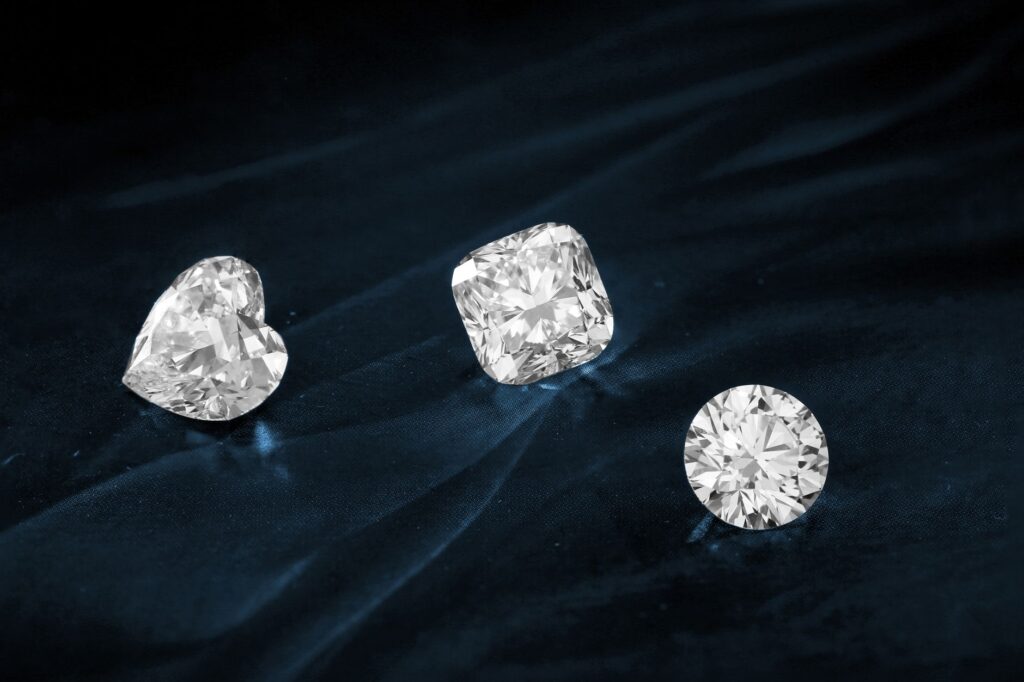
Round brilliant diamonds usually hide color very well because of their facet pattern and strong light return. In a round diamond, E color often looks exceptionally white. Many buyers could choose a lower color grade in a round cut and still be very happy, especially if the diamond is well cut.
Oval, Pear, and Marquise
Elongated shapes such as oval, pear, and marquise can show color a little more easily in some cases, especially toward the tips or along the edges. E color is a comfortable grade for buyers who want a white look in these shapes. It offers extra reassurance without being extreme.
Princess and Cushion
Princess cuts often face up white well, while cushions can vary more depending on facet style and cut quality. An E color cushion may look especially bright, though a well-cut lower grade can also perform well visually. In these shapes, cut can influence color appearance as much as the grade itself.
Emerald and Asscher
Step-cut diamonds such as emerald and Asscher tend to show more of the stone’s interior and can make body color easier to notice. In these shapes, E color is a safer choice if you want a clear, crisp appearance. Buyers who prefer step cuts often place more importance on color than shoppers choosing brilliant cuts.
How E Color Looks in Different Metals
The metal around a diamond changes how white or warm the diamond appears. This is one of the most important practical factors in choosing color. A diamond does not exist in a vacuum, and the ring setting can influence the way your eye reads the stone.
White Gold and Platinum
White metals tend to emphasize a diamond’s whiteness. In platinum or white gold, E color looks particularly clean and colorless. These metals are often chosen by buyers who want the diamond to appear bright and icy.
If you are trying to decide between E and a slightly lower grade for a white-metal setting, the difference may still be minimal. But E is a very safe choice when you want to avoid any chance of visible warmth.
Yellow Gold
Yellow gold can make a diamond appear slightly warmer by contrast, even if the diamond itself is quite white. This does not mean E color is a poor choice in yellow gold. It simply means the surrounding metal influences your perception.
In yellow gold, many buyers can comfortably choose a lower color grade than E and still enjoy a bright-looking diamond. E will still look white, but the visual advantage over near-colorless grades may be less obvious than in white metal settings.
Rose Gold
Rose gold adds warmth to the overall look of a ring. Because of that, E color can still appear beautifully white, but the contrast is softer. Buyers who choose rose gold often prioritize style and overall harmony more than the absolute highest color grade.
How Lighting Affects E Color
Lighting plays a major role in how diamond color is perceived. A diamond can look slightly different depending on whether you are outdoors, indoors, or under jewelry store lighting. This does not mean the grading changed, only that your eye is receiving different information.
Daylight
Natural daylight is often the most honest lighting for judging color. In daylight, E color should still appear white and clean. Any subtle differences from D or F are usually hard to notice unless you are comparing stones directly.
Indoor Lighting
Typical indoor lighting can make color differences even less obvious. Many homes and offices use lighting that is not especially revealing. Under these conditions, E color normally looks white without drawing attention to itself.
Jewelry Store Lighting
Jewelry stores often use bright lighting designed to maximize sparkle. This kind of lighting can make diamonds look more brilliant and can also make color differences harder to evaluate accurately. A diamond may look impressive in the store but behave a little differently in everyday lighting.
Because of this, it is better not to judge color from sparkle alone. A highly sparkling diamond may appear whiter simply because the light return distracts from subtle body color.
Warm and Cool Lighting
Warmer lighting can make any diamond appear a bit more yellow or creamy. Cooler lighting can make a diamond seem sharper and more icy. E color generally handles both well, but the environment still affects the eye’s perception.
This is why a diamond can seem “white enough” in one room and slightly different in another. The grade itself has not changed, only the viewing conditions have.
Price Premium vs Visual Benefit
E color is premium-priced because it sits in the colorless category near the top of the scale. The question is whether the visual gain over lower grades is worth the additional cost. In many cases, the answer depends more on budget priorities than on visible beauty.
The price jump from F to E can be meaningful, and the jump from G or H to E can be even larger. Yet the visible improvement is often modest, especially in smaller or well-cut diamonds. This is the classic issue of diminishing returns.
Where the Extra Cost Goes
Diamond pricing rises quickly as color improves in the top part of the scale. That is because top color grades are rarer and more difficult to produce consistently, especially in larger stones. Buyers often pay for rarity as much as appearance.
For a consumer, that means E color is not only about how the diamond looks. It is also about where it sits in the market and how much premium you are willing to pay for a small shift in color quality.
Diminishing Returns in the Colorless Range
Once a diamond is already in the colorless range, each step up often brings a smaller visible change. The difference between H and G may be more noticeable than the difference between E and D. As you move higher, you begin paying more for subtler refinements.
That does not make E a bad choice. It simply means buyers should understand what they are buying so they can decide whether the extra money buys peace of mind, measurable quality, or a visible improvement.
Who Should Consider E Color?
E color can make sense for buyers who want a diamond that is unquestionably white but do not necessarily need the absolute top grade. It is a thoughtful middle point between premium color and practical value. It also works well for buyers who prefer a very crisp, clean appearance and do not want to think about body color at all.
Good Reasons to Choose E
- You want a very white diamond with little to no visible color.
- You are buying a larger diamond where color differences may be easier to notice.
- You like step-cut shapes such as emerald or Asscher, which can show more body color.
- You are choosing a white gold or platinum setting and want a crisp look.
- You prefer to stay comfortably within the colorless range without paying for D.
Buyer Profiles That Often Fit E Color
E color can be a practical choice for engagement ring shoppers who value a high-end look but still want flexibility elsewhere in the budget. That budget might go toward better cut quality, a larger carat size, or a more detailed setting. In many cases, those factors create more visible impact than moving from F to E.
It can also suit buyers who are particularly color-sensitive. Some people are simply more attuned to subtle tint, and for them, E provides reassurance without unnecessary overcomplication.
Who Can Save Money by Choosing Lower Color Grades?
Not every buyer needs E color to get a beautiful diamond. In fact, many shoppers can choose a lower grade and still end up with a stone that looks bright and white in normal wear. This is especially true when the diamond is well cut and set in a way that complements its color.
Situations Where Lower Grades Often Look Great
- Round brilliant diamonds with strong light return.
- Smaller carat sizes, where color is harder to see.
- Yellow gold settings, where contrast with the metal is softer.
- Buyers who care more about cut, size, or budget than top color grading.
- Diamonds viewed mainly face-up rather than from the side.
For many buyers, grades such as F, G, or H offer excellent visual performance at better value. These stones can still look white to the eye, especially when cut well. The main point is that a diamond does not need to be E to look attractive.
E Color in Lab Grown Diamonds
E color is especially relevant in lab grown diamonds because lab grown material often reaches higher color grades more readily than many natural diamonds. That means shoppers may see a larger share of E, F, and D options in the lab grown market. This can make the top color range feel more accessible.
Still, the same visual principles apply. Lab grown diamonds do not automatically look different from natural diamonds simply because they were created differently. Color is color, and the visible result depends on the same real-world factors such as cut, shape, size, and setting.
Why Lab Grown Diamonds Often Reach High Color Grades
Modern lab growth methods can produce diamonds with very little nitrogen or other trace elements that contribute to body color. As a result, higher color grades are common. This does not make every lab grown diamond colorless, but it does mean buyers may encounter E color more frequently and at lower prices than in natural diamonds.
That pricing difference is one reason buyers often compare lab grown diamond color grades more carefully. If E color is affordable, some shoppers choose it for peace of mind. Others may decide that a slightly lower color grade is the smarter use of budget because the visible difference is still minimal.
Is Color More Important in Lab Grown Diamonds?
Not inherently. The rules of visibility are the same. What changes is the market context. Because E color may be easier to afford in lab grown diamonds, buyers sometimes upgrade without much financial strain, but that does not always mean the upgrade creates a meaningful visual benefit.
In other words, lab grown diamonds often make top color grades more attainable, but buyers should still ask the same question: will I actually see the difference in real life?
How E Color Compares to Nearby Grades
Comparing E to surrounding grades is the most useful way to understand its value. The biggest practical question is not how E ranks in theory, but how it looks relative to D, F, and near-colorless grades once mounted in jewelry.
| Grade | General Appearance | Visibility of Difference | Value Consideration |
|---|---|---|---|
| D | Top colorless grade, extremely white | Very hard to distinguish from E in normal wear | Highest premium, often chosen for rarity or perfection preference |
| E | Colorless, very white, slightly below D | Usually subtle or invisible without comparison | Strong choice for buyers wanting top-tier whiteness without absolute top pricing |
| F | Colorless, very white | Often nearly indistinguishable from E | Common value point within the colorless range |
| G to H | Near-colorless, still white to most eyes | May be subtle, especially in well-cut rounds | Often better value than E with little visible trade-off for many buyers |
E vs D Color Diamonds
The difference between E and D is extremely small. Both are colorless, and both should look very white. D is technically the top grade, but the practical visual difference is often minimal unless the diamonds are compared directly under controlled conditions.
For some buyers, D is worth it simply because they want the best graded color available. For others, E provides nearly the same look with a slightly lower price. If you are value-conscious, E is often the more balanced choice.
E vs F Color Diamonds
E and F are both in the colorless range. In many cases, they look virtually identical once mounted. The main difference is more about grading precision and price than obvious visible color.
If you are deciding between E and F, it often makes sense to look at the entire diamond, especially cut quality and shape. You may find that an excellent F is more impressive overall than an average E.
E vs G Color Diamonds
G is the highest grade in the near-colorless range, and it is often one of the strongest value points in the market. Compared with E, G may be slightly warmer in direct comparison, but many buyers never notice that difference once the stone is set and worn.
If maximum whiteness is important, E has the edge. If overall value matters more, G can be a very smart choice. The best answer depends on how sensitive you are to subtle color and what metal you plan to use.
Common Buyer Mistakes With E Color Diamonds
Color grading can be confusing because the differences are real, but often very small. Buyers sometimes overreact to the grade on paper and miss the bigger picture. A smart purchase requires understanding how color interacts with cut, size, shape, and setting.
Overpaying for Invisible Upgrades
One of the most common mistakes is paying a significant premium for a grade that will not look meaningfully different in daily wear. This is especially common when buyers assume D or E must always look dramatically better than F or G. In reality, the benefit may be too subtle to justify the cost for some shoppers.
Ignoring the Metal Color
Metal color can influence how white a diamond appears. A buyer who chooses E in yellow gold may not get a noticeably whiter look than someone who chooses a slightly lower grade. The visual context matters, so the setting should be part of the color decision.
Relying Only on the Grading Report
A grading report is important, but it does not tell the whole story. Two diamonds with the same color grade can look different if one has better cut quality or a more flattering shape. Color should be evaluated as part of the entire diamond, not in isolation.
Assuming Higher Color Always Means Better Beauty
Beauty is not determined by color alone. A better cut diamond in a slightly lower color grade can look more brilliant and appealing than a higher color diamond with weaker proportions. Buyers sometimes focus so heavily on color that they overlook the factor most likely to affect sparkle and overall presence.
How to Think About E Color as a Buyer
The easiest way to think about E color is this: it is a premium, colorless diamond grade that looks very white in nearly all practical situations. It offers strong assurance for buyers who want high color without insisting on the absolute top grade.
At the same time, E is not always the smartest place to spend money if your goal is maximum visible impact. In many cases, cut quality and size matter more to the eye. That is especially true for buyers comparing lab grown diamonds, where budget can often be allocated more strategically.
A Practical Decision Framework
- Choose E if you want a very white diamond and prefer a high colorless grade.
- Consider F if you want nearly the same look and are open to a slightly lower grade.
- Consider G or H if value is your priority and you are buying a well-cut round diamond or a yellow gold setting.
- Pay extra attention to color if you are choosing a step-cut shape, a larger stone, or a white-metal setting.
Frequently Asked Questions About E Color Diamonds
Is E color considered colorless?
Yes. E color is part of the colorless range on the standard diamond color scale. It should appear white and free of noticeable body color in normal viewing conditions.
Does E color look the same as D color?
To most people, yes, or very close to it. The difference is usually extremely subtle and often only visible in direct comparison under controlled lighting.
Is E better than F?
E is technically one grade higher than F, but the visible difference is often minimal. Whether E is “better” for you depends on whether you value the slight upgrade enough to justify the added cost.
Will an E color diamond look good in yellow gold?
Yes. An E color diamond will still look white in yellow gold. However, the contrast with the metal may make lower grades look acceptable too, so E is not always necessary for a bright appearance in that setting.
Is E color a good choice for lab grown diamonds?
Yes. E color is a strong choice in lab grown diamonds, especially for buyers who want a very white stone. Still, lower grades may offer better value if the visual difference is not important to you.
Should I choose E or spend more on cut?
In many cases, cut is the better place to spend extra money. A well-cut diamond reflects light more effectively, which often has a bigger effect on beauty than moving from a near-colorless grade to E.
Can E color help a diamond look larger or brighter?
E color can contribute to a crisp, bright appearance, but it does not make a diamond physically larger. Brightness is influenced more by cut quality, shape, and light performance than by color grade alone.
Do all diamond shapes show E color the same way?
No. Round brilliant diamonds tend to hide color better than step cuts like emerald or Asscher. E color is especially reassuring in shapes that show more body color.
The Bottom Line on What Is E Color Diamond
An E color diamond is a high-end, colorless diamond grade that looks very white in most real-world settings. It sits just below the top D grade, and the visual difference is usually subtle enough that many buyers would not notice it outside of side-by-side comparison. That makes E a strong choice for shoppers who want top-tier whiteness without automatically paying the maximum premium for D.
For practical buying, the most important questions are how the diamond is cut, what shape it is, what metal it will be set in, and how sensitive you are to color differences. If you want a diamond that feels confidently white, E is an excellent grade. If you are trying to maximize value, it is worth comparing E with F, G, and H under the same viewing conditions before deciding where the extra money is most useful.