Marquise diamonds have gone through several style cycles over the decades, and many shoppers are noticing them again in 2026. That renewed interest is not just about nostalgia. It also reflects a broader shift toward distinctive engagement ring styles, larger-looking center stones, and diamond shapes that feel a little less common than round or oval.
If you are wondering whether marquise diamonds are making a comeback, the short answer is yes, but with an important caveat. They are not replacing round or oval diamonds as the most popular choices. Instead, they are gaining ground among buyers who want a more elongated, elegant look and are comfortable with a shape that makes a stronger style statement.
For lab grown diamond shoppers, the marquise shape is especially interesting because its elongated outline can create a larger face-up appearance for the carat weight. That can make it a practical option for buyers comparing lab grown diamonds across different shapes, especially when budget, size, and visual presence all matter.
Quick Answer: Are Marquise Diamonds Making a Comeback?
Yes, marquise diamonds are seeing renewed popularity in engagement rings and fine jewelry. Social media visibility, vintage-inspired designs, and the appeal of elongated shapes have all helped bring them back into the conversation. They are not the default mainstream choice, but they are increasingly viewed as stylish, distinctive, and unexpectedly elegant.
The comeback is strongest among buyers who want something different from the round brilliant look. It is also being helped by the rise of lab grown diamonds, since shoppers can often choose a larger or higher-quality marquise within the same budget compared with a natural diamond.
Still, marquise diamonds are not the best shape for everyone. They have some unique advantages, but also a few practical considerations, including the bow tie effect, protective prong placement, and a visual style that can feel more fashion-forward than timeless to some buyers.
Why Marquise Diamonds Are Getting More Attention
Diamond trends often move in cycles. Shapes that once felt dated can become desirable again when design preferences shift. Marquise diamonds are benefiting from several broader trends at once, including vintage styling, elongated silhouettes, and a preference for rings that look intentional rather than conventional.
Vintage and heirloom-inspired design
The marquise shape has a strong historical identity. It has appeared in antique jewelry, royal-inspired designs, and decorative settings for generations. Buyers who want a ring with a sense of character often find that marquise diamonds deliver that feeling more naturally than many other shapes.
This matters because engagement ring buyers are increasingly looking beyond simple trend-following. They want a shape that feels personal, and marquise diamonds can offer that without becoming too unusual.
Social media and visual distinctiveness
Jewelry trends are heavily influenced by what photographs well. The marquise cut has a dramatic outline that stands out in close-up images, especially on social platforms where ring shapes are compared side by side. Its pointed ends and long silhouette create an immediate visual identity.
That visibility has made the shape more familiar to younger buyers. When a diamond shape is seen often enough in celebrity styling, designer collections, or ring inspiration posts, it begins to feel less niche and more current.
Better value perception in lab grown diamonds
Lab grown diamonds have changed how many buyers think about shape. Since lab grown stones generally cost less than natural diamonds of similar size and quality, shoppers often have more room in the budget to prioritize a larger center stone or a more distinctive cut.
Marquise diamonds can appear larger than round diamonds of the same carat weight because of their elongated face-up shape. For buyers focused on visual size, that can make the shape especially attractive in the lab grown market. If you are comparing different options, it helps to understand how carat weight and face-up size are not the same thing, which is one reason many people review guides on diamond carat and diamond cut before choosing a shape.
What Makes a Marquise Diamond Different?
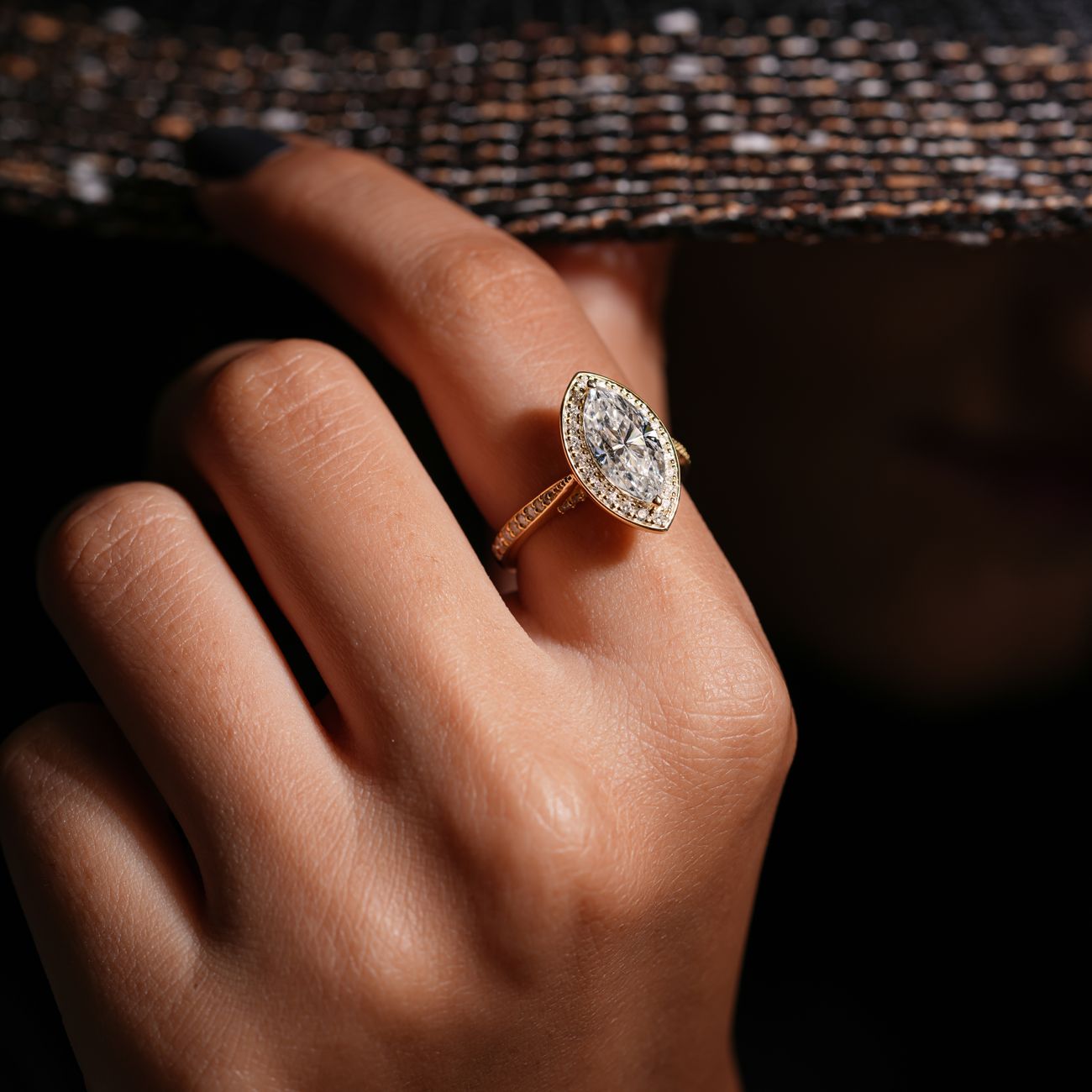
A marquise diamond is an elongated shape with pointed ends and curved sides. It is usually cut to maximize the stone’s length and create a dramatic, boat-like outline. The shape is sometimes described as elegant, regal, or dramatic because it draws the eye along its length.
Unlike round brilliant diamonds, which are designed primarily for balanced light performance, marquise diamonds depend more heavily on proportion and symmetry. Small differences in length, width, and the placement of the points can noticeably affect how the stone looks.
Basic shape characteristics
Marquise diamonds are part of the brilliant-cut family, meaning they are faceted to produce sparkle rather than the clean step-like reflections seen in emerald cuts. However, their long body and pointed ends create a different visual pattern from round or oval diamonds.
Common characteristics include:
- An elongated shape that can make fingers look longer
- Pointed ends that need protection in a ring setting
- Strong face-up size for the carat weight
- A potentially visible bow tie effect in the center
- High sensitivity to cut proportions and symmetry
Length-to-width ratio matters
One of the most important buying details for a marquise diamond is the length-to-width ratio. This tells you how narrow or wide the stone appears when viewed from above. A lower ratio creates a fuller, wider marquise, while a higher ratio creates a slimmer, more elongated one.
Many buyers prefer something in a balanced range rather than an extreme shape. A ratio that is too low may look stubby, while one that is too high can look overly narrow. The best choice depends on personal style and the ring design, but proportion has a major impact on overall appearance.
Appearance and Visual Performance
Marquise diamonds have a distinctive look that sets them apart from most other shapes. Their visual impact comes from a combination of length, sparkle, and the way the eye moves across the stone. That can make them very appealing, but it also means they are less forgiving than some other cuts.
Brilliance and sparkle
Because marquise diamonds are brilliant-cut, they can show lively sparkle. In well-cut stones, the facets reflect light in a lively, scattered pattern that many buyers find attractive. This makes them visually energetic rather than subdued.
That said, sparkle in a marquise diamond is not judged the same way as in a round brilliant. The shape naturally creates areas of stronger and weaker light return depending on its proportions. A well-cut marquise will have good brightness across the stone without obvious dark zones dominating the center.
Fire
Fire refers to the colored flashes of light a diamond gives off. Marquise diamonds can show fire well because they are cut with brilliant-style facets. However, fire is influenced more by cut quality and lighting conditions than by shape alone.
In practical terms, buyers should not expect one marquise to look the same as another. A stone with stronger symmetry and appropriate depth is more likely to show balanced sparkle and attractive flashes of color.
Scintillation
Scintillation is the pattern of sparkle you notice when a diamond moves. Marquise diamonds can be visually interesting because the elongated shape creates changes in light across the stone as it shifts. This movement can look elegant and dynamic, especially in a ring with a slender profile.
At the same time, a poorly proportioned marquise may look uneven when moved under light. That is why actual viewing matters, not just the certificate or carat weight.
The bow tie effect
One of the most important visual issues in marquise diamonds is the bow tie effect. This is the dark band or shadow that appears across the center of some elongated diamonds, including marquise, oval, pear, and radiant shapes.
The bow tie happens because of the way light enters and exits the stone. In some stones, certain angles allow more light leakage, creating a darker central area. A slight bow tie is common and not always a problem, but a strong one can make the diamond look less lively.
For shoppers, this means the cut quality of a marquise diamond matters a great deal. Two stones with the same carat weight can look very different if one has better proportions and light performance than the other.
How Marquise Diamonds Compare to Other Popular Shapes
When deciding whether marquise diamonds are making a comeback in a way that matters to your purchase, it helps to compare them with other popular shapes. The table below highlights the practical differences buyers usually notice first.
| Shape | Visual Style | Sparkle Pattern | Face-Up Size | Durability Consideration | Trend Status |
|---|---|---|---|---|---|
| Marquise | Elegant, dramatic, vintage-inspired | Bright brilliant sparkle with possible bow tie | Large for carat weight | Pointed ends need protection | Rising again, especially in fashion-forward rings |
| Round | Classic, balanced, traditional | Strongest overall brightness and sparkle | Moderate relative to carat | Very durable shape | Always popular |
| Oval | Soft, elongated, modern classic | Brilliant sparkle with possible bow tie | Large for carat weight | Generally durable | Still highly popular |
| Pear | Asymmetrical, elegant, slightly more ornate | Bright with a pointed tip that can show variation | Large visual spread | Tip needs protection | Consistently popular |
| Emerald | Clean, refined, step-cut, understated | More mirror-like than sparkly | Good face-up size, less sparkle impact | Corner protection matters | Popular for minimal, elegant styles |
Marquise versus round brilliant
Round brilliant diamonds remain the benchmark for sparkle and broad consumer appeal. They usually offer the most predictable light performance and the strongest market familiarity. Marquise diamonds, by contrast, are chosen more for shape and visual personality than for maximum uniform sparkle.
If your priority is timelessness and easy resale recognition, round is often the safer conventional choice. If your priority is size appearance and a more distinctive silhouette, marquise may be more appealing.
Marquise versus oval
Oval diamonds are the closest modern comparison to marquise. Both are elongated shapes that can look larger than their carat weight suggests. Both can show bow tie effects, although it varies by stone.
The main difference is style. Oval diamonds feel softer and more mainstream, while marquise diamonds feel sharper, more dramatic, and more vintage-inspired. Buyers who want a familiar but elongated look often choose oval. Buyers who want something more distinctive may lean marquise.
Marquise versus pear
Pear-shaped diamonds also offer elongation and finger-flattering appeal, but they have one pointed end and one rounded end. That gives them a more asymmetrical feel. Marquise diamonds are symmetrical from end to end, which creates a more structured and balanced outline.
For some buyers, symmetry is part of the appeal. For others, the pear shape feels slightly softer and more romantic. Neither is objectively better. They simply communicate different design styles.
Marquise versus emerald cut
Emerald cuts are step cuts, so they emphasize clarity and clean lines rather than intense sparkle. Marquise diamonds are much more brilliant in appearance. That makes marquise a better choice for buyers who want a lively, eye-catching center stone.
Emerald cuts often require higher clarity because their open facets reveal inclusions more easily. Marquise diamonds can also show inclusions, but brilliant faceting may hide them somewhat better. Still, a clean stone is always preferable, especially in larger sizes.
Advantages of Choosing a Marquise Diamond
Marquise diamonds have several practical strengths that explain why they are coming back into style. Their appeal is not based on trend alone. There are real visual and purchasing advantages that make them attractive to many buyers.
They can look larger than other shapes
One of the biggest reasons buyers consider marquise diamonds is the face-up size advantage. Because the shape is long and narrow, it often covers more visible surface area than a round diamond of the same carat weight. That can make the stone look substantial without requiring a higher carat weight.
This is especially relevant for lab grown diamonds, where buyers may already be comparing more size options within the same budget. If visual presence matters, marquise can be a smart shape to evaluate.
They create a flattering finger effect
The elongated silhouette of a marquise diamond often makes the finger appear longer and slimmer. This is one reason the shape has remained appealing in engagement rings and fashion rings over time.
That finger-flattering effect is not universal, though. It depends on the wearer’s hand shape, ring setting, and the stone’s proportions. In a good setting, marquise can be one of the most elegant-looking diamond shapes.
They offer a distinctive style without being too unusual
Marquise diamonds are recognizable, but not obscure. For buyers who want something less common than round or oval without going fully unconventional, marquise can be a practical middle ground. It is different enough to stand out, but still familiar enough to feel wearable.
That balance is part of the current comeback. Many shoppers want a ring that feels personal and less mass-market, and marquise offers that quality naturally.
They can work beautifully in both vintage and modern settings
Marquise diamonds are versatile in terms of design. They can look ornate in halo or vintage settings, but they also work in clean, minimal settings with thin bands and simple prongs. That flexibility helps the shape appeal to a wider range of buyers.
In modern designs, the shape can feel sleek and architectural. In antique-inspired settings, it can feel romantic and detailed.
Disadvantages and Trade-Offs
No diamond shape is perfect, and marquise diamonds come with some important trade-offs. Understanding these before you buy can prevent disappointment later.
They are more sensitive to symmetry issues
Because the shape is elongated and tapered, small symmetry problems are easier to notice. If one side is slightly uneven or the points are not aligned correctly, the diamond may look off-center or visually unbalanced.
This means buyers should look carefully at the stone in addition to reviewing the grading report. Shape quality is not always captured fully by certification alone.
The pointed ends need protection
The two ends of a marquise diamond are vulnerable to chipping if left exposed. This does not mean the shape is fragile in daily wear, but it does mean the setting matters. Many marquise engagement rings use protective V-prongs or bezel-style elements near the points.
If you plan to wear the ring every day, the setting should be designed with durability in mind. That is true for all pointed shapes, not just marquise.
Bow tie can be more noticeable in some stones
Because marquise diamonds are elongated, the bow tie effect can be more noticeable than in round diamonds. Some stones handle this well. Others have a dark center that distracts from the overall brilliance.
For this reason, buyers should not choose marquise by image alone. Video, actual light performance, and expert review matter more than with some other shapes.
They may not feel as timeless to every buyer
Although marquise diamonds have a long history, their style is not as universally accepted as round diamonds. Some buyers love the statement-making look, while others prefer a shape that feels less tied to fashion cycles.
If long-term classic appeal is your top priority, you may still prefer round, oval, or emerald. If you want a shape with more character, marquise is worth serious consideration.
Who Marquise Diamonds Are Best For
Marquise diamonds are a strong fit for certain types of buyers. The shape tends to work best for people who value visual length, distinct style, and a slightly vintage feel.
Marquise may suit you if you want:
- An elongated diamond that can make the hand look slimmer
- Good visual size for the carat weight
- A shape that stands out from common choices
- A vintage-inspired or fashion-forward look
- A center stone that can feel elegant without being overly trendy
Marquise may not be ideal if you want:
- The most universally classic diamond shape
- Maximum sparkle consistency with minimal shape variation
- A low-maintenance stone with less concern about pointed ends
- A shape that is easy to evaluate without careful side-by-side comparison
In practice, many first-time buyers choose marquise when they already know they want something less conventional. It is often a shape people grow to love after comparing it with round and oval options rather than a shape they select automatically.
How Marquise Diamonds Perform in Lab Grown Diamonds
Marquise diamonds are especially relevant in the lab grown market because buyers often gain more flexibility with budget, size, and quality. A lab grown marquise can offer a strong combination of style and perceived size, which is attractive to shoppers who want a larger center stone without moving far outside their budget.
That said, the same buying rules still apply. A lab grown diamond can be beautifully cut or poorly proportioned. It can have strong symmetry or noticeable light issues. Certification, visual inspection, and trusted sourcing remain important.
Many buyers exploring lab grown diamonds are also comparing how different shapes look at the same carat weight. Marquise often performs well in those comparisons because its elongated outline creates a graceful spread on the finger.
How lab grown changes the value conversation
Lab grown diamonds generally offer a lower purchase price than natural diamonds of similar size and quality. That can make it easier to choose a more carefully cut marquise, a larger carat weight, or a better color and clarity grade within the same budget.
However, it is important to keep expectations realistic. While the upfront value can be strong, resale value for lab grown diamonds is typically lower than for natural diamonds. That does not make them a poor purchase, but it does mean buyers should think about personal use more than investment potential.
Important Buying Considerations for Marquise Diamonds
If you are shopping for a marquise diamond, there are several details that deserve more attention than they might with round or princess cuts. The shape is highly dependent on proportions, and a small difference can noticeably affect appearance.
Look closely at the length-to-width ratio
The ratio shapes the overall personality of the diamond. A moderate ratio often looks balanced and elegant, while extremes can make the stone appear too narrow or too short. There is no single ideal ratio, but the proportions should match the ring style and your visual preference.
For example, a more slender marquise can look refined in a minimalist solitaire, while a slightly fuller marquise may suit a vintage-inspired halo setting better.
Prioritize symmetry
Symmetry is important in marquise diamonds because the eye quickly notices imbalance in elongated shapes. The points should align cleanly, and the curves should flow evenly from side to side. If one side looks more extended or one point seems uneven, it can affect the entire appearance.
This is one reason it helps to study the diamond in person or through high-quality video. The grading report is useful, but it will not always show every visual issue.
Watch for the bow tie effect
A small bow tie is not unusual, but a strong dark band across the center can reduce the diamond’s liveliness. When comparing stones, pay attention to how the center area behaves under different lighting. A good marquise should still feel bright and active even though some shadowing may be present.
This is especially important when shopping online. Product photos can flatter a diamond more than real-world lighting does.
Protect the points in the setting
Because the ends are pointed, the setting should shield them from impact. V-prongs are common and usually a practical choice. A well-made setting is part of the diamond’s long-term durability, especially for daily wear.
If you want to understand settings in more detail, it is helpful to review guides on engagement rings and jewelry care before finalizing your choice.
Balance color and clarity with the shape
Marquise diamonds can sometimes show body color more readily in the pointed ends or across the body if the stone is not well proportioned. For that reason, many buyers prefer a color grade that keeps the diamond looking bright face-up. Clarity is also important, although brilliant faceting can help mask small inclusions better than step cuts.
If you are comparing lab grown stones, this is where knowledge of diamond color and diamond clarity can help you choose wisely. Not every buyer needs the highest grades, but the shape should be matched thoughtfully to the stone’s visible quality.
Common Mistakes Buyers Make with Marquise Diamonds
Marquise diamonds are rewarding to buy, but they also lend themselves to a few common errors. These mistakes usually come from focusing too much on carat weight or price and not enough on how the shape actually looks.
Choosing by carat weight alone
Carat weight does not tell you how attractive the diamond will look. A poorly cut marquise can appear less elegant than a smaller but better-proportioned stone. Since the shape is elongated, face-up dimensions and proportion often matter more than the number on the certificate.
Ignoring the bow tie effect
Some shoppers see a large marquise online and assume it will look equally bright in person. In reality, a strong bow tie can make the center look darker than expected. This is one of the most important visual checks for the shape.
Overlooking the setting
A marquise without proper point protection is more vulnerable to damage over time. The setting is not just decorative. It is part of the diamond’s functional design.
Forgetting to compare different ratios
Two marquise diamonds with the same carat weight can look quite different if their proportions vary. Comparing only the certificate data can lead to a mismatch between expectation and appearance.
Assuming all elongated shapes look the same
Marquise, oval, pear, and radiant shapes all have different personalities. Buyers sometimes assume marquise is just a more unusual oval, but the pointed ends and symmetrical outline give it a much stronger identity.
Marquise Diamonds and Style Trends in 2026
In 2026, marquise diamonds fit well into several active jewelry trends. Elongated center stones are still popular, but buyers are looking for variations that feel more personal than the most common choices. Marquise offers that mix of familiarity and distinctiveness.
It also works well with a growing preference for rings that look intentional rather than identical. Whether set east-west, vertically, or in a delicate solitaire, marquise can support different design directions without losing its core identity.
Why the shape feels current again
Marquise feels current because it satisfies two competing preferences at once. It looks vintage enough to feel character-rich, but sleek enough to feel modern. Buyers who want a ring that does not resemble every other engagement ring often find that appealing.
The shape is also visually strong in both natural and lab grown diamonds, which broadens its audience. As more shoppers compare shapes using online tools and educational resources, the marquise cut has an easier time standing out.
Frequently Asked Questions
Are marquise diamonds actually popular again?
Yes. They are not the most popular shape overall, but they are more visible now than they were a few years ago. Interest is coming from vintage styling, social media exposure, and buyers who want an elongated shape with more personality than round or oval.
Do marquise diamonds look bigger than round diamonds?
Often, yes. Marquise diamonds can appear larger face-up than round diamonds of the same carat weight because of their long outline. The exact impression depends on the stone’s proportions and how it is set.
Is the bow tie effect a deal-breaker?
Not always. A slight bow tie can be common and acceptable in marquise diamonds. A strong or overly dark bow tie, however, can reduce brightness and make the stone look less lively, so it is worth examining carefully.
Are marquise diamonds durable enough for everyday wear?
They can be, as long as the setting protects the pointed ends. The shape itself is suitable for daily wear, but the points are more vulnerable than rounded edges. A secure setting is essential.
Do marquise diamonds hide inclusions well?
They can hide small inclusions reasonably well because of their brilliant-style faceting, but that depends on the location and size of the inclusions. Like all diamonds, marquise stones should still be evaluated for clarity and visual cleanliness.
Are marquise diamonds good for lab grown engagement rings?
Yes, especially for buyers who want a larger-looking center stone or a distinctive shape within a moderate budget. The same quality factors still apply, including cut, symmetry, color, clarity, and setting design.
Will a marquise diamond go out of style?
Any trend can shift, but marquise has a long history and is not purely a temporary fashion. It may move in and out of the spotlight, yet its shape has remained recognizable for generations. That gives it more staying power than many trend-driven designs.
Conclusion
Marquise diamonds are making a real comeback, but in a thoughtful way rather than a mass-market takeover. They appeal to buyers who want an elongated shape, a distinctive look, and strong face-up presence for the carat weight. In the lab grown market, those benefits can be even more attractive because buyers often have more flexibility in size and quality.
At the same time, marquise diamonds require careful buying. Proportion, symmetry, the bow tie effect, and setting protection all matter more than they do with some other shapes. When chosen well, a marquise diamond can feel elegant, modern, and personal without looking overly trendy.
For buyers comparing diamond shapes, the main question is not whether marquise is objectively better. It is whether its style, proportions, and practical considerations fit your priorities. If you want a shape that stands out while still feeling classic enough to wear for years, marquise deserves serious consideration alongside other popular options such as round, oval, and pear.