A size 8 finger changes the way a diamond looks more than most buyers expect. A stone that appears substantial on a smaller ring size can look more modest once it is worn on a wider finger, even when the carat weight sounds impressive on paper. That is why the best diamond size for size 8 finger is not a single universal carat number. It depends on the look you want, the shape you choose, and how much finger coverage matters to you.
For practical buying purposes, ring size affects visual balance. On a size 8 finger, a diamond usually needs a bit more spread, meaning visible top-down size, to create the same visual impact it would have on a size 4, 5, or 6 finger. This does not mean smaller diamonds look wrong on a size 8 finger. It means expectations should be adjusted so the diamond you choose matches your preferred appearance.
This guide explains what actually looks proportionate on a size 8 finger, which carat ranges tend to feel small, balanced, or bold, and how shape, cut, and setting can change the result. It also covers where lab grown diamonds fit in, since they often allow buyers to reach a larger visual size without the same budget jump as natural diamonds.
Quick Answer
The best diamond size for size 8 finger is often between about 1.25 and 2.00 carats for buyers who want a balanced, noticeable center stone. A 1.00 carat diamond can still look attractive on a size 8 finger, but it usually appears more modest than many buyers expect. A 1.50 carat diamond is commonly seen as a strong middle ground, while 2.00 carats and above create a more prominent look with greater finger coverage.
That said, carat weight alone is not enough. The best choice also depends on:
- Diamond shape, since elongated shapes often look larger face-up than round diamonds of the same carat weight
- Cut quality, because poor proportions can hide weight where you cannot see it
- Setting style, which can make the center stone look larger or smaller
- Budget, especially when comparing natural and lab grown diamonds
- Personal style, since some buyers want a subtle ring and others want stronger finger coverage
If you want a quick practical reference for a size 8 finger:
| Look | Typical Round Diamond Size Range | General Visual Impression on Size 8 Finger |
|---|---|---|
| Delicate | 0.50 to 0.90 carat | Noticeably small to modest |
| Classic | 1.00 to 1.25 carats | Balanced but not large |
| Substantial | 1.50 to 2.00 carats | Strong presence and good coverage |
| Bold | 2.25 carats and up | Very noticeable, larger look |
Understanding the Carat Concept
What diamond carat actually means
Carat is a measure of weight, not visible size. One carat equals 200 milligrams. Buyers often use carat as if it directly tells them how large a diamond will look, but that is only partly true.
Two diamonds with the same carat weight can look different from the top. One may appear wider and larger, while another may carry more of its weight in the depth, where it is less visible once set in a ring. This is why judging by carat alone can lead to disappointment.
What face-up size means
Face-up size refers to how large the diamond appears when viewed from above, which is how people normally see a ring. This is the most practical measure for buyers concerned about visible size.
For round diamonds, face-up size is usually described by diameter in millimeters. For example, a well-cut 1.00 carat round diamond is often around 6.4 to 6.5 mm in diameter. A well-cut 1.50 carat round is often around 7.3 to 7.4 mm. That difference sounds small numerically, but it becomes noticeable on the hand.
Why finger size matters
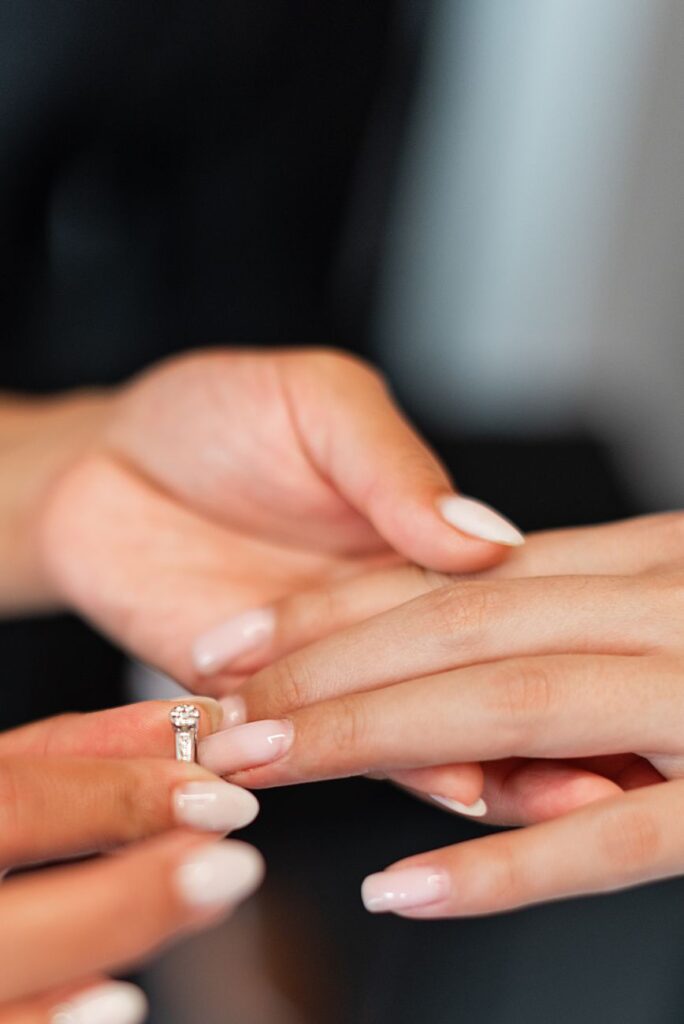
A diamond does not exist visually in isolation. It is seen in relation to the finger, the band, and the entire ring design. On a size 8 finger, the same diamond covers a smaller percentage of the finger width than it would on a smaller finger.
That is the core reason this topic matters. A size 8 finger is not unusually large, but it is large enough that visible spread becomes especially important when buyers want a ring to feel proportionate rather than tiny.
What Buyers Usually Expect
Expecting the carat number to tell the whole story
Buyers often assume a 1 carat diamond will look “big enough” because it is such a familiar benchmark. In reality, 1 carat is a weight milestone, not a visual guarantee. On a size 8 finger, 1 carat usually reads as classic and tasteful, but not especially large.
This is not a flaw. It is simply a matter of proportion. Buyers influenced by close-up product photos or social media images can easily overestimate how much finger coverage a given carat weight will provide in real life.
Assuming all 1.50 or 2.00 carat diamonds look the same
They do not. Shape matters. Cut matters. Millimeter measurements matter. Even small differences in spread can affect the visual outcome on a larger finger size.
A 1.50 carat oval may look noticeably larger than a 1.50 carat round because it stretches lengthwise and often appears to cover more finger area. A deep-cut round with hidden weight may look smaller than an ideally cut round of the same carat weight.
Underestimating the effect of band width
A wider band can make the center stone look relatively smaller. A very thin band can make that same diamond stand out more. On a size 8 finger, buyers sometimes choose a wider band for comfort or durability, then realize they need a little more center stone spread to maintain visual balance.
What It Actually Looks Like on a Size 8 Finger
General visual scale
On a size 8 finger, diamond appearance often falls into practical ranges rather than exact rules. A round diamond under 1 carat usually looks delicate to modest. Around 1.00 to 1.25 carats tends to look classic and balanced. Around 1.50 to 2.00 carats starts to look more substantial. Above 2.00 carats becomes increasingly prominent.
This is especially important for buyers who say they want the diamond to “look nice on the hand” but do not necessarily want a dramatic statement ring. For many, that sweet spot is somewhere in the 1.25 to 1.75 carat range, depending on shape and setting.
Approximate round diamond appearance by carat size
| Carat Weight | Approximate Round Diameter | How It Often Looks on Size 8 Finger |
|---|---|---|
| 0.50 ct | About 5.1 mm | Delicate, clearly small center stone |
| 0.75 ct | About 5.8 mm | Modest, understated |
| 1.00 ct | About 6.4 to 6.5 mm | Classic, balanced, not large |
| 1.25 ct | About 6.9 mm | Noticeable, slightly fuller look |
| 1.50 ct | About 7.3 to 7.4 mm | Substantial, often ideal for visible presence |
| 2.00 ct | About 8.1 mm | Prominent and bold |
| 2.50 ct | About 8.7 to 8.9 mm | Very strong finger coverage |
Finger coverage matters more than the number
What people notice first is not the carat weight. They notice the ring’s overall visual presence. On a size 8 finger, a 1.00 carat round does not disappear, but it also does not dominate the hand. It often looks refined and traditional.
By contrast, a 1.50 carat round usually feels more clearly noticeable from conversational distance. A 2.00 carat round begins to create a stronger visual statement, especially in solitaire settings.
Factors That Change Apparent Size
Shape
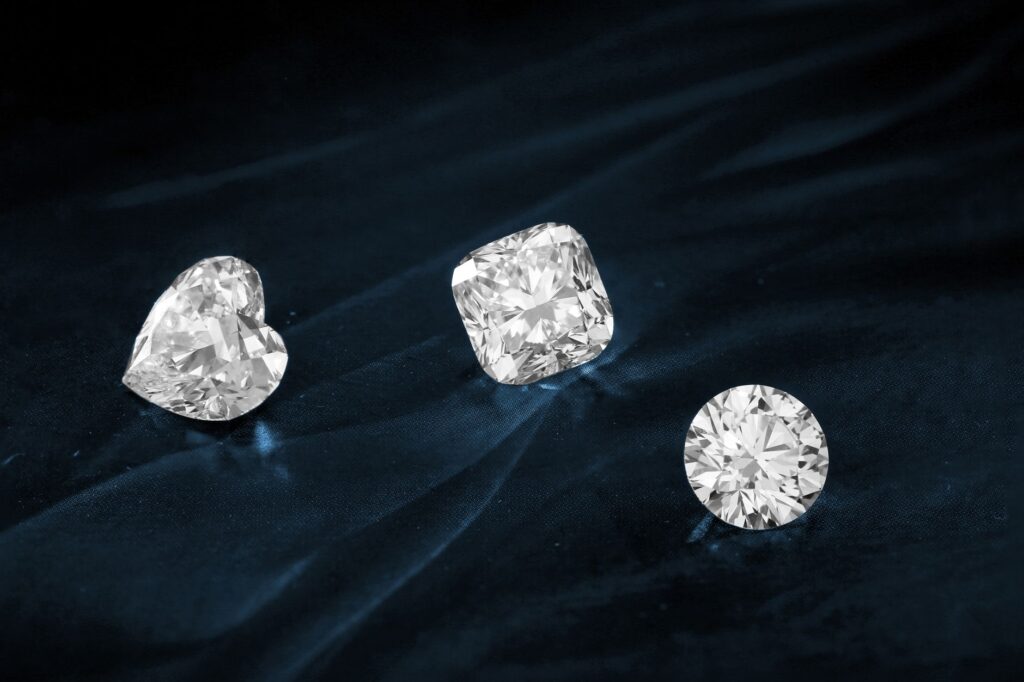
Shape is one of the biggest factors in apparent size. Some shapes spread their weight over a larger visible surface area, while others keep more of the weight compact.
In general:
- Round is the standard reference but often looks smaller than elongated shapes at the same carat weight
- Oval often looks larger due to its longer outline
- Marquise usually provides strong finger coverage and length
- Pear can also create a longer, larger appearance
- Emerald and radiant can look broad and elegant, though proportions vary
- Cushion can face up smaller than some buyers expect, especially if cut deep
- Princess can look compact for its weight compared with elongated shapes
For a size 8 finger, elongated shapes are often chosen by buyers who want the diamond to look larger without paying for a major jump in carat weight.
Cut quality
Cut quality affects both sparkle and visible size. A well-cut diamond reflects light better and can appear more lively and noticeable. It also tends to have more balanced proportions, which helps preserve face-up spread.
A poorly cut diamond may carry too much weight in the bottom, making it look smaller from above. This is one reason experienced buyers do not choose by carat number alone. They compare measurements and proportions too.
Depth and spread
Depth refers to how tall the diamond is from top to bottom. A diamond with excessive depth can hide weight where it cannot be seen when worn. Spread refers to how wide the diamond looks from above.
For buyers focused on apparent size, spread is critical. On a size 8 finger, that visible width and length often matter more than a small increase in carat weight that does not produce much larger face-up dimensions.
Setting style
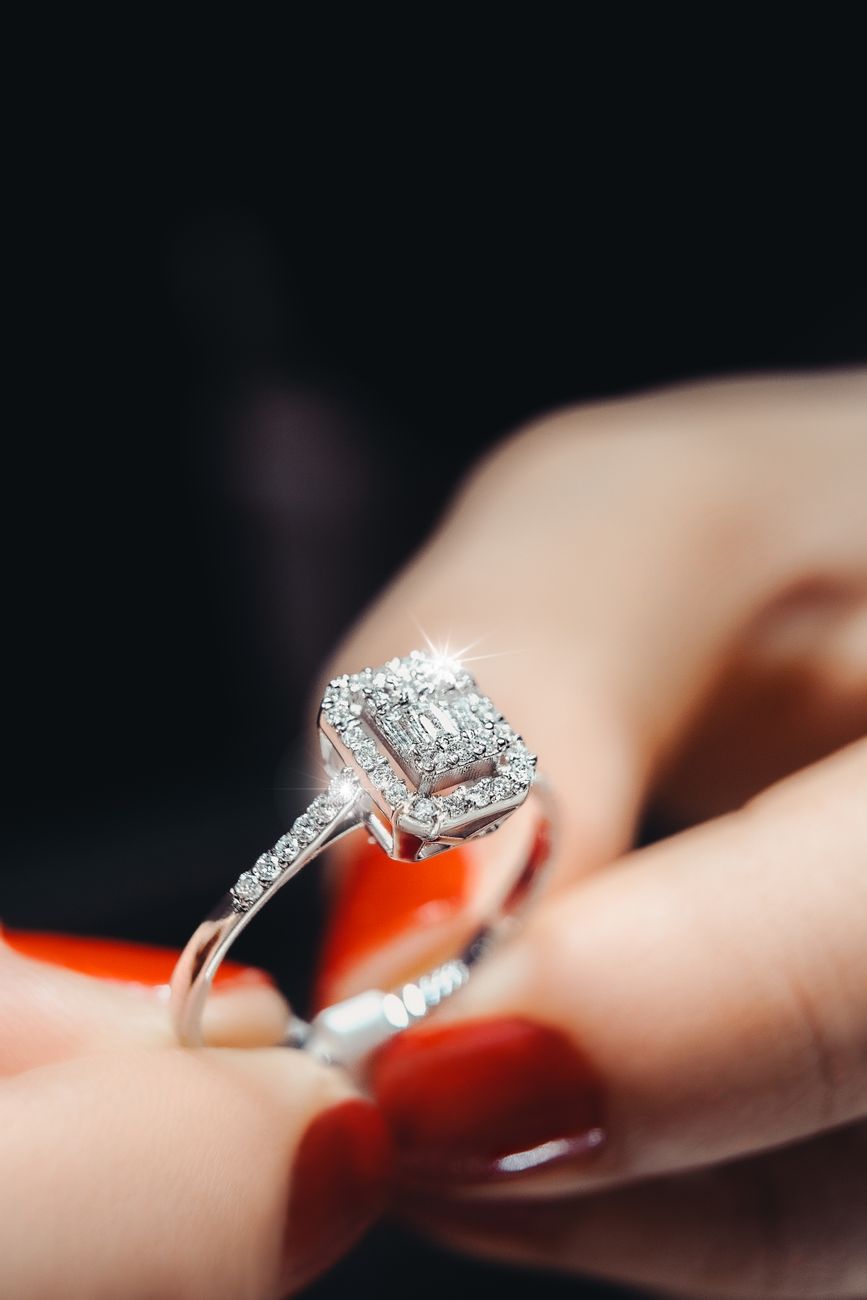
The setting can noticeably influence how large the center stone appears. A halo setting surrounds the center with smaller diamonds, making the overall top view look larger. A solitaire is cleaner and timeless, but it does not add visual width in the same way.
Other setting details also matter:
- Thin bands can make the center diamond look larger
- Wide bands can make the center diamond look smaller by comparison
- Cathedral settings can add presence and height
- Hidden halos add sparkle but less top-view size than a traditional halo
- Three-stone settings create more total finger coverage
Color and clarity do not usually change size much
Diamond color and diamond clarity influence appearance and value, but they do not strongly change visible size on the finger. In practical terms, shape, cut, and setting do far more to affect size perception.
This matters for budgeting. A buyer focused on visual impact may benefit more from prioritizing a strong cut and slightly larger spread than from paying a premium for very high color or clarity grades that are difficult to notice once set.
Real-World Size Examples
1.00 carat round on size 8 finger
A well-cut 1.00 carat round diamond usually measures around 6.4 to 6.5 mm. On a size 8 finger, it often looks classic and proportional, but not large. It gives a clean, traditional engagement ring look.
This can be the right choice for buyers who prefer subtle elegance, do not want a flashy ring, or are balancing budget across the center stone, setting, and wedding band. It is less ideal for someone who specifically wants noticeable finger coverage.
1.50 carat round on size 8 finger
A 1.50 carat round often measures about 7.3 to 7.4 mm. On a size 8 finger, this is a meaningful step up in presence. It usually looks substantial without becoming oversized.
For many buyers, this is the practical sweet spot. It offers stronger visual impact than 1.00 carat while still staying within a classic overall look, especially in solitaire or simple pavé settings.
2.00 carat round on size 8 finger
A 2.00 carat round typically measures around 8.1 mm. On a size 8 finger, it looks prominent and clearly larger than average. The jump from 1.50 to 2.00 carats is visible, though not always dramatic enough to justify the price jump in natural diamonds for every buyer.
This size suits buyers who want stronger center-stone presence and are comfortable with a more attention-grabbing ring.
1.50 carat oval on size 8 finger
A 1.50 carat oval often looks larger than a 1.50 carat round because of its length. On a size 8 finger, it can create elegant finger coverage and a slimming visual effect.
This is one of the most practical options for buyers who want a larger look without moving all the way to a heavier round diamond. The trade-off is that oval cut quality can vary, and some stones show a bow-tie effect, which is a darker area across the center.
0.90 carat vs 1.00 carat on size 8 finger
The visual difference between 0.90 and 1.00 carat is usually small, especially if both are well cut. The price difference, however, can be larger than the visual difference because 1.00 carat is a major benchmark weight.
On a size 8 finger, a well-cut 0.90 carat may look extremely similar to a 1.00 carat once mounted. Buyers focused on value should not ignore slightly under the benchmark sizes.
2.00 carat oval vs 2.00 carat round on size 8 finger
The 2.00 carat oval usually appears larger in terms of finger coverage than the 2.00 carat round. The round may still offer a different type of visual appeal, often with a classic symmetrical outline and strong brilliance when well cut.
For apparent size alone, the oval often wins. For buyers who prioritize the traditional round look and its predictable light performance, the round may still be the preferred choice.
Price vs Visual Benefit
Why price jumps faster than visible size
Diamond prices do not rise in a straight line with visible spread. They tend to jump at popular benchmark sizes such as 1.00, 1.50, and 2.00 carats. That means you often pay a noticeable premium for a milestone weight even when the visual size increase is modest.
This is especially true with natural diamonds. The larger the stone gets, the more expensive each additional fraction of a carat becomes.
Diminishing returns in visible size
The increase from 1.00 to 1.50 carats is usually noticeable on a size 8 finger. The jump from 1.50 to 2.00 carats is also visible. But each price step may be much larger than the visible size increase suggests.
This creates a common buying question: is the upgrade worth it? The answer depends on priorities. If visual presence is the main goal and the budget allows it, moving up can make sense. If value efficiency matters more, stopping just under a benchmark or choosing a shape with more spread can be smarter.
Practical value ranges
| Option | Visual Benefit on Size 8 Finger | Value Perspective |
|---|---|---|
| 0.90 ct round | Similar to 1.00 ct, slightly smaller | Often better value than 1.00 ct |
| 1.25 ct round | Noticeably fuller than 1.00 ct | Often a strong middle ground |
| 1.50 ct round | Clear size upgrade | Popular balance of size and practicality |
| 1.50 ct oval | Looks larger than round of same weight | Often excellent visual value |
| 2.00 ct round | Prominent appearance | More expensive, stronger statement |
How lab grown diamonds change the size decision
Lab grown diamonds have significantly changed the size conversation. Buyers who want the best diamond size for size 8 finger often discover that lab grown diamonds allow them to move from a 1.00 or 1.25 carat natural diamond to a 1.50, 2.00, or even larger diamond within a similar budget.
Visually, a lab grown diamond looks the same as a natural diamond if the quality factors are equivalent. The main differences usually relate to origin, pricing structure, and resale expectations. For buyers whose top priority is visible size and appearance on the hand, lab grown diamonds can be very budget-efficient.
The trade-off is that lab grown diamonds generally have weaker resale value than natural diamonds, and the category has seen strong price declines over time. That does not make them a poor choice. It simply means the value proposition is usually centered on appearance and upfront affordability rather than long-term retained value.
Who Should Size Up
Buyers who want noticeable finger coverage
If your goal is for the center stone to stand out clearly on a size 8 finger, sizing up often makes sense. In practical terms, that usually means looking beyond 1.00 carat, especially for round diamonds.
A 1.50 carat round or a well-proportioned 1.25 to 1.50 carat elongated shape often provides the visual presence these buyers expect.
Buyers choosing a wider band
If the ring will have a wide band, the center stone may need more size to maintain balance. A diamond that looks perfect on a slim solitaire can feel smaller once paired with a broader shank or a substantial wedding band.
Buyers comparing to social media images
Online photos often make diamonds appear larger than they do in everyday wear. Close-up photography, selective angles, and small-hand models all affect perception. Buyers who have built expectations from those images may need to size up, or at least compare millimeter measurements carefully, to achieve a similar real-world impression.
Buyers prioritizing appearance over benchmark tradition
Some people are less concerned with owning a “1 carat” or “2 carat” diamond as a status milestone and more concerned with how the ring actually looks. These buyers may benefit from choosing the shape and spread that create the best visual effect for a size 8 finger, even if it means selecting a non-round shape or a lab grown diamond.
Who Can Save Money
Buyers comfortable with a classic, modest look
Not every size 8 finger needs a 1.50 or 2.00 carat center stone. A 1.00 carat round can look beautiful and balanced if the buyer prefers understated elegance. In this case, paying for a larger diamond may not produce enough extra satisfaction to justify the cost.
Buyers open to slightly under-benchmark weights
Choosing a 0.90 instead of 1.00 carat, 1.40 instead of 1.50, or 1.90 instead of 2.00 can offer real savings with relatively small visual compromise. This is one of the most reliable ways to improve value.
Buyers willing to use shape strategically
An oval, pear, or marquise can often provide a larger-looking result than a round of the same carat weight. For a size 8 finger, this can be an effective way to gain finger coverage without paying for a heavier round diamond.
Buyers who prioritize cut over raw carat weight
A well-cut diamond with strong spread often looks better than a heavier diamond with poor proportions. Saving money by avoiding hidden weight is one of the smartest decisions a buyer can make.
Buyers considering lab grown diamonds
For those focused on visual impact rather than origin prestige or resale potential, lab grown diamonds can make larger sizes more accessible. On a size 8 finger, this may allow a buyer to reach the 1.50 to 2.00 carat visual range without stretching the budget as much as a natural diamond would.
Common Buyer Mistakes
Chasing carat numbers instead of measurements
The best diamond size for size 8 finger should be evaluated by millimeter spread and overall look, not just the carat label. Two diamonds with the same weight can look meaningfully different.
Ignoring finger size in comparisons
A ring that looks large on a size 5 finger may look moderate on a size 8 finger. Buyers should evaluate diamonds in relation to the actual hand they will be worn on.
Overpaying for magic sizes
Benchmark weights like 1.00, 1.50, and 2.00 carats often carry pricing premiums. These “magic sizes” are popular because they are psychologically satisfying and easy to market, but the visible difference compared with slightly smaller weights is often limited.
Choosing deep stones that face up small
A deep-cut diamond may sound impressive by weight but show less visible size. This is especially frustrating for buyers focused on finger coverage.
Using a very wide band without adjusting center size expectations
Band width changes proportions. A wider ring style can make even a solid center stone appear smaller by comparison.
Assuming round is always the best choice for size
Round diamonds are classic and often excellent for brilliance, but they are not always the best option for apparent size. Buyers wanting a larger look on a size 8 finger should compare elongated shapes carefully.
Paying too much for high color or clarity when size is the priority
Once set, small differences in color and clarity may be difficult to notice, especially for non-experts. If visual size matters most, allocating too much of the budget to top grades can keep you from reaching the spread you really want.
Frequently Asked Questions
Is 1 carat big enough for a size 8 finger?
Yes, 1 carat is big enough in the sense that it can look attractive, balanced, and appropriate. But it usually looks modest rather than large on a size 8 finger. Buyers who want stronger presence often prefer 1.25 to 1.50 carats or an elongated shape.
What looks bigger on a size 8 finger, round or oval?
At the same carat weight, an oval usually looks bigger than a round because it has more visible length and often more finger coverage. A round may still be preferred for its classic shape and light performance, but for apparent size alone, oval often has the advantage.
Is 2 carats too big for a size 8 finger?
No, 2 carats is not automatically too big for a size 8 finger. In fact, it often looks bold but proportionate, especially in a simple solitaire or well-balanced setting. Whether it feels too large depends more on personal style, lifestyle, and ring design than finger size alone.
What is the best shape if I want the biggest look?
Marquise, oval, and pear shapes often provide strong apparent size and finger coverage. These shapes can look larger than round diamonds of the same carat weight. However, they should still be evaluated carefully for cut quality and overall proportions.
Should I choose a halo to make the diamond look bigger?
A halo can be a smart option if visible size is a priority. It increases the overall top-view footprint of the ring and can make the center appear larger. The trade-off is that the look is more design-driven than a plain solitaire, so it depends on your style preferences.
What round diamond size is most balanced on a size 8 finger?
For many buyers, a round diamond in the 1.25 to 1.75 carat range feels the most balanced on a size 8 finger. Within that range, 1.50 carats is often a strong middle ground between modest and bold.
Can I go smaller if I choose a thin band?
Yes. A thin band can visually emphasize the center stone and make it look larger by contrast. This can help a 1.00 or 1.25 carat diamond appear more prominent than it would in a wider setting.
Are lab grown diamonds a good option for getting a bigger size?
They can be. Lab grown diamonds often allow buyers to choose a larger center stone for the same budget compared with natural diamonds. For a size 8 finger, that can be especially useful if finger coverage is important. The trade-off is that lab grown diamonds usually have lower resale expectations and have experienced greater price compression over time.
Conclusion
The best diamond size for size 8 finger depends less on a single ideal carat number and more on the look you want to achieve. In broad terms, a 1.00 carat diamond usually looks classic and modest, a 1.50 carat diamond often provides a strong and balanced presence, and a 2.00 carat diamond creates a more prominent statement.
The most important lesson is that carat weight alone does not tell you how large a diamond will actually look. Face-up measurements, shape, cut quality, depth, setting style, and band width all influence visual size. On a size 8 finger, these details matter because the same diamond will cover less of the finger than it would on a smaller ring size.
For buyers focused on value, slightly under benchmark weights, well-cut diamonds with good spread, and elongated shapes often offer better visual efficiency. For buyers who want more finger coverage within budget, lab grown diamonds can also be a practical option. The right choice is the one that fits your style, budget, and expectations for how the ring should look on the hand, not just the carat number on a certificate.