Carat weight can change a diamond’s appearance, but it does not tell the whole story. Two diamonds with the same carat weight can look noticeably different once they are set in a ring, especially if one has a deeper cut, a different shape, or a setting that exposes more of the stone. That is why buyers who focus only on the number often end up surprised by how the diamond actually looks on the hand.
Quick Answer
How Diamond Carat Affects Price is simple at the surface and more complicated in practice: as carat weight goes up, price usually rises, often faster than the size increase you can see. A 2 carat diamond is not just twice the price of a 1 carat diamond in many cases. The jump can be much larger because larger diamonds are rarer, and buyers pay a premium for stones at popular weight thresholds.
From a visual standpoint, carat does matter, but it is only one part of how big a diamond appears. Shape, cut quality, depth, and finger size can make the same carat weight look larger or smaller. For many shoppers, the best value comes from choosing a diamond that looks substantial on the hand without paying extra just to cross a popular carat mark.
Understanding the Carat Concept
What diamond carat actually means
Carat is a unit of weight, not a direct measurement of size. One carat equals 200 milligrams. This matters because a diamond’s weight can increase without a dramatic increase in face-up appearance, which is the view you see when the diamond is mounted in a ring.
In other words, carat tells you how heavy the diamond is, while millimeter measurements tell you more about how large it may look from above. That distinction is central to understanding diamond pricing and size expectations.
Carat is not the same as visual size
Some diamonds are cut deeper, which means more of the weight sits below the surface. A deep diamond can weigh more while looking smaller from the top. Other diamonds are cut with a shallower profile and may appear larger face-up at the same carat weight.
This is why two stones with identical carat weights can look different in a ring. The weight is the same, but the visible spread is not.
What face-up size means
Face-up size refers to how large a diamond looks when viewed from the top. Buyers usually care about this more than raw weight because it is what the eye sees in everyday wear. A diamond that spreads well across the finger can look larger than another diamond of the same weight.
For round diamonds, face-up size is often discussed in millimeters across the top. For fancy shapes such as oval, cushion, pear, or emerald, the visible size can be influenced even more by proportions and shape outline.
What Buyers Usually Expect
Expecting a bigger appearance because the carat number increased
It is natural to assume that a larger carat number will create a proportionally larger look. In reality, the visual jump is often smaller than people expect. A diamond that goes from 0.90 carat to 1.00 carat may look only slightly different, yet the price can move up sharply.
This is one reason size comparisons are so important. A small increase in weight does not always produce a meaningful change in appearance.
Confusing carat with diameter
Many shoppers think a 1 carat diamond has a fixed size. That is not true. Diamonds with the same weight can have different diameters, depending on cut style and proportions.
A well-cut 1 carat round diamond may have a wider face-up look than a poorly proportioned one that carries more weight below the girdle. That difference becomes especially important once the diamond is mounted.
Comparing carat numbers without measurements
Carat comparisons can be misleading when buyers ignore millimeter size. A stone listed as 1.50 carat might not look dramatically larger than a well-cut 1.30 carat stone if the 1.50 carat diamond is deep or narrow. Measurements matter because they show the actual spread.
For practical buying, both carat and millimeter dimensions should be considered together. This is one of the most useful habits a shopper can develop.
What It Actually Looks Like
Visual appearance on the hand
Diamond size is experienced through the eye, not the scale. On the hand, the stone’s outline, diameter, and how much of the finger it covers are usually more noticeable than the exact carat number. This is especially true in engagement rings, where the diamond is often the focal point.
Finger coverage depends on both the diamond and the wearer. A stone can look bold on a size 4 finger and more modest on a size 8 finger, even when the carat weight is identical.
Relative size and the illusion of scale
Humans judge size by comparison. A diamond can appear larger when it is surrounded by a thin band, a simple setting, or side stones that guide the eye to the center stone. It can look smaller when it is mounted in a thick setting or paired with heavy design elements that reduce the focus on the center diamond.
That means the same diamond can create a very different impression depending on the ring design. Carat alone does not control the final look.
Why millimeters matter
Diamond measurements in millimeters describe the actual spread across the top. For round brilliant diamonds, this is a strong indicator of visual size. For example, two 1 carat diamonds can both weigh the same, but one may measure wider and look larger because it was cut to maximize spread.
This is one of the most practical lessons for buyers. If you want to know how big a diamond will look, ask for its measurements in addition to carat weight.
Factors That Change Apparent Size
Shape
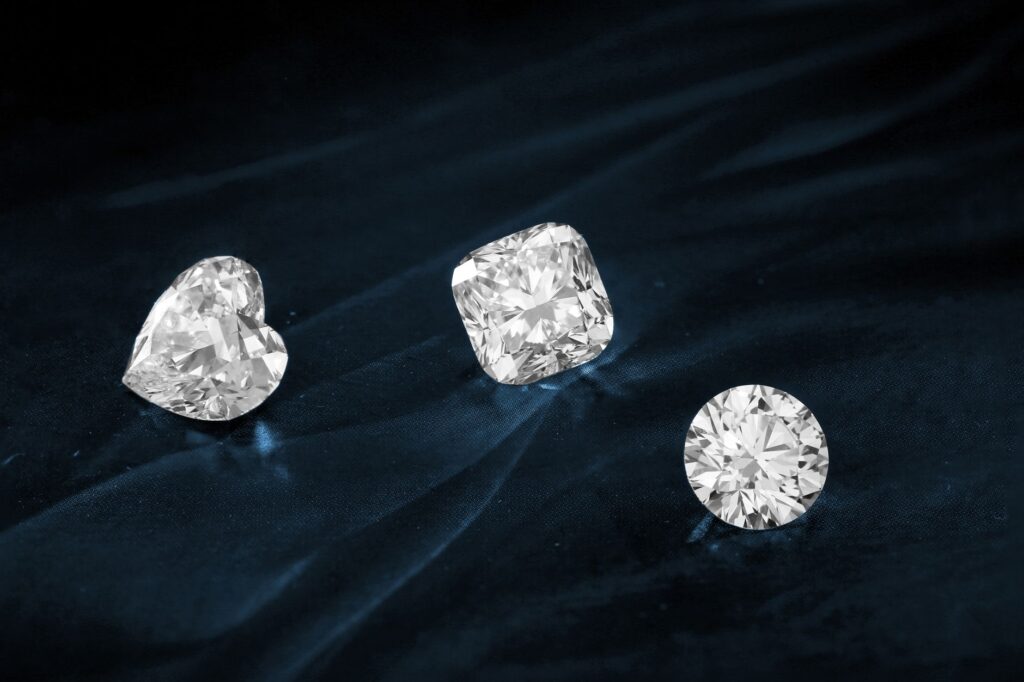
Shape has a major effect on how large a diamond appears. Elongated shapes such as oval, pear, marquise, and emerald often look larger per carat than round or square shapes because they cover more length across the finger.
Round diamonds are popular because of their sparkle and balanced appearance, but they usually do not maximize visual spread as efficiently as some elongated shapes. Cushion and princess cuts can vary widely depending on their proportions, so shape alone does not guarantee a larger look.
| Shape | Typical visual effect | Buyer note |
|---|---|---|
| Round | Balanced, classic appearance | Strong sparkle, but not always the largest face-up look per carat |
| Oval | Often looks larger than round | Elongated outline can create more finger coverage |
| Pear | Lengthens the look of the stone | Can appear larger, especially in slim settings |
| Marquise | Very strong spread for its weight | Can maximize size but may be less common |
| Cushion | Can look smaller or larger depending on cut | Proportions matter a lot |
| Emerald | Broad, elegant face-up look | Less sparkle, more emphasis on clarity and outline |
Cut quality
Cut quality is one of the most important factors affecting how large a diamond appears. A well-cut diamond reflects light efficiently and can look brighter and more lively, which helps it stand out on the hand. A poor cut may make a diamond appear smaller, duller, or less attractive even if the carat weight is high.
This is why a skilled buyer often prioritizes cut before chasing a higher carat number. In many cases, a well-cut smaller diamond looks better than a larger diamond with weaker proportions.
Depth and proportions
Depth is the distance from the top of the diamond to the bottom. A deeper stone carries more weight below the visible surface, which can reduce face-up spread. A shallower stone may look larger, but if it is too shallow, it can lose sparkle or face durability problems in the setting.
The goal is not simply the shallowest possible diamond. The goal is a balanced stone that has good light performance and solid visible spread.
Setting design
The setting can change the diamond’s perceived size more than many buyers expect. A thin solitaire band can make the center stone look larger, while a thick shank or a halo setting creates a different visual effect. Halos can make the center appear bigger by surrounding it with smaller accent diamonds, though the actual center stone is still the same size.
Prongs, bezels, basket height, and metal color also matter. A lighter, cleaner setting often lets the diamond dominate the visual field more effectively.
Finger size and hand proportions
Finger size plays a practical role in how large a diamond looks. A 1 carat round diamond usually covers more of a size 4 finger than a size 7 finger. That does not mean one person is getting a better diamond, only that the visual context changes.
Hand proportions also influence the result. Longer fingers can make a diamond look slightly smaller, while shorter fingers may make the same stone appear more prominent.
Real-World Size Examples
1 carat on a size 4 finger
On a smaller finger, a 1 carat round diamond often has a noticeable, balanced presence. It may cover a meaningful portion of the finger without looking oversized. For many buyers, this falls into a sweet spot where the diamond feels substantial but still proportionate.
In an oval or marquise shape, the same 1 carat can look even larger because the outline stretches lengthwise.
1 carat on a size 7 finger
On a larger finger, a 1 carat diamond can look more modest. It will still be clearly visible and attractive, but it may not have the same finger coverage it would on a smaller hand. Some buyers are satisfied with that scale, while others prefer a larger look and may consider 1.25 carat or 1.50 carat.
This is where knowing your own proportions becomes useful. Size preferences are not just about budget, they are also about how the diamond fits the wearer’s hand.
2 carat oval vs. 2 carat round
A 2 carat oval diamond often appears larger than a 2 carat round because of its elongated shape. The oval spreads the weight across a longer outline, which can create more visible surface area. A 2 carat round may have a more symmetrical and classic appearance, but it typically does not maximize spread in the same way.
That said, round diamonds often command higher pricing because of demand and cutting style. So the visual difference should be weighed against the market difference.
0.90 carat vs. 1 carat
This is one of the most common buying comparisons. Visually, the difference is often subtle, especially once the stone is set. Price, however, can jump because 1.00 carat is a widely recognized threshold.
In practical terms, a well-cut 0.90 carat diamond may offer nearly the same visual presence as a 1 carat diamond at a lower price. Buyers focused on value often consider this range carefully.
1.50 carat vs. 2 carat
This comparison is more visible than the 0.90 to 1 carat jump, but it still may not look as dramatic as the price suggests. The 2 carat diamond will generally show more finger coverage and a stronger presence. The question is whether that extra size is worth the often significant cost increase.
For some buyers, the answer is yes because the visual difference is meaningful. For others, the added cost is better spent on better cut quality or a more flattering shape.
Price vs Visual Benefit
Why prices rise faster than size
Diamond pricing is not linear. Larger diamonds are rarer, so the price per carat increases as size increases. This is especially true around popular thresholds like 1 carat, 1.50 carat, 2 carat, and 3 carat.
These popular thresholds are often called magic sizes. Our guide to why diamond prices jump at magic sizes explains why crossing a seemingly small weight boundary can create a much larger price increase than the visible size difference suggests.
As a result, a diamond may become much more expensive even when the visible size increase is modest. This is one of the central realities behind How Diamond Carat Affects Price.
Diminishing returns
At a certain point, each added fraction of a carat gives a smaller visual gain relative to the money spent. That is what buyers mean when they talk about diminishing returns. The jump from 0.70 to 0.90 carat may be easier to see than the jump from 1.90 to 2.10 carat, yet both can create meaningful price movement.
Understanding diminishing returns helps buyers decide whether they care more about the number on paper or the look on the hand.
Natural and lab grown diamond pricing
Lab grown diamonds change the size conversation because they are usually more affordable at the same carat weight. That means some buyers can choose a larger lab grown diamond within the same budget that would only allow a smaller natural diamond. The practical result is more flexibility around size, cut, and shape.
Still, size should not be the only consideration. Lab grown diamonds generally do not hold resale value in the same way some buyers expect from natural diamonds, and pricing can vary by quality, certification, and market conditions. A larger lab grown diamond can be a strong value choice for visual impact, but it should still be evaluated carefully.
Who Should Size Up
Buyers who want strong visual presence
Some buyers simply want the diamond to make a noticeable statement on the hand. For them, a larger carat weight may be worth paying for because the visual effect matters more than maximizing price efficiency. This is especially common in rings where the center stone is the main design feature.
In these cases, shape and setting can still help maximize the impression, but a higher carat weight may be the easiest path to the desired look.
Buyers shopping for smaller fingers
For smaller ring sizes, even moderate carat weights can look substantial. If a buyer wants more finger coverage, sizing up may create a proportion that feels balanced and elegant. The exact target depends on the person’s style and hand shape.
It is often useful to compare carat weight alongside actual ring size rather than in isolation.
Buyers who prefer a bolder design aesthetic
Some ring styles look better with more visual weight in the center stone. Vintage-inspired, halo, and three-stone designs can all pair well with larger carat weights. In those cases, the diamond is part of a wider design composition, not just a standalone stone.
If a buyer wants the diamond to anchor the entire ring, sizing up can make sense visually.
Who Can Save Money
Buyers who are open to near-threshold weights
Choosing a diamond just below a popular carat mark can save money without creating a noticeable visual compromise. A 0.90 carat diamond, for example, often looks very similar to a 1 carat diamond once set. The same idea can apply at other thresholds.
This approach is common among value-focused buyers who want the appearance of size without paying extra for a rounded number.
If getting the strongest balance of visible size, cut quality, and price is your priority, our guide to the best value lab grown diamonds highlights options designed for buyers who want more visual impact without paying mainly for premium grade labels or milestone carat numbers.
Buyers willing to choose a shape that spreads well
Some shapes offer more visible spread for the same budget. Oval, pear, and marquise diamonds often provide a larger face-up look per carat than a round diamond. If the goal is size appearance, shape can be one of the smartest ways to save money.
This does not mean those shapes are better in every case. It means they may be more efficient for buyers prioritizing visible size.
Buyers who care more about cut quality than weight
A smaller but well-cut diamond may look better than a larger diamond with poor proportions. Buyers who understand this often choose to hold the carat weight down slightly in exchange for stronger light performance and a more attractive overall look.
That trade-off can be especially sensible when the stone is being viewed daily in normal lighting conditions.
Common Buyer Mistakes
Chasing the carat number alone
One of the biggest mistakes is assuming that a larger carat number automatically means a better-looking diamond. It does not. Cut quality, shape, and spread matter just as much, and sometimes more.
A smart purchase focuses on the diamond’s overall appearance, not just the weight label.
Ignoring measurements
Skipping millimeter dimensions is risky. Measurements tell you how the diamond is actually shaped and how much surface area it covers. Two diamonds with the same weight can differ enough in spread that one looks clearly larger.
For buyers comparing options, this is one of the most useful pieces of information to request.
Overlooking finger size
Carat comparisons often fail when finger size is ignored. A diamond that feels large on one hand may feel moderate on another. That is why it is helpful to think about carat weight in the context of the wearer’s actual ring size.
Someone shopping for a proposal ring should consider proportions carefully rather than relying on online photos alone.
Overpaying for magic sizes
Popular thresholds can carry price premiums because many buyers want a round number. The difference between 0.95 and 1.00 carat may be visually small but financially meaningful. The same pattern appears around other milestones as well.
Buyers who understand this can often get a better-looking diamond by stepping just below the threshold and using the savings for higher cut quality or a better setting.
Choosing size over performance
Some shoppers push for a larger diamond while sacrificing cut quality, color, or clarity. That can be a poor trade if the stone loses brilliance or shows visible issues. A bigger diamond that looks dull is usually less satisfying than a slightly smaller diamond with stronger sparkle.
Visual performance should remain part of the size decision.
Frequently Asked Questions
Does a higher carat diamond always look much bigger?
No. It usually looks larger, but the increase can be smaller than expected. Cut, shape, and proportions all affect how much of that weight translates into visible size.
Is a 1 carat diamond considered large?
For many buyers, 1 carat is a meaningful and well-recognized size. Whether it looks large depends on the shape, setting, and finger size. On some hands it looks prominent, while on others it appears more moderate.
Why does a deep diamond look smaller?
A deep diamond carries more of its weight below the top surface. That reduces the visible spread, so it can appear smaller from above even though it weighs the same as another diamond.
Which diamond shapes look biggest per carat?
Elongated shapes such as oval, pear, and marquise often look larger per carat because they spread across more of the finger. Emerald cuts can also appear broad, though their visual character is different because they emphasize shape and clarity more than sparkle.
Is 0.90 carat a smart alternative to 1 carat?
Often, yes. The visible difference may be small, especially in a well-cut stone. If price efficiency matters, 0.90 carat can be a practical choice.
Do lab grown diamonds make it easier to choose a larger size?
Yes, usually. Lab grown diamonds often allow buyers to choose more carat weight for the budget. That can be helpful if visible size is a priority, but the diamond still needs to be evaluated for cut, certification, and overall quality.
Should I pay more for a bigger diamond or better cut?
In many cases, better cut offers more visual value than a modest size increase. A well-cut diamond tends to look brighter and more attractive. If the budget is limited, many experienced buyers would choose cut first and then carat weight.
Can settings make a diamond look bigger?
Yes. Thin bands, halos, and certain mounting styles can increase perceived size. The setting does not change the actual carat weight, but it can strongly influence how large the diamond appears on the hand.
Conclusion
Carat weight affects both price and appearance, but not in a simple one-to-one way. A larger diamond usually costs more, yet the visual gain may be smaller than the price jump suggests. That is why understanding face-up size, measurements, shape, cut, and finger proportions is so important.
For buyers trying to judge how large a diamond will actually look, the most useful approach is to compare carat weight with millimeter spread and overall design. In many cases, a well-cut diamond just below a major threshold offers stronger value than a slightly larger stone with less favorable proportions.
Whether the goal is maximum finger coverage, balanced everyday wear, or the best value for a given budget, the right decision comes from looking beyond the carat number alone. That is the clearest way to understand how diamond size really translates into real-world appearance.