Choosing between a pear and marquise diamond is often less about which shape is “better” and more about which one fits your style, hand shape, ring design, and comfort with maintenance. Both shapes are elongated, which means they can create a larger look than a round diamond of the same carat weight. Both can also be attractive choices for engagement rings, pendants, and other fine jewelry.
That said, Pear vs Marquise Cut Diamonds are not interchangeable. They have different silhouettes, different sparkle patterns, and different durability concerns. Understanding those differences can make it much easier to choose a shape that looks intentional and wears well in daily life.
Quick Answer
The main difference between pear and marquise diamonds is their outline. A pear diamond has one rounded end and one pointed end, while a marquise diamond has two pointed ends and a slim, football-like shape.
Pear diamonds tend to look softer and more romantic. Marquise diamonds often appear more dramatic and elongated, with a stronger vintage feel. In practical buying terms, both shapes can face up large for their carat weight, but both need careful proportion choices to avoid visual issues such as a visible bow tie or an awkward outline.
If you want a softer silhouette and a shape that is easy to pair with many ring styles, pear may be the better fit. If you want maximum elongation and a bolder look, marquise may be more appealing. The right choice depends on the look you want, how the stone will be worn, and how much emphasis you place on durability and finger coverage.
Understanding Pear and Marquise Diamonds
What is a pear cut diamond?
A pear diamond, sometimes called a teardrop shape, combines a rounded end and a pointed tip. It is a hybrid of the round brilliant and marquise outline, which is why it often feels balanced between soft curves and a sleek profile.
Pear shapes are usually worn with the point facing either up or down, depending on the design. In engagement rings, many people prefer the point facing toward the fingertip because it can visually lengthen the finger. Others prefer the point inward for a more unusual or protective setting style.
What is a marquise cut diamond?
A marquise diamond has an elongated shape with pointed ends on both sides. The shape is believed to have originated from a royal commission in French history, and it has long been associated with a vintage, elegant look.
Because of its narrow outline, a marquise diamond can look larger than many other shapes of the same weight. It also creates a strong lengthening effect on the finger. However, the two pointed ends can be more vulnerable to chipping if the stone is not well protected by the setting.
Key Differences Between Pear and Marquise Diamonds
When comparing these two shapes, it helps to look at the practical characteristics that affect appearance and wear. The table below highlights the most important differences for buyers.
| Feature | Pear Diamond | Marquise Diamond |
|---|---|---|
| Overall shape | One rounded end, one pointed end | Two pointed ends, elongated oval-like outline |
| Style impression | Soft, graceful, romantic | Dramatic, vintage, elongated |
| Finger effect | Can lengthen the finger with a gentler look | Strongly lengthens the finger |
| Face-up size | Appears large for its weight, especially in longer ratios | Often appears even larger for its weight because of the narrow shape |
| Durability concerns | Pointed tip needs protection | Both tips need protection |
| Bow tie risk | Can show bow tie depending on proportions | Can show bow tie, often more noticeably in some stones |
| Setting flexibility | Works well in many modern and classic settings | Often needs thoughtful setting design to protect tips |
| Fashion appeal | Broad appeal, slightly more mainstream | More distinctive, often chosen for a statement look |
Appearance and Visual Performance
How pear diamonds look on the hand
Pear diamonds create a graceful line on the finger. The rounded end softens the look, while the point adds direction and length. This shape often feels elegant without being too geometric, which is part of why it appeals to buyers who want something different from a round diamond but not overly sharp or angular.
The visual balance of a pear diamond depends heavily on its proportions. A well-cut pear should look symmetrical, with the rounded side and pointed side aligned neatly. If the shape is too wide, it can look bulky. If it is too long and narrow, it may look delicate but lose some visual presence.
How marquise diamonds look on the hand
Marquise diamonds are known for their dramatic length. The pointed ends draw the eye along the finger, which can create a very elongating effect. This is one reason the shape often looks larger than expected for its carat weight.
The marquise style is more angular in appearance than pear. Because the shape narrows at both ends, it tends to feel bolder and more architectural. Some buyers love that striking presence, while others find it less soft than a pear shape.
Sparkle, brilliance, and fire
Both pear and marquise diamonds are usually cut in brilliant style, which means they are designed to return light in a lively, sparkly pattern. Brilliance refers to white light return, while fire refers to the flashes of colored light you see when the diamond moves. Scintillation is the pattern of sparkle and contrast that appears as the stone moves under light.
Because both shapes are elongated and have pointed ends, their sparkle patterns are less uniform than a round brilliant. That is not a flaw. It is simply a result of the geometry of fancy shapes. The viewer often sees a combination of bright center flashes, edge reflections, and contrast zones rather than the tightly symmetrical sparkle pattern associated with round diamonds.
In both pear and marquise diamonds, cut quality matters a great deal. A well-proportioned stone will usually look brighter and more balanced. Poor proportions can lead to dark areas, uneven reflection, or a distracting bow tie effect across the center.
Understanding the bow tie effect
The bow tie effect is a dark area that can appear across the center of some elongated diamonds. It happens because of how the stone is cut and how light travels through the facets. This is common in pear and marquise diamonds, although the severity varies from stone to stone.
A slight bow tie is normal and often not bothersome. A strong bow tie, however, can make the center of the diamond look dark or dull in certain lighting. When comparing stones, it is better to view them in person or ask for clear videos because grading reports do not measure bow tie appearance.
Pros and Cons of Pear Diamonds
Advantages of pear diamonds
- Elegant and versatile look. Pear diamonds suit classic, modern, and vintage-inspired designs.
- Softens the hand. The rounded end creates a gentler silhouette than many other fancy shapes.
- Good finger coverage. The elongated shape can make the stone appear larger than a round diamond of similar weight.
- Many setting options. Pear diamonds can work in solitaires, halos, three-stone rings, and pendants.
- Popular but not overly common. The shape feels distinctive without being too unusual for many buyers.
Disadvantages of pear diamonds
- Pointed tip needs protection. The narrow end is vulnerable if left exposed.
- Can show asymmetry more easily. Since the shape is not perfectly symmetrical in the same way as a round diamond, proportion issues are more noticeable.
- Bow tie can be visible. Some pears show a darker center area depending on cut.
- Orientation matters. The way the stone is set affects its appearance and how secure it feels.
Pros and Cons of Marquise Diamonds
Advantages of marquise diamonds
- Strong finger-lengthening effect. The shape creates a long, elegant line.
- Excellent face-up size. Marquise diamonds often look large for their carat weight because they spread across the finger.
- Distinctive style. The shape stands out more than many standard round or oval stones.
- Vintage appeal. Marquise diamonds have a classic look that works well in retro-inspired or elongated designs.
Disadvantages of marquise diamonds
- Both ends are vulnerable. The pointed tips need careful setting protection.
- Bow tie can be more noticeable. A poorly cut marquise may show a dark center area.
- Style can feel bold. Some buyers prefer a softer shape and may find marquise too dramatic.
- Proportions matter a lot. Small changes in length-to-width ratio can significantly affect appearance.
How Proportions Affect Appearance
For fancy shapes, proportions are just as important as carat weight. Two diamonds with the same weight can look very different if one is cut too wide, too narrow, or too deep. That is especially true for pear and marquise diamonds, where shape is a major part of the appeal.
Length-to-width ratio
The length-to-width ratio describes how long a diamond is compared with its width. A higher ratio usually means a more elongated shape. A lower ratio creates a broader look.
For pears, many buyers prefer a balanced ratio that feels elegant without looking too skinny or too plump. For marquise diamonds, a slightly longer ratio is common because elongation is part of the shape’s identity. Still, excessively narrow stones can look fragile or less substantial in person.
Why ratio matters for buyers
Ratio affects both style and practicality. A more elongated diamond can make fingers appear slimmer and longer. It can also fit certain settings better, especially narrow solitaires or east-west designs.
But a ratio that looks appealing in a chart may not look ideal in real life if the stone has a weak outline or visible bow tie. This is why videos and side-by-side comparisons matter more than numbers alone when choosing between pear and marquise diamonds.
Durability and Daily Wear
Durability is a practical issue that buyers sometimes overlook when comparing diamond shapes. Diamonds are very hard, but their pointed areas can still chip if they receive a hard impact. This matters especially in rings worn every day.
Pear durability considerations
In a pear diamond, the pointed tip is the most vulnerable area. A protective prong or bezel-style detail can help reduce risk. If the point is exposed, it may be more likely to catch on clothing or get damaged during active wear.
The rounded end of a pear is generally less vulnerable, which gives the shape a mix of strength and sensitivity. For daily wear, the setting should secure the point without hiding the shape entirely.
Marquise durability considerations
Marquise diamonds need protection on both ends. Because there are two pointed tips, there are two areas that can chip if the setting is too open or if the ring is worn roughly. This does not make marquise diamonds unsuitable for engagement rings, but it does make setting design more important.
Protective prongs are common for marquise stones. Some buyers also choose settings that slightly cushion the ends without making the stone look too bulky. The goal is to preserve the shape while reducing the chance of damage.
Which Shape Looks Bigger?
Both shapes can look larger than a round diamond of the same weight, but marquise diamonds often have the strongest spread advantage. Because the shape extends farther across the finger, it can create a larger face-up appearance.
Pear diamonds also tend to face up well, especially in a balanced length-to-width ratio. They may not create quite the same dramatic spread as a marquise, but they often look substantial because of their broad rounded end and elongated body.
It is important to distinguish between face-up size and actual carat weight. Face-up size is how large the diamond appears from above, while carat weight is a measure of mass. Fancy shapes can make smart use of carat weight, but a shallow or too-thin stone may sacrifice sparkle or durability to achieve a larger look.
How Color and Clarity Show Up in Pear vs Marquise Diamonds
Color visibility
Elongated shapes can show color differently than round diamonds. In both pear and marquise diamonds, color may be more visible near the pointed ends or in the body of the stone, depending on cut and lighting. This is why some buyers notice that a diamond that looks nearly colorless in a report may still show warmth in person.
If you want a bright white look, color grade becomes more important as the stone gets larger. This is especially relevant in lab grown diamonds, where larger sizes are often more accessible within budget. Buyers can sometimes choose a higher color grade without moving dramatically up in price, which can be useful in elongated shapes.
Clarity visibility
Clarity is the measure of internal characteristics and surface features called inclusions and blemishes. In pear and marquise diamonds, clarity visibility can vary depending on where the inclusions are located and how the stone is cut.
Because these shapes have broad reflective areas and pointed ends, certain inclusions may be easier to notice if they sit near the center or in a large open area. That said, many inclusions are not visible to the naked eye, especially in well-cut stones. A buyer looking at a diamond should focus on whether the imperfections are visible face-up, not just the grade on paper.
Pear vs Marquise Diamonds: Which Has Better Sparkle?
Neither shape automatically has better sparkle. Sparkle depends on cut quality, proportions, and how the facets interact with light. A high-quality pear can be more appealing than a poorly proportioned marquise, and vice versa.
That said, some buyers perceive pears as having a softer, more fluid sparkle because of the rounded end. Marquise diamonds can create a more dramatic flashing pattern due to their pointed symmetry and strong outline. In both cases, the sparkle is influenced by how the diamond was cut to balance brilliance, fire, and contrast.
When evaluating sparkle, do not rely only on shape preference. Ask whether the stone is lively in different lighting conditions, whether the bow tie is distracting, and whether the outline feels balanced on the hand.
How Each Shape Works in Engagement Rings
Pear diamonds in engagement rings
Pear diamonds work well in many engagement ring styles. They are often chosen for solitaire rings because their shape can stand on its own, but they also look good with halos, side stones, and three-stone designs.
One practical benefit of the pear shape is flexibility in orientation. The point can face toward or away from the fingertip. That gives jewelers and buyers some room to tailor the ring to the wearer’s hand and style preferences.
Marquise diamonds in engagement rings
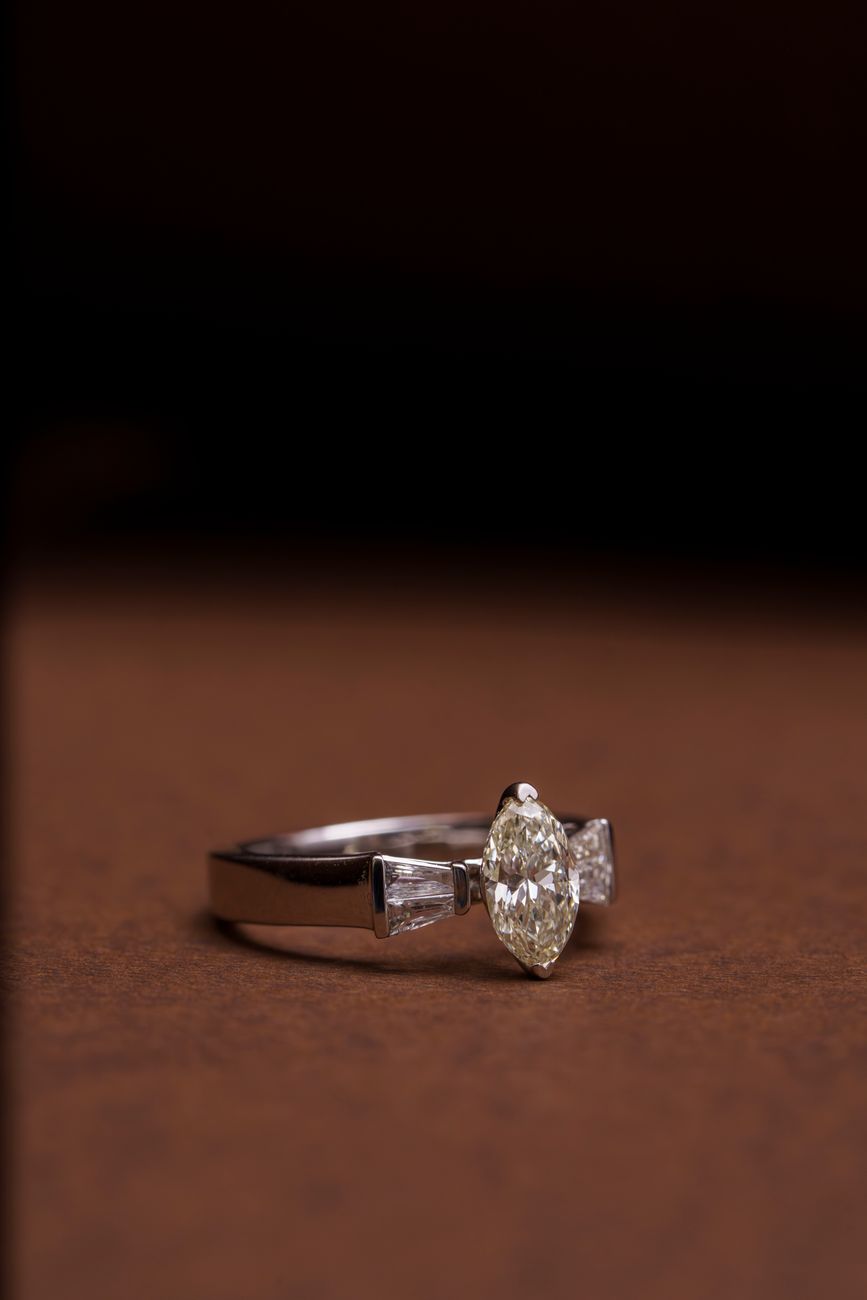
Marquise diamonds create a bold, elegant look in engagement rings. They can be striking as the center stone in a solitaire or paired with tapered side stones to echo the elongated form. They also work well in vintage-inspired designs, where their dramatic shape complements decorative metalwork.
Because the shape is so long and narrow, the setting matters more than it might for other shapes. A marquise that is too exposed can be vulnerable at the tips. A well-designed setting can improve both security and visual balance.
East-west settings and orientation choices
Some buyers like to wear elongated shapes horizontally in an east-west setting. Pear diamonds can look especially modern this way, depending on the ring style. Marquise diamonds can also be used east-west, although the result is more unusual and fashion-forward.
Orientation changes the personality of the shape. A traditional north-south setting emphasizes elongation, while an east-west layout creates a more contemporary look. If you are comparing pear vs marquise for a ring, the setting direction can matter almost as much as the shape itself.
Popularity and Style Trends
Pear diamonds have remained relatively popular because they feel distinctive without being too unconventional. They often appeal to buyers who want a shape that looks elegant, flattering, and a little different from the mainstream.
Marquise diamonds have also seen renewed interest, especially among buyers who like vintage design, celebrity-inspired styling, or bold minimalist jewelry. The shape is less common than pear in many retail settings, which can make it feel more unique.
That said, popularity should not be the only factor. A trendy shape that does not suit your hand or your lifestyle may not feel satisfying long term. A shape with quieter appeal but better proportions and better wearability may be the better buy.
Value Considerations
When people ask about value, they often mean two different things. One is purchase value, meaning what you get for the money today. The other is resale value, meaning how much the stone might be worth later.
In terms of purchase value, both pear and marquise diamonds can be attractive because they often provide a large-looking stone for the price of the carat weight. This is especially helpful for buyers comparing options in the lab grown diamond market, where shape, size, and quality can often be balanced more easily within budget.
In terms of resale value, buyers should be cautious. Fancy shapes generally do not hold resale value in the same way as many people expect, and marquise can be especially style-dependent. Pear diamonds tend to have broader appeal than marquise in some markets, but neither shape should be purchased mainly for investment purposes.
Lab Grown Diamonds and Pear vs Marquise Shapes
Lab grown diamonds are a practical option for both pear and marquise shapes because they can make larger or higher-quality stones more accessible. Since elongated shapes already look larger than many other cuts, lab grown diamonds can be a particularly efficient choice for buyers who want more visual size without moving far up the budget ladder.
This does not mean every lab grown pear or marquise is a better purchase than a natural stone. The right choice depends on your preferences, budget, and whether you value origin, rarity, or size and quality for the price. Lab grown diamonds should still be assessed for cut quality, color, clarity, and certification just like any other diamond.
For buyers comparing options, it is worth reviewing educational resources on diamond cut grades, diamond color grades, and diamond clarity grades before deciding on a shape. Shape is only one part of the overall diamond picture.
Important Buying Considerations
1. Prioritize proportions, not just carat weight
A larger carat weight does not automatically mean a better-looking pear or marquise diamond. If the proportions are off, the stone may look dull, too narrow, too wide, or unbalanced. Since fancy shapes are highly visual, shape quality matters at least as much as the number on the scale.
2. Ask for visual confirmation of the bow tie
Bow tie is one of the biggest visual issues in elongated diamonds. It is often difficult to judge from a grading report alone. Videos in natural lighting or direct in-person viewing are far more useful than relying only on measurements.
3. Choose a setting that protects the tips
This is especially important for marquise diamonds, but it also applies to pears. Protective prongs can help prevent chips and can make the stone feel more secure in everyday wear. A setting that ignores the tips may save metal work, but it can increase the risk of damage.
4. Think about how you will wear the ring
If you use your hands a lot at work or during sports and hobbies, durability and comfort may matter more than a dramatic silhouette. A pear or marquise can still be a good choice, but the ring should be designed with daily wear in mind.
5. Compare the stone in different lighting
Fancy shapes can look very different under office lighting, daylight, and indoor warm light. A diamond that appears lively in one environment may show more darkness or contrast in another. This is part of why buyers should look beyond static photos whenever possible.
6. Use certification as a starting point, not the final answer
A grading report from a respected lab helps confirm the diamond’s details, but it will not tell you everything about appearance. Reports do not fully capture bow tie visibility, outline balance, or how attractive a specific pear or marquise looks in person. For more context, buyers should review a diamond certification guide alongside the stone itself.
Common Mistakes Buyers Make
- Choosing by carat alone. A heavy stone can still look awkward if the proportions are poor.
- Ignoring the bow tie. Many buyers focus on size and forget to check how dark the center appears.
- Overlooking tip protection. Both shapes need secure settings, especially for engagement rings.
- Assuming all pears or marquises look alike. Small proportion changes can make a large visual difference.
- Buying from photos only. Screenshots can hide symmetry issues and lighting problems.
- Expecting resale to be strong. Fancy shapes should be purchased for enjoyment, not as a financial strategy.
Who Each Shape Is Best For
Pear diamonds may suit buyers who want:
- a softer, more romantic shape
- an elegant look with broad styling versatility
- a diamond that lengthens the finger without looking too sharp
- a shape that works well in both classic and modern ring settings
Marquise diamonds may suit buyers who want:
- the strongest elongated look
- a bold, distinctive shape with vintage character
- excellent finger coverage for the carat weight
- a diamond that feels less common than round, oval, or pear
How to Choose Between Them
If you are torn between pear and marquise, it helps to ask a few simple questions. Do you want a softer curve or a sharper, more dramatic profile? Do you want a shape that feels romantic, or one that feels more architectural? Will the ring be worn every day, or only occasionally?
In many cases, pear is the easier shape for first-time buyers because it offers a balanced mix of elegance and familiarity. Marquise can be the more striking option, especially if the wearer likes a bold look and is comfortable with a setting that protects the tips. Neither is universally better. The best choice depends on how the shape will look on the hand and how well it fits the wearer’s lifestyle.
For buyers considering engagement rings, it is also worth comparing these shapes with other elongated options such as oval, emerald, and radiant cuts. Each shape handles light, size perception, and durability a little differently. A broader comparison can be helpful if you are still narrowing down your list of diamond shapes.
Frequently Asked Questions
Do pear diamonds or marquise diamonds look bigger?
Marquise diamonds often look bigger because they extend farther across the finger. Pear diamonds also look large for their weight, but marquise usually has the stronger spread effect. Visual size still depends on proportions and cut quality.
Which shape is more durable for everyday wear?
Neither is the most durable shape overall because both have pointed areas. Pear diamonds have one pointed tip to protect, while marquise diamonds have two. With a secure setting, either can work for everyday wear, but marquise usually needs more careful tip protection.
Which has more sparkle, pear or marquise?
Sparkle depends more on cut quality than on shape. Both are brilliant-style cuts and can be very lively when well made. A well-cut pear may look softer and more fluid, while a well-cut marquise may show stronger contrast and dramatic flashes.
Is bow tie more common in pears or marquises?
Bow tie can appear in both shapes, but it is often something buyers notice more in marquise diamonds because of the shape’s narrow center. Some bow tie is normal in fancy shapes. The key is whether it is subtle or distracting.
Which shape is better for a lab grown diamond?
Neither shape is inherently better for lab grown diamonds. However, lab grown stones can make larger pears and marquises more accessible within budget. That can be helpful if you want a substantial-looking diamond without moving too high in carat weight or price.
Are pear diamonds or marquise diamonds more trendy?
Pear diamonds are generally more mainstream today, while marquise diamonds feel more distinctive and fashion-driven. Trends change over time, so it is better to choose the shape that fits the wearer’s style rather than relying only on popularity.
Can a pear or marquise diamond be set east-west?
Yes. Pear diamonds can be especially interesting in east-west settings, and marquise diamonds can also be placed horizontally for a modern look. The setting changes the visual effect significantly, so it should be planned with the shape in mind.
Conclusion
When comparing Pear vs Marquise Cut Diamonds, the choice comes down to silhouette, wearability, and personal style. Pear diamonds offer a softer teardrop shape with broad versatility. Marquise diamonds create a bolder, more dramatic outline with a strong lengthening effect.
Both shapes can look larger than their carat weight suggests, and both can perform well when the cut is balanced and the setting protects the pointed end or ends. Both also require more careful evaluation than a round diamond because proportions, bow tie, and orientation have a noticeable effect on appearance.
For buyers who want a graceful, adaptable shape, pear is often the easier fit. For buyers who want maximum elongation and a more distinctive presence, marquise may be the better match. The most practical next step is to compare well-cut examples side by side, review certification details, and pay close attention to how the stone actually looks in real light.