When shoppers ask what is the best ratio for marquise diamonds, they are usually trying to answer a more practical question. How long should the stone look, how balanced should it appear, and what ratio creates the most attractive shape on a ring finger?
The short answer is that there is no single best ratio for every marquise diamond. Most buyers find that a ratio between 1.85 and 2.10 looks balanced and elegant, while ratios from about 1.75 to 2.25 can still be very appealing depending on personal style and the stone’s overall proportions. The best ratio is the one that matches the visual look you want, the setting you plan to use, and the size of the diamond itself.
Marquise diamonds are highly shape-sensitive, which means small changes in proportions can noticeably change the way they look. A slightly longer ratio can create a slimmer, more dramatic appearance. A slightly shorter ratio can look fuller and less pointed. Because of this, buyers should think about ratio as part of the diamond’s overall face-up appearance, not as a number to judge in isolation.
What a marquise diamond ratio actually means
Diamond ratio is the relationship between a stone’s length and width. For marquise diamonds, this is usually written as length divided by width. For example, a marquise that measures 12 mm long and 6 mm wide has a ratio of 2.0, because the length is twice the width.
This number matters because marquise diamonds are elongated by design. Unlike round diamonds, where symmetry is judged differently, the ratio in a marquise strongly affects how slender, bold, delicate, or balanced the stone appears. A minor difference in ratio can make the diamond feel noticeably different on the hand.
Ratio should also be considered alongside the diamond’s cut quality, outline symmetry, and the presence of a bow tie effect. A great ratio cannot fully compensate for poor shape appeal, and a slightly outside-average ratio can still look excellent if the overall proportions are strong.
Quick answer: the best ratio for marquise diamonds
If you want the most broadly flattering and versatile look, aim for a ratio around 1.85 to 2.10. This range is often considered the sweet spot because it usually creates a graceful elongated shape without making the diamond look overly narrow.
Here is a simple way to think about it:
- 1.75 to 1.85 gives a slightly fuller, wider marquise look.
- 1.85 to 2.10 is the most balanced and commonly preferred range.
- 2.10 to 2.25 creates a longer, slimmer, more dramatic outline.
There is no universally correct answer because the ideal ratio depends on finger shape, ring style, and whether you want the stone to look soft and elegant or long and striking. Buyers comparing marquise diamonds should always evaluate the ratio in person or with high-quality images and videos whenever possible.
Why marquise ratio matters more than it does for many other shapes
Marquise diamonds are one of the most proportion-dependent diamond shapes. Their elongated body and pointed ends make them visually sensitive to balance. If the stone is too short, it can look stubby. If it is too long, it can look narrow or stretched.
This sensitivity is one reason marquise diamonds can look either exceptional or awkward depending on the cut. Two diamonds with the same carat weight can have very different visual impressions if one has a balanced ratio and the other has proportions that feel too compressed or too extended.
Ratio also influences how the diamond fills space on the finger. Many shoppers want a marquise because it can appear larger than some other shapes of the same weight. A well-proportioned ratio helps maximize that effect without making the stone look thin or fragile.
How marquise ratios affect appearance
Lower ratios: fuller and wider-looking
A marquise with a lower ratio, such as 1.75 or 1.80, will appear a little shorter and broader. Some buyers prefer this because it feels softer and less sharp. It can also look substantial on smaller hands or in settings where the diamond is paired with side stones.
The trade-off is that lower ratios may not deliver the same long, elegant silhouette that many people associate with the marquise shape. If the ratio drops too low, the diamond may begin to lose the classic marquise identity and can look more compressed.
Mid-range ratios: balanced and classic
Ratios around 1.90 to 2.05 are often considered the most classic for marquise diamonds. These proportions usually create the familiar stretched oval-like form with pointed ends that feels refined but not excessive.
This range tends to work well for engagement rings because it looks graceful on the hand and usually suits many ring settings. It is also a practical choice for buyers who want a shape that feels timeless rather than strongly trend-driven.
Higher ratios: dramatic and elongated
Ratios above 2.10 create a longer and slimmer look. Some buyers love this because it makes the diamond appear elegant and distinctive. A more elongated marquise can also make fingers look longer and slimmer.
The downside is that very high ratios may make the stone feel narrow, especially in smaller carat sizes. A ratio that is too high can also make end points seem more exposed, which matters for durability and ring design.
What is the ideal marquise diamond ratio by carat weight?
The best ratio can shift slightly depending on the diamond’s carat weight. Smaller stones often benefit from a ratio that is not too long, because an overly elongated shape can look thin. Larger stones can usually support a higher ratio without losing visual presence.
| Carat size | Often flattering ratio range | What it tends to look like |
|---|---|---|
| Under 1.00 carat | 1.80 to 2.00 | Balanced and not overly narrow |
| 1.00 to 2.00 carats | 1.85 to 2.10 | Classic elongated marquise look |
| Over 2.00 carats | 1.90 to 2.20 | Elegant, dramatic, and finger-lengthening |
These are general guidelines, not rules. A smaller marquise can still look beautiful at a longer ratio if the cut is well executed, and a larger stone may look best with a more moderate ratio if the wearer prefers a fuller outline.
Length-to-width ratio versus overall cut quality
Many shoppers focus on ratio because it is easy to compare on paper. But ratio alone does not tell the full story. Two marquise diamonds with the same ratio can look very different if their points, shoulders, and facet pattern are not well aligned.
For marquise diamonds, overall cut quality affects whether the stone looks lively and well shaped. This includes how evenly the curves flow into the points, how centered the top and bottom are, and whether the diamond has a noticeable bow tie effect. The ratio should be evaluated together with those features.
In other words, ratio tells you how long or wide the diamond is. Cut quality tells you how well that shape is executed.
Appearance and visual performance of marquise diamonds
Brilliance and sparkle
Marquise diamonds are brilliant-cut shapes, which means they are designed to reflect a lot of light back to the eye. When proportions are strong, they can look lively and bright. The many facets help create sparkle across the stone’s surface.
That said, marquise diamonds can show uneven brightness if the cut is not well balanced. A poor arrangement of facets or an awkward ratio can make parts of the diamond look dark, especially near the center. This is why shoppers should not rely on ratio alone when judging sparkle.
Fire and flash
Fire refers to the rainbow flashes of light a diamond produces. Marquise diamonds can show attractive fire, especially when the stone is well cut and viewed under direct light. However, because marquise diamonds are elongated, their visual fire can sometimes be less uniform than that of a round diamond.
For most buyers, the bigger practical question is whether the diamond looks lively across its full shape. A marquise with a balanced ratio and strong facet pattern will usually appear more evenly bright than one that is too narrow or too short.
Scintillation and movement
Scintillation is the pattern of light and dark flashes you see when a diamond moves. Marquise diamonds can have beautiful scintillation, but they are also more sensitive to proportion issues. If the stone is too long or poorly cut, the ends may appear disconnected from the center, which weakens the visual rhythm.
A well-proportioned ratio tends to help the eye move smoothly along the length of the stone. That creates a graceful sense of motion, which is one of the main appeals of the marquise shape.
Bow tie effect
The bow tie effect is the dark area that can appear across the center of many elongated diamond shapes, including marquise diamonds. A little shadowing is common, but a strong bow tie can make the stone look less lively.
Ratio can influence how noticeable the bow tie appears, but it is not the only factor. Table size, crown angle, pavilion depth, and facet alignment all play a role. A very slim ratio may sometimes make the bow tie feel more pronounced, but a poorly cut medium-ratio stone can have the same problem.
Advantages of marquise diamonds
- They often look larger for their carat weight. The elongated outline spreads visual surface area across the finger.
- They create a finger-lengthening effect. Many buyers like how the shape visually elongates the hand.
- They have a distinctive look. The marquise stands out more than some of the most common shapes.
- They can suit many settings. Marquise diamonds work well in solitaire, halo, three-stone, and vintage-inspired designs.
- They can be a strong value choice. In some markets, marquise diamonds may cost less per carat than more in-demand shapes like round brilliants, though pricing depends on the full set of quality factors.
For buyers comparing shapes in a diamond buying guide, the marquise is often appealing because it offers a lot of visual presence. In the lab grown diamond market, this can be especially useful for shoppers who want a larger-looking center stone within a defined budget.
Disadvantages of marquise diamonds
- The pointed ends are vulnerable. They can chip more easily if not protected by prongs or a suitable setting.
- Cut quality is harder to judge by ratio alone. Buyers need to look carefully at proportions and symmetry.
- Bow tie issues are common. Some marquise diamonds show noticeable darkness in the center.
- They are less mainstream than round or oval diamonds. Some shoppers prefer more familiar shapes for long-term style comfort.
- Clarity and color can be more noticeable in some stones. The open shape and larger reflective areas may reveal issues depending on the diamond.
These drawbacks do not make marquise diamonds a poor choice. They simply mean that buyers need to pay attention to the diamond’s real-world appearance rather than only its grading report.
Who marquise diamonds are best for
Marquise diamonds are a good fit for buyers who want something elegant, elongated, and a little less common than the most traditional shapes. They are especially appealing to people who like a stone that makes the finger look longer and slimmer.
They can also be a smart option for shoppers who care about face-up size. Because of their shape, marquise diamonds may appear larger than other diamonds of the same carat weight. This is one reason they can be popular in both natural and lab grown diamonds, where buyers may be comparing size, value, and overall visual impact.
Marquise diamonds may be especially suitable for:
- buyers who want a distinctive but still classic shape
- people with shorter fingers who want a lengthening effect
- shoppers looking for a larger visual spread
- those who enjoy vintage-inspired or elegant ring designs
- buyers comfortable evaluating shape details carefully
How marquise compares to other popular diamond shapes
Understanding the best ratio for marquise diamonds is easier when you compare the shape with other elongated styles. The most common comparisons are oval, pear, and elongated cushion, since buyers often choose among these options when deciding on an engagement ring.
| Shape | General visual feel | Ratio sensitivity | Durability considerations | Common buyer appeal |
|---|---|---|---|---|
| Marquise | Elegant, pointed, dramatic | High | Pointed ends need protection | Finger-lengthening and larger face-up look |
| Oval | Soft, balanced, versatile | Moderate | No sharp points, easier daily wear | Classic elongated appearance with broad appeal |
| Pear | Teardrop, directional, distinctive | High | One pointed end needs protection | Fashion-forward and flattering on the hand |
| Elongated cushion | Soft corners, vintage feel | Moderate | Generally more protected corners | Soft sparkle and a romantic style |
Marquise versus oval
Oval diamonds are usually the closest comparison because both shapes are elongated. Ovals tend to look softer and more familiar to many buyers, while marquise diamonds look sharper and more directional because of their points.
In terms of ratio, ovals often have a broad acceptable range, but marquise diamonds are generally more sensitive. A marquise ratio that is too short or too long can feel obvious more quickly than a similar shift in an oval.
Marquise versus pear
Pear diamonds also have a pointed silhouette, but the shape is asymmetrical, with one rounded end and one pointed end. Pear shapes can look more fluid and organic, while marquise diamonds are symmetrical and more architectural.
Buyers who want a centered, balanced look often prefer marquise. Buyers who want a slightly more unique outline may prefer pear. In both cases, the quality of the outline matters more than any single measurement.
Marquise versus round brilliant
Round brilliants are the standard reference for sparkle and symmetry. They usually show the most consistent brilliance, and their pricing often reflects their strong demand. Marquise diamonds offer a different advantage, which is visual spread and a distinctive outline rather than maximum sparkle uniformity.
If a buyer prioritizes classic brilliance above all else, a round stone may be the better fit. If the buyer wants a shape that stands out and often appears larger for its weight, marquise can be a compelling alternative.
How ratio affects face-up size
Face-up size refers to how large the diamond looks when viewed from above. Marquise diamonds are often valued because they can deliver strong face-up presence relative to carat weight.
Ratio plays a role here, but not in a simple bigger-is-better way. A longer ratio can increase the length of the stone, which may improve the visual spread. But if the stone becomes too narrow, the width may shrink enough that the diamond no longer feels substantial.
This is why a mid-range ratio is often preferred. It balances length and width in a way that maximizes presence without sacrificing fullness.
Color and clarity considerations for marquise diamonds
Color visibility
Marquise diamonds can show color differently depending on their proportions and setting. In some cases, the open shape and elongated body can make warmth easier to notice near the points or along the body of the stone.
For shoppers comparing diamond color grades, a near-colorless range often works well, especially in white metal settings. Lower color grades can still look attractive in some marquise diamonds, particularly in yellow or rose gold, but buyers should inspect the stone carefully.
Clarity visibility
Marquise diamonds can also reveal inclusions depending on where those inclusions sit in the stone. Because the shape draws the eye along its length, any visible internal mark near the center may stand out more than it would in a more compact shape.
That does not mean marquise diamonds require exceptionally high clarity in every case. It means the placement of inclusions matters. A stone with a modest clarity grade can still look clean if the visible characteristics are not easy to see without magnification.
For buyers comparing grading options, it is useful to review diamond clarity grades and diamond color grades alongside the shape itself.
Best settings for marquise diamonds
The right setting can make a marquise diamond look more secure and more attractive. Because the ends are pointed, settings that protect the tips are especially important. This is one of the most practical buying considerations for everyday wear.
Solitaire settings
A solitaire setting lets the shape stand on its own. This is a classic option for shoppers who want the diamond to be the focal point. A well-balanced ratio is especially important in this style because there is little else to distract from the outline.
Halo settings
Halos can make marquise diamonds look larger and can soften the overall appearance. They may also help visually frame a ratio that feels slightly too long or too narrow. However, the center stone still needs good proportions, because a halo cannot fix a poorly shaped marquise.
Three-stone settings
Side stones can complement the length of a marquise and add balance to the ring. This style works well when the center stone has a mid-range ratio, since the proportions tend to blend more naturally with the side stones.
Prong protection
For daily wear, the pointed ends should be protected by prongs or a setting that minimizes exposure. This is not just a design issue. It is a durability issue that can affect the long-term condition of the diamond.
Natural and lab grown marquise diamonds
Marquise diamonds are available in both natural and lab grown form, and shape considerations are largely the same in either category. Ratio, cut quality, bow tie effect, color, and clarity all matter regardless of origin.
One practical difference is value. Lab grown diamonds often allow buyers to consider larger marquise stones or higher overall quality at a lower price point than a comparable natural diamond. That can be useful for shoppers who want a more dramatic elongated shape without moving too far up in budget.
However, resale expectations should remain realistic. Lab grown diamonds generally do not follow the same resale patterns as natural diamonds. Buyers comparing options should factor that into their long-term decision, especially if they are deciding between size, budget, and future value.
Important buying considerations for marquise ratios
Do not judge by ratio alone
A ratio number is useful, but it does not tell you whether the stone is attractive in person. Two diamonds with the same ratio can differ significantly in outline, brightness, and bow tie visibility. Always consider the full appearance.
Check the symmetry of the ends
The points should line up cleanly, and the curve should be even on both sides. If one end appears different from the other, the stone may feel unbalanced even if the ratio is technically appealing.
Look at the stone from different angles
Photos taken face-up can hide issues that become visible in motion. Videos or in-person viewing are especially useful for marquise diamonds because the way the center darkens or brightens can change as the stone moves.
Consider the ring setting
The setting can change how the ratio looks. A thin band may make a marquise appear longer, while a wider or more ornate setting can make it feel slightly shorter. Buyers should think about the diamond and setting together, not separately.
Match the shape to the wearer’s style
Some people love a dramatic elongated look. Others prefer a softer, fuller profile. The best ratio is not just the one that is considered ideal on paper. It is the one that matches the wearer’s preferences and daily lifestyle.
Common mistakes buyers make with marquise diamonds
- Choosing ratio without checking overall cut quality. A good number does not guarantee a good-looking diamond.
- Ignoring the bow tie effect. A dark center area can reduce the diamond’s brightness.
- Buying a shape that is too narrow for personal taste. Some buyers end up preferring a fuller outline after seeing multiple stones.
- Overlooking tip protection in the setting. The pointed ends need practical protection for everyday wear.
- Assuming the same ratio looks the same in every carat size. Size changes how the ratio is perceived.
- Focusing only on the grading report. Visual appeal matters a great deal in marquise diamonds.
What ratio looks best on the finger?
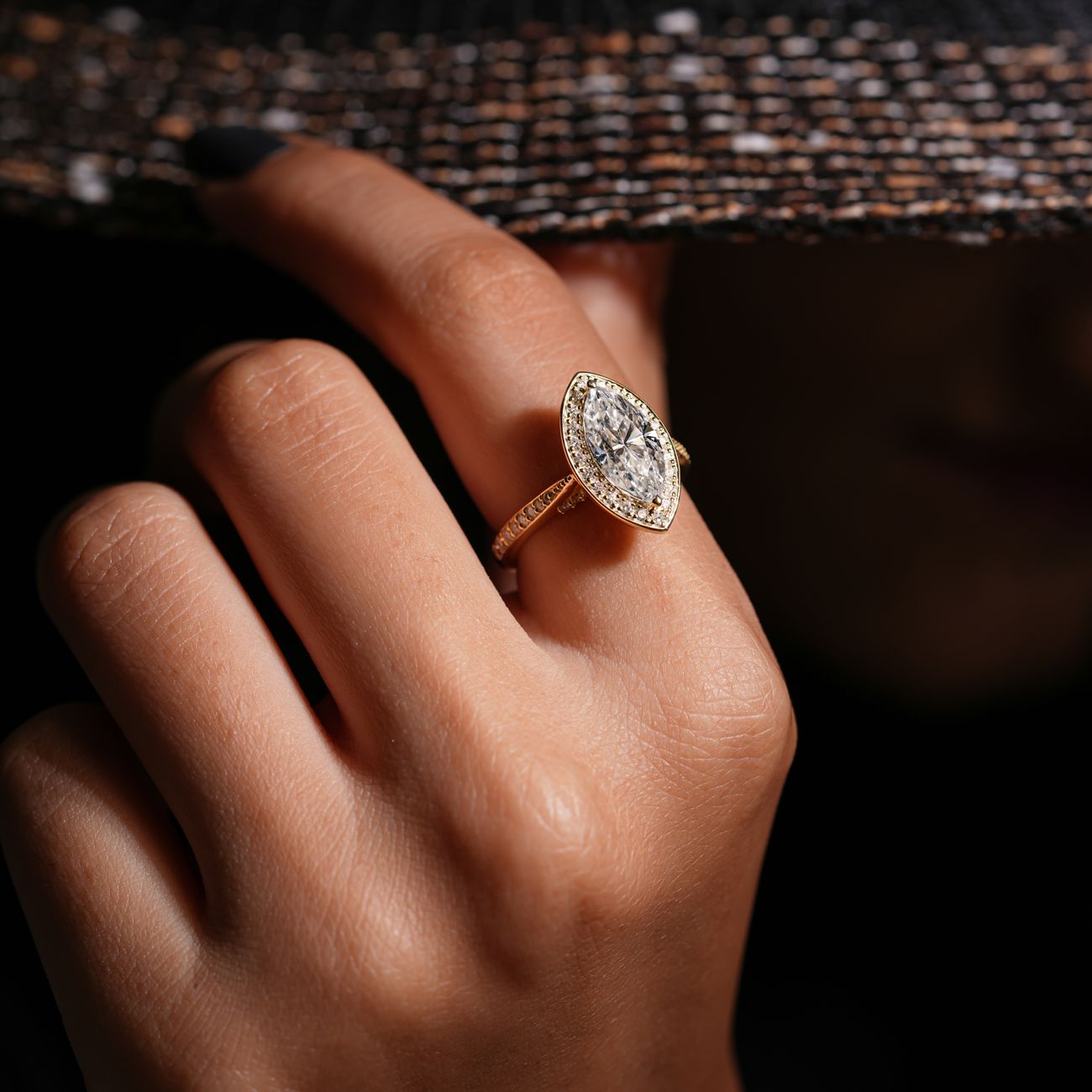
There is no universal answer, because finger shape and ring size change the visual effect. That said, most people find that marquise diamonds around 1.9 to 2.05 create a flattering balance on the hand. This range usually looks elongated without becoming too thin.
If the wearer has shorter fingers and wants more lengthening, a slightly higher ratio can work well. If the wearer prefers a fuller and more noticeable center stone, a slightly lower ratio may be better. The goal is to make the shape feel intentional rather than extreme.
Also remember that the ring setting, band width, and carat weight all influence how the shape reads on the hand. A diamond that looks narrow in a loose photo may look perfectly balanced once mounted.
Price considerations for marquise diamonds
Marquise diamonds are sometimes priced more favorably than round brilliants, but the price difference is not automatic. Pricing depends on color, clarity, carat weight, cut quality, and market demand. A beautifully cut marquise with strong proportions can still carry a premium compared with a poorly cut stone of similar size.
Because marquise diamonds can appear larger per carat, some buyers see them as a value-conscious choice. This is especially relevant in lab grown diamonds, where buyers may focus on maximizing visible size and overall quality rather than prioritizing resale value.
When evaluating price, compare diamonds with similar proportion sets. A stone that is slightly less expensive but has a weak bow tie or poor symmetry may not be a better purchase than a slightly more expensive diamond with stronger visual balance.
How to evaluate marquise diamonds in a practical way
For buyers who are not gemologists, the easiest approach is to combine the grading report with visual inspection. Start by checking the ratio, then look at the outline, the points, and the brightness across the center.
A useful process is:
- Confirm the length-to-width ratio.
- Check the symmetry of the points and curves.
- Look for bow tie darkness in photos or video.
- Review color and clarity in context of the setting and size.
- Compare the stone against one or two nearby ratios to see what look you prefer.
If you are shopping online, a vendor that provides images, videos, and a grading report from a respected lab is especially helpful. For more background, buyers often also review diamond certifications and how they relate to shape quality.
Frequently asked questions
What is the most common marquise diamond ratio?
A ratio around 1.85 to 2.10 is commonly seen and widely considered attractive. This range usually creates a balanced marquise shape that feels elegant without looking too narrow.
Is a higher marquise ratio always better?
No. A higher ratio creates a longer, slimmer stone, which some buyers love. But if the ratio becomes too high, the diamond can look narrow or less substantial. The best ratio depends on the look you want and the size of the stone.
Do marquise diamonds look bigger than round diamonds?
They often can. Marquise diamonds spread their weight across a longer outline, which can make them appear larger face-up than some round diamonds of the same carat weight. Visual size still depends on the exact proportions.
Are marquise diamonds prone to bow tie problems?
They can be. The bow tie effect is common in elongated shapes, including marquise. Some stones show only a mild shadow, while others show a strong dark band across the center. It is important to inspect each stone individually.
What setting is safest for a marquise diamond?
Settings that protect the pointed ends are usually the safest. Prong designs, bezel accents, or carefully built halo settings can help reduce the risk of chips at the tips.
Does ratio matter more in marquise than in oval or pear shapes?
Yes, usually it does. Marquise diamonds are especially sensitive to proportion changes because the shape is symmetrical and pointed at both ends. Small shifts in ratio can noticeably change the overall appearance.
Can a marquise diamond have a good ratio and still look bad?
Yes. A good ratio does not guarantee attractive cut quality, symmetry, or light performance. A diamond can have an acceptable number on paper but still show a weak bow tie, uneven ends, or a shape that feels awkward in person.
Final guidance on the best ratio for marquise diamonds
The best ratio for marquise diamonds is usually one that falls in the 1.85 to 2.10 range, with many buyers preferring the classic balance around 1.9 to 2.05. That range tends to look elegant, elongated, and versatile without becoming too narrow or too short.
Still, ratio is only one part of the decision. A marquise diamond should also be judged by its overall outline, cut quality, bow tie visibility, color, clarity, and the setting that will protect its pointed ends. The right choice is the stone that looks balanced to your eye and fits the intended ring style.
For buyers comparing shapes, marquise diamonds offer a distinctive combination of length, presence, and visual spread. They are especially appealing to people who want a shape that feels elegant but not overly common. In both natural and lab grown diamonds, the strongest purchase is usually the one that balances proportion, beauty, and practical wearability.