A 1 carat diamond can look impressively different from another 1 carat diamond, and that is the part many buyers miss. The number on the report tells you weight, not how much of the finger the stone will cover, how wide it will look from above, or how large it feels once set in a ring.
That is why How Diamond Carat Is Measured matters so much in real buying decisions. Carat weight is a precise gemological measurement, but the way a diamond appears on the hand depends on shape, cut, depth, and setting design as much as it does on weight.
Quick Answer
Diamond carat is measured by weight, not by size. One carat equals 200 milligrams, or 0.2 grams. Two diamonds with the same carat weight can still look different in size because one may be cut deeper, have a wider outline, or have a shape that spreads more across the finger.
For buyers, the key lesson is simple: carat tells you how heavy a diamond is, not exactly how big it will look. If visual size matters, compare measurements, shape, and face-up appearance, not just the carat number.
If you’re wondering how those measurements translate into what you’ll actually see on the hand, our guide on how diamond carat affects appearance explains why diamonds with the same weight can look noticeably different once they are set.
Understanding the Carat Concept
What carat means
Carat is the standard unit used to measure a diamond’s weight. It does not describe sparkle, color, clarity, or surface area. The term comes from historical gemstone weighing systems, and today it is used worldwide in diamond grading.
A full carat is divided into 100 points. So a 0.50 carat diamond is often called a 50-point diamond, and a 0.75 carat diamond is 75 points. This makes it easier to discuss diamonds that fall below one carat.
Why weight and size are not the same thing
Weight is only one part of a diamond’s physical makeup. Two diamonds can have the same carat weight but different proportions. One may be shallow and spread wider across the top, while another may be deeper and look smaller from above.
That difference matters because most buyers judge diamond size by face-up appearance, meaning how large the diamond looks when viewed from the top in a ring. A diamond’s visible spread can matter more than its weight on paper.
How carat is measured in practice
Diamonds are weighed on highly precise scales after they are cut and polished. Even tiny differences matter, which is why diamond pricing often changes at specific weight thresholds such as 0.50, 0.70, 0.90, or 1.00 carat.
Those thresholds are important because many shoppers focus on rounded numbers. A diamond at 0.95 carat may cost less than a 1.00 carat stone, even if the visible difference is very small.
What Buyers Usually Expect
They expect carat to equal visible size
A common assumption is that a bigger carat number always means a much larger-looking diamond. In reality, the visual difference between carat weights is often less dramatic than buyers expect, especially at smaller sizes.
For example, the jump from 0.90 carat to 1.00 carat is only 0.10 carat in weight. That may sound meaningful, but the actual face-up size difference can be subtle once the stones are set.
They compare numbers without measurements
Two round diamonds can both be labeled 1 carat, yet one may measure 6.3 mm across and another 6.5 mm. That small difference may seem minor, but it can affect how the diamond looks on the hand.
Buyers who look only at carat weight can miss better-looking options. In many cases, the diameter and proportions matter more than the exact weight on the grading report.
They assume a heavier diamond is always the better value
Higher carat weight does not automatically mean better value. A diamond priced at a popular weight like 1.00 or 2.00 carats may cost more per carat than a similar diamond just below that threshold.
That does not make the heavier diamond a bad choice, but it does mean buyers should think about visual benefit versus price increase. In size-focused shopping, the most expensive option is not always the most efficient one.
What It Actually Looks Like
Face-up appearance is what most people notice
When a diamond is set in a ring, the top view is what usually draws attention. This is called face-up appearance. It refers to how much visible surface area the diamond presents when it is worn.
Face-up appearance is influenced by both width and shape. A diamond with a slightly larger spread can look noticeably bigger, even if the carat difference is small. That is why shoppers often compare millimeter measurements, not just weight.
Finger coverage changes the perception of size
The same diamond can look different on different hands. A 1 carat diamond may appear more substantial on a size 4 finger than on a size 7 finger because it covers a greater proportion of the finger width.
This is one reason there is no universal answer to how large a diamond will look. A buyer’s hand size, ring style, and preferred setting all influence the final visual effect.
Scale matters more than many buyers expect
People often judge size in relation to what surrounds the diamond. A thin band can make a center stone look larger, while a wide band can make the same stone appear smaller by comparison.
Likewise, a halo setting can create the impression of a larger center stone because the small surrounding diamonds add visual presence. That does not change the center diamond’s carat weight, but it does change the overall look.
Factors That Change Apparent Size
Shape
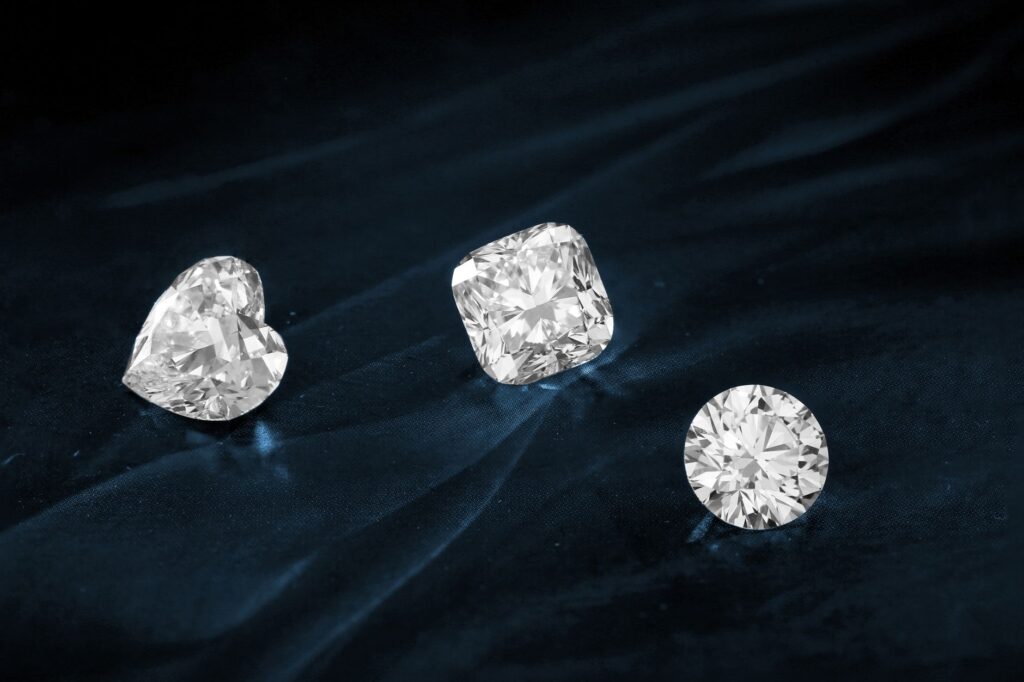
Diamond shape has a major effect on how large a stone looks. Some shapes spread farther across the finger, while others hold more of their weight in depth.
In general, elongated shapes such as oval, pear, marquise, and emerald cut often appear larger than round diamonds of the same carat weight because they cover more visible area. Round diamonds, however, remain the most popular choice and often maximize sparkle.
| Shape | Visual size tendency | Consumer note |
|---|---|---|
| Round | Balanced, classic face-up look | Often optimized for brilliance rather than maximum spread |
| Oval | Often looks larger than round | Elongated outline can flatter the finger |
| Pear | Can look larger than round | Pointed end may change the visual balance |
| Emerald | Wide, elegant face-up presence | Step-cut facets show shape and clarity clearly |
| Marquise | Often looks largest for the weight | Strong length can create dramatic finger coverage |
| Cushion | Varies widely by cut style | Some cushions face up smaller than their weight suggests |
Cut
Cut describes how well a diamond’s proportions, angles, and polish work together to return light. It strongly influences sparkle, but it also affects visible size.
A well-cut diamond can look more attractive and balanced on the hand than a poorly cut one of the same weight. Some cut styles retain more weight in depth, which can make the stone look smaller from above. Others are designed to spread out more efficiently.
Depth
Depth is the distance from the top of the diamond to the bottom point, measured through the stone. A diamond that is too deep may hide weight below the girdle, the outer edge of the diamond, rather than showing it face-up.
This matters because hidden weight does not improve visible size. Buyers often want the diamond that looks largest for its carat weight, not simply the heaviest stone.
Proportions and spread
Spread is the amount of surface area a diamond shows from the top. Two diamonds with identical carat weights can have different spreads depending on their cut proportions.
Spread is especially useful to compare in round diamonds, where diameter measurements can reveal whether the stone faces up on the small or large side for its weight. In fancy shapes, length and width measurements tell a similar story.
Setting design
The setting can change the size illusion significantly. A low-profile solitaire may make the center diamond feel neat and concentrated, while a cathedral or halo setting can make the ring appear larger overall.
Prongs, bezel settings, and band width all affect visual size as well. A bezel can make a stone look a little smaller because metal surrounds the edge, while slim prongs can leave more of the diamond exposed.
Real-World Size Examples
1 carat on a size 4 finger versus a size 7 finger
On a smaller finger, a 1 carat diamond often looks substantial and well-proportioned. The stone may cover more of the width of the finger, which creates the impression of a larger ring.
On a size 7 finger, the same diamond can still look attractive, but it may appear more modest because there is more finger surface around it. This does not mean the diamond is small. It means scale changes how size is perceived.
2 carat oval versus 2 carat round
A 2 carat oval typically faces up longer and may appear larger than a 2 carat round. The elongated shape can create a stronger visual presence, especially on average-sized fingers.
A 2 carat round often looks more compact and symmetrical. Many buyers prefer this classic appearance, but if visual size is the priority, an oval may offer more apparent spread for the same weight.
0.90 carat versus 1 carat
These two weights are close enough that the visual difference may be modest. In many cases, the bigger distinction is price, not appearance.
That is why some buyers choose a 0.90 carat diamond if it offers better proportions or a better overall grading profile. The slight reduction in weight may save money without creating a noticeable difference once the diamond is set.
0.70 carat versus 1 carat
This comparison is more noticeable. A 1 carat diamond generally shows a clear increase in finger coverage compared with a 0.70 carat stone, although the exact impact depends on shape and cut.
That said, a well-cut 0.70 carat diamond can still look elegant and balanced, especially in a delicate setting. Buyers focused on quality or budget may find the trade-off worthwhile.
| Comparison | Visual difference | Typical buyer takeaway |
|---|---|---|
| 0.90 ct vs 1.00 ct | Often subtle | Price difference may be larger than the visible difference |
| 0.70 ct vs 1.00 ct | More noticeable | 1 ct usually looks meaningfully larger |
| 1.00 ct vs 1.50 ct | Clearly noticeable | Size upgrade becomes more obvious |
| 2.00 ct vs 3.00 ct | Very noticeable | Visual impact rises significantly, along with cost |
Price vs Visual Benefit
Why price rises faster than size
Diamond pricing does not increase in a straight line as carat weight rises. It often jumps at popular size thresholds because demand is higher at those weights. A 1 carat diamond may cost more per carat than a 0.95 carat diamond of similar quality.
This pricing pattern means buyers pay not only for extra weight, but also for the market preference attached to certain sizes. That is why carat shopping is often about finding the best balance between visible size and budget.
Diminishing returns are real
The first few jumps in carat weight may produce modest visible gains, but each additional increase often costs more for a smaller improvement in apparent size. A buyer moving from 1 to 1.5 carats will usually see a meaningful difference. The jump from 2.8 to 3.0 carats, however, may be visually much smaller than the price increase suggests.
This is where comparing millimeter measurements becomes valuable. If the larger diamond does not add much visible spread, the extra cost may not translate into a meaningful size benefit.
Lab grown diamonds change the budget equation
Lab grown diamonds often allow buyers to choose a larger carat weight for the same budget compared with natural diamonds. That can be helpful for shoppers who prioritize visible size.
Even so, the same principles still apply. A larger lab grown diamond still needs good proportions, sensible measurements, and an appropriate setting to look its best. Bigger weight is helpful only if the stone also presents well face-up.
Who Should Size Up
Buyers who prioritize visual presence
Some shoppers want the diamond to have a stronger presence from across the room. In that case, sizing up can make sense, especially if the ring is meant to feel noticeable in everyday wear.
This is often true for buyers choosing an engagement ring that will be worn daily and viewed often. The visual effect matters in real life, not just under magnification.
Buyers with larger fingers
On larger ring sizes, a smaller center stone can sometimes look less substantial than expected. Increasing carat weight may help restore balance between the stone and the hand.
That does not mean every larger finger requires a bigger diamond. It simply means scale should be considered carefully, especially if the buyer wants strong finger coverage.
Buyers choosing elongated shapes carefully
Some buyers intentionally size up in oval, pear, or marquise cuts to maximize visible length. These shapes can look especially elegant when the goal is a longer, more dramatic outline.
Because these shapes often already face up large for their weight, buyers may be able to choose a slightly lower carat weight and still achieve the look they want. But if strong presence is the goal, extra weight can reinforce that effect.
Who Can Save Money
Buyers open to slightly under-threshold weights
Choosing 0.90 instead of 1.00 carat, or 1.90 instead of 2.00 carats, can reduce cost without a dramatic visual sacrifice. This approach works best when the diamond has strong proportions and the setting is flattering.
For many shoppers, these slightly lower weights offer excellent value. The savings can be used for better cut quality, a more appealing setting, or a higher color or clarity grade.
Buyers focused on cut quality over maximum weight
A well-cut diamond often looks brighter and more attractive than a heavier one with weaker proportions. If the goal is a beautiful ring rather than the highest possible carat number, sacrificing a little weight for a better cut can be a smart choice.
This is especially important in smaller sizes, where a diamond’s overall beauty depends heavily on how well it returns light.
Buyers who prefer subtlety
Not every shopper wants a very large-looking center stone. Some prefer a more understated look that feels comfortable for daily wear and matches a minimalist style.
For those buyers, a lower carat weight can be an advantage. It can provide elegance without becoming too bold or overpowering on the hand.
Common Buyer Mistakes
Chasing carat numbers without checking proportions
A big mistake is assuming a higher number is always better. If a diamond carries extra weight in depth rather than width, the buyer may pay more without gaining visible size.
Always compare measurements and proportions when possible. Carat weight alone does not tell the whole story.
Ignoring finger size
A diamond that looks large on one person may look moderate on another. Finger width, hand size, and ring style all affect the final appearance.
Ignoring this can lead to disappointment after purchase. It is more useful to think in terms of proportion than in absolute size expectations.
Overpaying for popular carat thresholds
Popular weights often carry price premiums. That does not mean they should be avoided entirely, but buyers should know when they are paying extra for the label of the size rather than for a meaningful visual difference.
Sometimes the smartest move is to buy just below a threshold and put the savings toward a better overall diamond.
Ignoring shape effects
A round diamond and an oval diamond of the same weight do not deliver the same look. Shoppers who compare only carat weight may miss shapes that appear larger or flatter the finger more effectively.
This matters especially for buyers who care about visual size and overall ring style.
Assuming larger is always better
Larger diamonds are not automatically the better choice. They may cost significantly more, and they may not suit every hand, setting, or lifestyle.
For many buyers, the best diamond is the one that balances size, quality, and budget in a way that feels practical long term.
How to Judge Diamond Size More Accurately
Look at millimeter measurements
Diameter and length measurements often reveal more about apparent size than carat alone. For round diamonds, the width in millimeters is especially useful. For fancy shapes, length and width together give a better sense of spread.
Two diamonds with the same carat weight may measure differently enough to change the visual impression. That is why experienced buyers often compare measurements first and weight second.
Consider the shape in relation to your hand
Different shapes create different visual effects on the finger. A round diamond may look more balanced, while an oval can elongate the hand. A marquise can appear especially long and dramatic.
The best shape is not only the one that looks largest. It is the one that fits the wearer’s style and hand proportions well.
Pay attention to the setting
The setting can amplify or reduce the apparent size of a diamond. Thin bands and low-profile settings often make the center stone feel more prominent. Wider bands or heavy metal work can make the stone seem smaller.
This is one reason the same diamond can look different in different ring styles. Carat is only part of the picture.
What This Means for Lab Grown Diamonds
Lab grown diamonds often give buyers more size for the budget, which can be useful if carat weight is a priority. A shopper who wants a larger visual look may be able to move up in size without moving far outside budget.
That advantage can be meaningful, but the buying logic remains the same. The diamond still needs good face-up spread, suitable proportions, and a setting that supports the look you want.
Lab grown diamonds also follow the same weight-based measurement standard as natural diamonds. A 1 carat lab grown diamond is still 200 milligrams. The difference is not in how carat is measured, but in how much diamond a given budget can buy.
Because larger lab grown diamonds are more accessible, some buyers become more focused on appearance per dollar. In that context, comparing actual measurements and shape becomes even more important. Bigger is easier to achieve, so visual efficiency matters more.
If you’re ready to compare actual stones, our guide to the best lab grown diamonds highlights well-balanced options and explains what to look for beyond carat weight alone.
Frequently Asked Questions
Is carat the same as size?
No. Carat measures weight, not size. Size is better understood through face-up dimensions, shape, and how the diamond looks once set in a ring.
Why does a 1 carat diamond sometimes look smaller than I expected?
It may have deeper proportions, a shape that does not spread as wide, or a setting that reduces visible surface area. Finger size also affects how large the diamond appears.
What is face-up size?
Face-up size is how large the diamond looks when viewed from above. It is the practical size most buyers care about because it reflects how the diamond appears in everyday wear.
Do round diamonds look smaller than elongated shapes of the same carat weight?
Often, yes. Elongated shapes such as oval, pear, and marquise can cover more visible surface area for the same weight. Round diamonds, however, are valued for their symmetry and brilliance.
Is a 0.90 carat diamond a good alternative to 1 carat?
It can be. The visual difference is often subtle, while the price difference may be meaningful. A 0.90 carat diamond can be a practical value choice if the proportions are strong.
What diamond shape looks largest for the weight?
Marquise, oval, and pear shapes often appear large for their carat weight because they spread out more visibly across the finger. Actual appearance still depends on the specific cut and proportions.
Does a larger carat always mean better value?
No. Larger diamonds can cost much more without offering a proportionate increase in visible size. Value depends on how much size, quality, and beauty you get for the price.
Should I choose carat or cut first?
For most buyers, cut should be a top priority because it affects sparkle and overall appearance. Carat matters too, but a well-cut diamond usually gives a more satisfying result than a poorly cut one of the same weight.
Conclusion
How Diamond Carat Is Measured is straightforward in theory, but the buying implications are more nuanced. Carat is a weight measurement, and that number does not always match what the diamond looks like on the hand. Shape, cut, depth, proportions, finger size, and setting design all influence how large the diamond appears.
If your goal is to understand how big a diamond will actually look, focus on face-up size and millimeter measurements, not just the carat label. That approach helps you compare diamonds more realistically and avoid overpaying for hidden weight or popular size thresholds.
For many buyers, the best choice is not the heaviest diamond available. It is the one that balances visible size, quality, and budget in a way that feels proportionate and practical over time.