Diamond color is one of the easiest quality factors to misunderstand because the grading scale sounds more dramatic than the actual visual differences usually are. A diamond can move several grades on a report while still looking very similar once it is set in a ring and viewed from a normal distance.
That is especially true in the lab grown diamond market, where higher color grades are more common and shoppers often wonder whether paying for a colorless grade is actually necessary. In practical terms, the answer depends on metal choice, diamond shape, size, and how closely you tend to inspect fine details.
Quick Answer: What Is Diamond Color?
What is diamond color? Diamond color is the presence or absence of visible tint in a diamond, usually measured on a scale from D to Z. D is the most colorless grade, while Z shows noticeable yellow or brown tint. The less color a diamond has, the higher its color grade.
For most buyers, the real question is not the technical definition. It is whether the color is visible to the naked eye and whether paying for a higher grade changes the diamond’s appearance enough to matter. In many cases, the difference between adjacent grades is subtle, especially in smaller stones and when the diamond is mounted.
How Diamond Color Is Graded
The standard color scale used by major gemological labs runs from D to Z. This scale measures how much body color a diamond shows compared with a master set of reference stones under controlled lighting.
At the top of the scale, D, E, and F are called colorless. These diamonds appear very white, with little to no detectable tint. G through J are usually described as near-colorless. These diamonds may show slight warmth, but often still look white once set, especially to casual observers.
Lower on the scale, K and below show more visible warmth. In that range, a diamond may begin to look noticeably creamy, yellowish, or brownish depending on the stone and lighting. At that point, color becomes a more obvious part of the diamond’s appearance.
Color grades are not the same as overall beauty
It is important to separate color grade from visual appeal. A diamond’s cut has a major effect on brightness and sparkle, and a well-cut lower-color diamond can often look better than a poorly cut higher-color diamond. That is why buyers should never evaluate color in isolation.
If you want to understand how different color grades actually change a diamond’s look in everyday wear, see our guide on How Diamond Color Affects Appearance.
In other words, diamond color matters, but it is only one part of the overall appearance. The shape, cut quality, size, and setting can all change how color is perceived.
What Diamond Color Actually Looks Like
When people hear that a diamond has a lower color grade, they often imagine a strong yellow tone. In reality, most grading differences are much more subtle than that. A diamond in the G to J range may still look white face-up, meaning from the top view, especially once mounted in jewelry.
What changes first is usually a slight softness or warmth in the body of the stone. The tint may be easier to notice from the side than from the top. In many diamonds, that warmth is faint enough that it does not distract from the sparkle.
In contrast, colorless diamonds tend to reflect light with a cleaner, cooler appearance. This does not automatically mean they look more brilliant, only that they usually appear a touch whiter when compared side by side with lower grades.
Whiteness versus warmth
Buyers often describe diamond color in plain English as either “white” or “warm.” That is a useful way to think about it. A whiter-looking diamond has very little tint, while a warmer diamond may show a gentle creamy or yellowish cast.
Warmth is not necessarily bad. Some buyers like the softer look of a slightly warmer diamond, especially in yellow gold. Others want the crisp, icy appearance of a colorless stone. The right choice depends on what you want the diamond to look like in real life.
Can Most People See the Difference?
This is the most important question for buyers, and the answer is often more nuanced than the grading scale suggests. In normal viewing conditions, most people cannot easily tell the difference between adjacent color grades once a diamond is mounted, especially when the stones are compared one at a time instead of side by side.
What is easy to see in a gem lab under controlled conditions is not always easy to see in daily wear. A diamond ring is usually viewed from a distance, in motion, and under changing light. Those conditions make subtle color differences harder to detect.
Side-by-side comparison matters
Color differences become much easier to notice when two diamonds are placed next to each other in the same lighting. In that setting, a D color diamond may look cleaner and whiter than a G, and a G may look whiter than an I. Without a direct comparison, however, many of those differences become much less obvious.
This is why some shoppers feel disappointed after paying for a higher grade and later realizing they cannot easily tell the difference in everyday use. The visual benefit can be real, but it is often small.
Distance and movement reduce visibility
People usually inspect jewelry from 12 to 18 inches away or farther. At that distance, the eye is far less sensitive to slight tint, especially in diamonds under about one carat. Movement also affects perception because the stone is constantly flashing, which draws attention to sparkle rather than body color.
That is one reason why a lower color grade can still look excellent in a ring. If the diamond is lively and well cut, sparkle tends to dominate how the stone is perceived.
Lighting changes what you see
Lighting has a major effect on diamond color perception. Cool, bright daylight may make a diamond look whiter, while warm indoor lighting can make a lower color grade appear softer or more tinted. Jewelry store lighting is often designed to maximize sparkle, which can make color differences harder to spot.
A diamond that looks nearly colorless in one setting may show a little more warmth in another. That does not mean the stone changed. It means diamonds interact with their environment.
How Diamond Color Looks in Different Metals
The metal around the diamond can either hide or highlight body color. This is one of the most practical buying considerations, yet it is often overlooked. The same diamond can look different in platinum, white gold, yellow gold, or rose gold.
White gold and platinum
White metals tend to show color more clearly because they provide a neutral or cool backdrop. If you place a near-colorless diamond in a white gold or platinum setting, any slight tint may become more noticeable, especially in larger stones. That is why some buyers prefer higher color grades for these settings.
This does not mean lower color grades should be avoided in white metals. It means buyers who want the cleanest, whitest look often choose higher color grades when the setting is silver-toned.
Yellow gold
Yellow gold is more forgiving. The warm tone of the metal can make a diamond with slight color appear whiter by comparison. In many cases, a G, H, I, or even J color diamond can look attractive in yellow gold because the setting reduces the contrast.
For buyers who prefer yellow gold, paying extra for a very high color grade may offer less visible benefit. The metal color can do some of the work of masking subtle warmth.
Rose gold
Rose gold behaves somewhat like yellow gold in this context. Its warm tone can soften the appearance of minor diamond color. Some shoppers like the way slight warmth in the diamond complements the setting rather than competing with it.
That is one reason rose gold is often paired with near-colorless diamonds. The combination can look balanced and intentional.
How Diamond Color Looks in Different Shapes
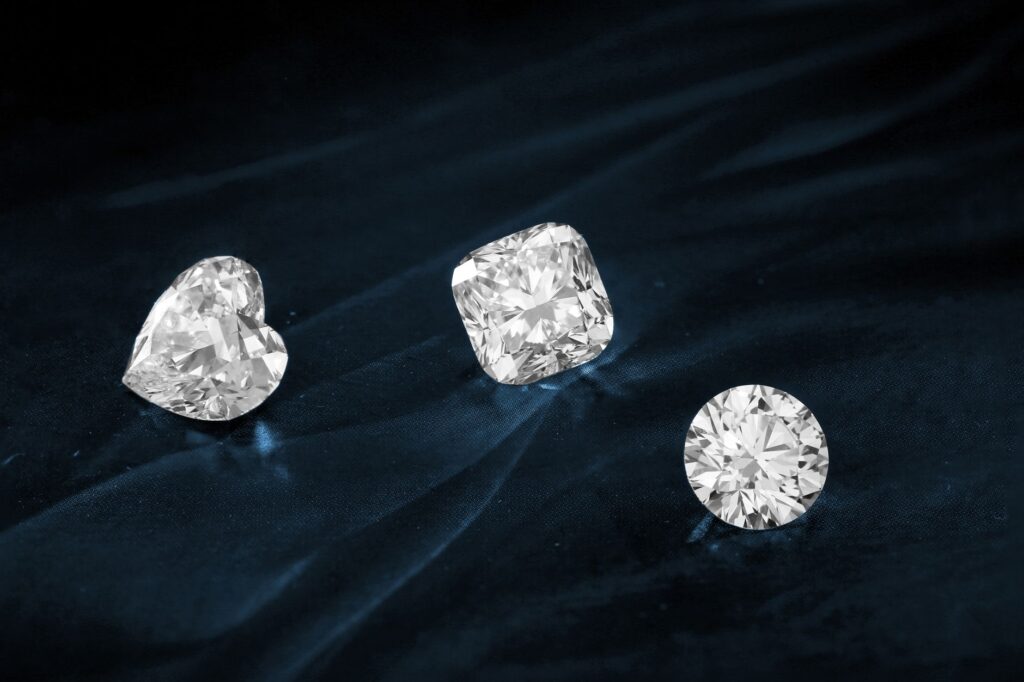
Diamond shape also changes how color is perceived. Some shapes hide color better than others because of the way light travels through the stone. This is especially important when evaluating lab grown diamonds, which are often purchased in shapes like round, oval, cushion, and emerald cut.
Round brilliant diamonds
Round brilliant diamonds tend to hide color well because their faceting pattern returns a lot of light to the eye. A well-cut round diamond often looks whiter than other shapes of the same color grade. This is one reason round diamonds are a popular choice for buyers who want flexibility on color.
Oval, pear, and marquise diamonds
Elongated shapes can sometimes reveal more color at the ends of the stone, especially in larger sizes. The difference is not always dramatic, but it can be easier to notice than in a round brilliant. Buyers often respond by choosing a slightly higher color grade in these shapes if they want a particularly white appearance.
Emerald and radiant cuts
Step cuts like emerald cut show larger open facets, which can make color more visible. These shapes do not hide tint as well as brilliant cuts. Radiant cuts are more forgiving than emerald cuts, but they can still show some color depending on the stone’s grade and size.
Cushion and princess cuts
Cushion cuts vary widely, but many have enough brilliance to mask minor color fairly well. Princess cuts can also appear bright and white, though some styles show color more readily than rounds. As always, cut quality matters because a poorly cut diamond will not disguise color as effectively.
How Diamond Color Looks in Different Lighting
Lighting can make a diamond appear more colorless or more tinted without changing the stone itself. This is why buyers should avoid judging color only under store spotlights or only under daylight. A balanced view across several lighting conditions is more useful.
Daylight
Natural daylight is often the most revealing because it gives a broad view of the diamond’s appearance. In this lighting, subtle body color may be easier to spot, especially in larger stones. At the same time, daylight can make a diamond look fresh and crisp.
Indoor white lighting
Cool indoor lighting tends to emphasize whiteness and reduce the appearance of warmth. This is one reason a near-colorless diamond may look very white inside a home, office, or showroom. For many buyers, this is the environment that matters most because it resembles daily life.
Warm lighting
Incandescent or warm LED light can make lower color grades appear warmer. That does not mean the diamond is unattractive. It simply means warmth is more visible in yellow-toned environments.
If you know your diamond will be worn often in restaurants, candlelit spaces, or homes with warm lighting, it may be worth seeing how different color grades perform in those conditions.
Colorless vs Near-Colorless Diamonds
The most common buying decision is not whether a diamond is colorless in an absolute sense. It is whether the extra cost of a colorless grade is worth it compared with a near-colorless option. The difference often comes down to how critical “icy white” appearance is to you.
| Color Range | General Appearance | Typical Buyer Takeaway |
|---|---|---|
| D to F | Colorless, very white, minimal visible tint | Best for buyers who want the whitest possible look and are willing to pay for it |
| G to J | Near-colorless, often still faces up white, slight warmth possible | Often the best balance of appearance and value |
| K to Z | Increasing warmth or yellow/brown tint | Can work well for some styles, but color becomes more visible |
In practical terms, D to F diamonds are the safest choice if you want very little visible color in any setting. G to J diamonds are often smart value choices because they can look white to most observers while costing less. Which range is best depends on your tolerance for slight warmth and your setting choice.
Price Premium vs Visual Benefit
Higher color grades usually cost more, but the visual improvement is not always proportional to the price increase. This is where buyers can overpay without gaining a meaningful difference in everyday appearance.
As color rises from G to F to E to D, the price premium can increase faster than the visible benefit. In some cases, the diamond becomes harder to distinguish from the next grade down unless it is compared directly under controlled conditions.
This is especially relevant in lab grown diamonds. Because lab grown stones often offer strong color grades at lower prices than natural diamonds, many shoppers become tempted to choose the highest grade available. That is not always necessary if the goal is visible beauty rather than report prestige.
Diminishing returns are real
Once a diamond already looks white to the eye, each additional color grade tends to deliver smaller visible gains. Those gains may matter to some buyers, particularly in larger stones or platinum settings. But for others, the money is better directed toward cut quality, a preferred shape, or a larger carat size.
That is a classic example of diminishing returns. The more you spend to improve color at the top of the scale, the smaller the real-world difference often becomes.
Lab Grown Diamonds and Color
Lab grown diamonds deserve special attention because their color behavior follows the same general rules as natural diamonds, but the market context is different. They are graded on the same color scale, and they can be colorless or near-colorless just like mined diamonds.
One key difference is that lab grown diamonds are often produced in higher color ranges more consistently. That means shoppers can frequently find D, E, or F grades at prices that would be far more expensive in natural diamonds. As a result, some buyers assume they should always choose the highest color available.
That is not always necessary. A well-cut G or H lab grown diamond may still look very white, especially in smaller sizes or warmer settings. If your goal is a beautiful-looking ring rather than the highest possible paper grade, a near-colorless lab grown diamond can be an efficient choice.
Does color behave differently in lab grown diamonds?
The visual effect of color is essentially the same whether a diamond is lab grown or natural. What changes is availability and price. Because lab grown diamonds often give buyers access to higher grades more easily, the trade-off becomes less about “can I afford colorless?” and more about “do I need to pay for it?”
That makes color evaluation even more important. A buyer may be able to afford D color in a lab grown diamond, but that does not mean D is the best value for every ring design or personal preference.
Who Should Upgrade to a Higher Color Grade?
There are situations where paying more for a higher color grade makes sense. The key is to connect the grade to the visual goal, not to treat the highest grade as automatically better.
You may want to upgrade if:
- You want the whitest possible appearance in a platinum or white gold setting.
- You are choosing a larger diamond where color is easier to notice.
- You prefer step-cut shapes like emerald cut, which can show tint more readily.
- You are very sensitive to warmth and notice even slight color differences.
- You plan to compare the diamond side by side with higher-grade stones.
In those cases, the higher color grade can produce a visual result that matters to you. The value question is not whether the diamond is objectively superior, but whether the extra whiteness is visible and worthwhile in your specific design.
Who Can Save Money on Color?
Many buyers can confidently choose a lower color grade and still get a diamond that looks bright and attractive. This is often the best strategy when the budget is limited and other quality factors deserve attention.
You may be able to save money if:
- You are buying a round brilliant or another brilliant-cut shape.
- You are setting the diamond in yellow gold or rose gold.
- You are working with a smaller stone, where tint is less visible.
- You are comfortable with a faint warm appearance that does not affect sparkle.
- You would rather allocate budget to cut quality or size.
In many real-world purchases, a near-colorless diamond offers the best balance of beauty and value. It can look white to the eye while avoiding the premium attached to the top color grades.
Common Buyer Mistakes With Diamond Color
Color is easy to overthink because it is measurable, but not always easy to see. That creates several common buying mistakes.
Overpaying for invisible upgrades
One frequent mistake is paying a substantial premium for a higher color grade without checking whether the difference is visible in the chosen setting. If the diamond already looks white to the eye, the practical improvement may be minimal.
This is especially common when buyers focus too heavily on the grading report. A report is useful, but it does not tell the whole visual story.
Ignoring the metal color
Another mistake is failing to consider the ring metal. A diamond that might look slightly warmer in platinum can appear very balanced in yellow gold. Matching the diamond to the setting can save money and improve appearance.
Assuming all tint is obvious
Some buyers assume any grade below F will look yellow. That is not true. Most near-colorless diamonds still appear white in normal wear, and many people never notice the difference unless they compare stones directly.
Choosing color before cut
Color should not be the first thing you optimize if the cut is weak. A diamond with poor light performance can look dull regardless of color grade. Cut influences sparkle, brightness, and overall liveliness, which often matter more to the eye than a small color difference.
How to Evaluate Diamond Color in Real Life
If you want to judge color accurately, the most useful approach is to combine the grading report with visual inspection. That does not require gemological training. It just means looking at the diamond in conditions similar to everyday wear.
Here are a few practical things to focus on:
- View the diamond both face-up and from the side.
- Check it under different lighting, not just store spotlights.
- Compare it in the intended metal if possible.
- Look at it by itself, then next to higher and lower color grades.
- Pay attention to whether any warmth actually bothers you.
The final question is simple: does the diamond look white enough for your preferences in the setting you plan to wear? If yes, a higher grade may not add much practical value.
Color and Diamond Size
Carat weight affects how noticeable color can be. As diamonds get larger, body color may become easier to detect because there is more material for light to travel through. That is why buyers often become more selective about color as the center stone size increases.
In smaller diamonds, slight color differences are frequently hard to detect. In larger diamonds, especially those above 1.5 carats or 2 carats, the same color grade may appear more noticeable. This is one reason larger lab grown diamonds often prompt more color-focused buying decisions.
If you are choosing between size and color, the better value often depends on shape and setting. A well-cut near-colorless diamond may look impressively white at a larger size, while a high-color stone can still be a good choice if whiteness is a top priority.
Does Diamond Color Affect Durability?
Color does not affect a diamond’s hardness or durability. A lower color grade does not mean the diamond is weaker. Durability is more closely related to cut, shape, and how the stone is set and worn.
That is an important distinction because buyers sometimes assume that better color means better quality overall. In reality, color is an appearance factor, not a durability factor.
Frequently Asked Questions
Is diamond color visible to the naked eye?
Sometimes, but not always. Higher color grades are easier to identify under controlled conditions or when compared side by side. In normal wear, many near-colorless diamonds still look white to the eye.
What is the best diamond color for an engagement ring?
There is no single best grade for everyone. D to F offers the whitest look, while G to J often gives strong value because the diamond can still appear white in most settings. The best choice depends on metal color, shape, size, and budget.
Are lab grown diamonds usually higher in color?
Yes, lab grown diamonds are often available in higher color grades more easily than natural diamonds. That does not mean lower grades are unattractive. It just means the market tends to offer more high-color options at lower prices.
Is a D color diamond worth it?
It can be if you want the cleanest, whitest possible look and are comfortable paying for it. For many buyers, though, the extra cost is not matched by a dramatic visual difference once the diamond is set.
What color diamond looks white in yellow gold?
Near-colorless diamonds often look very white in yellow gold because the warm metal helps mask slight tint. Many buyers find G through J to be a practical range in yellow gold settings.
Does diamond color matter more in larger stones?
Yes, color is usually easier to notice in larger diamonds. As size increases, many buyers become more careful about color because slight warmth can be more visible.
Should I choose color or cut first?
Cut should usually come first because it controls sparkle and light performance. A well-cut diamond with slightly lower color often looks more attractive than a higher-color diamond with weak cut.
Can a diamond look colorless even if it is not D?
Yes. Many diamonds in the G to J range can look colorless or nearly colorless to most people once mounted. Whether they appear colorless depends on lighting, setting, shape, and personal sensitivity to tint.
Conclusion
Diamond color is important, but its practical impact is often smaller than buyers expect. The main thing to remember is that grading and visual appearance are not always the same. A diamond can be technically lower in color and still look white and attractive in everyday wear.
For most shoppers, the smartest approach is to balance color with cut, shape, size, and metal choice. Higher color grades are most useful when you want the whitest possible appearance, especially in white metals or larger stones. Near-colorless grades often deliver the best value because they usually look white enough without the premium attached to the top of the scale.
If you are comparing options, focus on what you can actually see, not just what the report says. That approach leads to more confident buying decisions and a better match between the diamond and your expectations. If you’re ready to compare complete options, our guide to the Best Lab Grown Diamonds can help you evaluate color, cut, clarity, and value together rather than focusing on a single grading factor.