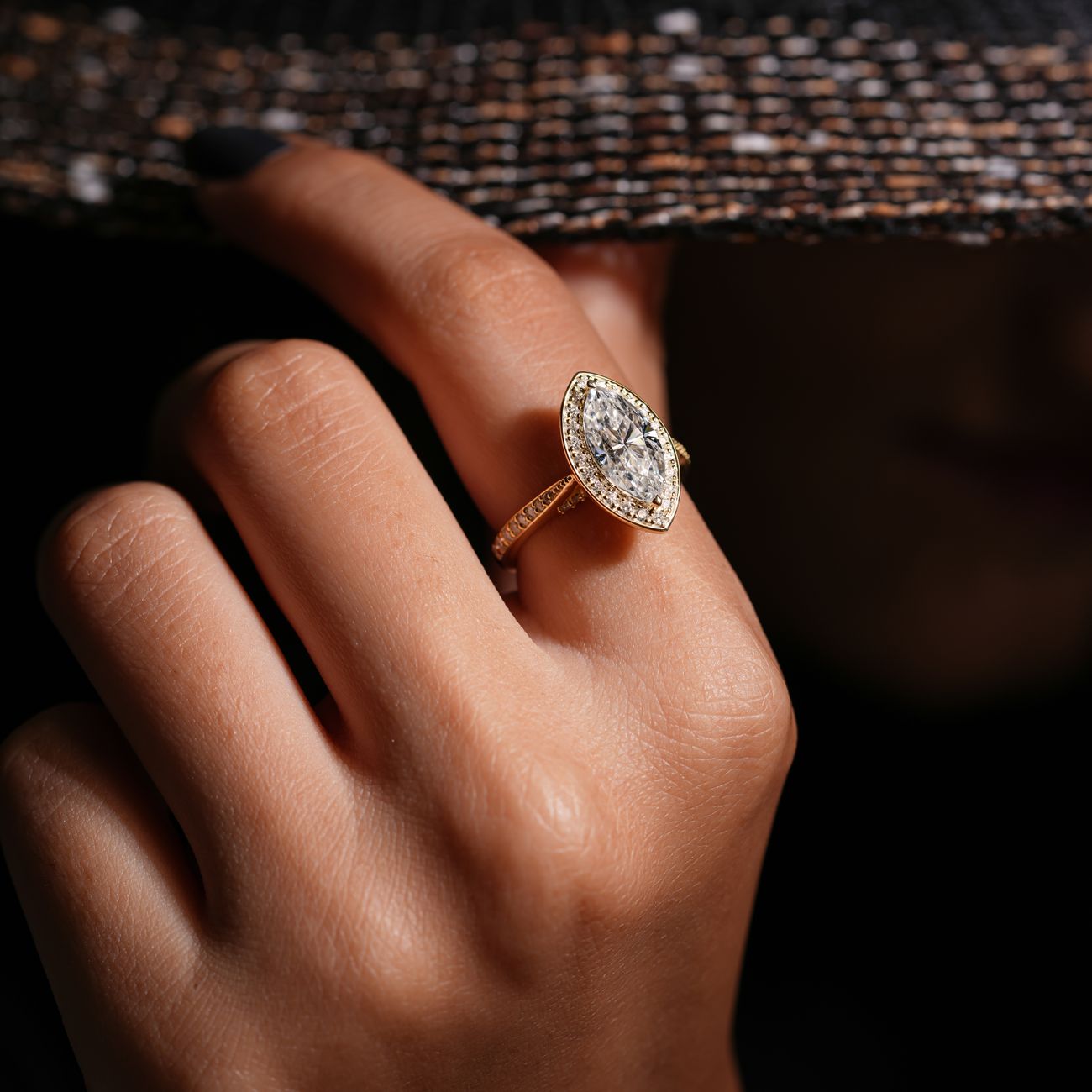
Marquise diamonds often appear larger than other diamond shapes of the same carat weight because of the way their outline spreads across the finger. Their elongated shape gives them more visible surface area from above, which creates a larger-looking face-up presence without necessarily adding more weight. For shoppers comparing diamond shapes, this can be a meaningful advantage, especially when trying to maximize size perception within a budget.
The effect is not just about length. Marquise diamonds also concentrate their weight differently than round diamonds, which can make them look more impressive from the top view than their carat weight might suggest. That said, appearance depends on proportions, cut quality, and setting style, so not every marquise diamond will look equally large.
Quick Answer: Why Marquise Diamonds Look Larger
Marquise diamonds look larger because they are long and narrow, with a pointed oval shape that spreads carat weight over more visible surface area. In practical terms, this means a marquise diamond can often face up bigger than a round diamond of the same weight. Buyers who want strong size presence may find this shape appealing, especially in engagement rings.
The shape can create a dramatic look on the finger, but it also comes with trade-offs. The points are more vulnerable to damage, and the shape may show proportion issues more easily than some other cuts. Understanding those details helps buyers decide whether the visual size advantage is worth it.
Understanding the Marquise Shape
The marquise is one of the more recognizable diamond shapes. It has an elongated body and two pointed ends, creating a silhouette that looks similar to a football or a boat seen from above. That shape gives the diamond its distinctive look and is also the reason it can appear larger than it really is in carat weight.
In jewelry, the marquise shape is often chosen for its elegant line and strong finger coverage. It can look vintage, dramatic, or modern depending on the setting. For buyers comparing diamond shapes, it offers a different visual experience from round, oval, pear, or emerald cuts.
What the Shape Actually Changes
The shape changes how the eye reads the stone. A round diamond concentrates its width in a circular outline, while a marquise stretches that same weight over a longer area. The result is more visible length and often a greater sense of size when the diamond is worn.
This is one of the most important ideas for diamond shoppers to understand: carat weight is not the same as visual size. A diamond’s outline, depth, and proportion all affect how large it looks on the hand.
What Makes a Marquise Diamond Look Bigger?
The main reason marquise diamonds look larger is their elongated outline. When you view a diamond from the top, what matters most to your eye is not carat weight but the amount of visible area. A long shape naturally covers more space along the finger than a round or square shape of the same weight.
This is sometimes called face-up size. Face-up size refers to how large a diamond appears when worn, and it is different from carat weight, which measures mass. Two diamonds can weigh the same and still look very different in size because they distribute their weight differently.
Marquise diamonds are also cut with a structure that emphasizes length. Their pointed ends extend the outline, and the shape creates a strong visual line across the finger. That line tends to make the stone seem bigger than a more compact shape.
Carat Weight vs. Visible Size
Many first-time buyers assume carat weight and size are the same thing. They are not. Carat is a measure of weight, while size is what the diamond appears to be on the hand.
Marquise diamonds often look especially efficient in this regard. Because they distribute weight across a longer shape, more of the diamond’s mass contributes to the visible outline rather than sitting deeper in the stone. This is one reason people comparing diamond shapes often notice marquise diamonds seem to “spread” more visually than round diamonds.
The Role of Length-to-Width Ratio
The length-to-width ratio has a major impact on how large a marquise diamond appears. This ratio compares the diamond’s length to its width. A higher ratio creates a longer, narrower stone, which can look more elegant and often larger from the top view.
However, an extreme ratio can make the stone look too thin or overly stretched. A balanced marquise shape usually has a ratio that feels proportionate rather than exaggerated. Many buyers prefer a ratio that maintains the classic marquise outline without making the diamond look narrow or unstable.
Why the Shape Extends Across the Finger
Finger coverage matters in diamond appearance. A marquise diamond stretches lengthwise, so it covers more of the visible area on the hand. This can make the ring look more substantial, even if the diamond is not especially heavy in carat terms.
That visual extension is one reason marquise diamonds are often chosen for engagement rings. They can create the impression of a larger center stone and can also make the finger appear longer. For some buyers, that effect is as important as the actual diamond size.
Marquise Diamond Appearance and Visual Performance
Marquise diamonds have a distinctive look that sets them apart from round, oval, princess, and emerald cuts. Their appeal comes from both the shape itself and the way light behaves in the stone. Like all diamonds, the visual result depends heavily on cut quality.
When a marquise is well-cut, it can look elegant, bright, and elongated. When proportions are off, the same shape can look uneven or show dark areas in the center. That is why buyers should look beyond carat weight and pay attention to how the diamond performs face-up.
Brilliance and Sparkle
Marquise diamonds are typically cut with brilliant-style faceting, meaning their facets are arranged to return light efficiently. This gives them strong sparkle, often with lively flashes as the diamond moves. Brilliance refers to white light return, while sparkle is the visible flash pattern you notice when the stone catches light.
Because of the shape, marquise diamonds can show an attractive mix of sparkle and size. The elongated outline helps the diamond stand out, while the faceting adds brightness. Still, the sparkle pattern is different from a round brilliant diamond, which is usually more uniform and intense in light return.
Fire and Scintillation
Fire is the dispersion of light into colored flashes. Scintillation refers to the sparkle pattern created by light and dark movement when the diamond is in motion. Marquise diamonds can display both, but the effect depends on cut proportions and facet arrangement.
Because marquise diamonds are less standardized in appearance than round brilliants, two stones of the same shape may look noticeably different. A well-cut marquise can deliver pleasing flashes of light, but one with poor proportions may seem dull in the middle or overly bright at the ends. That is why visual inspection matters so much with this shape.
The Bow Tie Effect
One common issue in elongated diamond shapes is the bow tie effect. This appears as a dark shadow across the center of the stone, resembling a bow tie from one angle. Marquise diamonds can show this effect because of the way light travels through their shape.
Some bow tie is common in many elongated shapes, but excessive darkness can make the diamond look less lively. Buyers should view the diamond in multiple lighting conditions if possible. A small amount of contrast can add character, but a heavy bow tie may reduce the stone’s overall appeal.
Advantages of Marquise Diamonds
Marquise diamonds offer several practical advantages for buyers who want a distinctive, size-forward look. These benefits are part of why the shape has remained relevant in the diamond market, including in lab grown diamonds where buyers may be able to choose larger stones within a given budget.
They Look Larger Than Their Carat Weight
This is the most obvious advantage. Marquise diamonds can create a bigger visual presence than round diamonds or square shapes of the same carat weight. For buyers focused on finger coverage, this can be an efficient way to maximize appearance.
In many cases, a marquise diamond can look like it “goes further” across the ring top than a round diamond. That makes the shape especially appealing for shoppers who want a noticeable center stone without increasing carat weight too aggressively.
They Can Make Fingers Look Longer
Because the shape is elongated, marquise diamonds often flatter the hand by creating a lengthening effect. This can be appealing to buyers who want a ring that visually stretches the finger. The effect is subtle, but it is one reason the shape has enduring appeal.
That said, the finger-lengthening effect depends partly on ring proportions and setting. A wide band or large side stones may reduce the visual elongation, while a slim setting can enhance it.
They Have a Distinctive, Elegant Look
Marquise diamonds do not blend in as much as some more common shapes. Their pointed silhouette gives them a vintage-inspired character, but they can also look modern in the right setting. Buyers who want something less expected than a round or oval diamond may appreciate that individuality.
This distinctive look can also work well in three-stone rings, halo settings, and minimalist solitaires. The shape offers enough visual interest that it often does not need much additional design support.
They Can Be Cost-Efficient in Visual Size
In some cases, marquise diamonds offer strong perceived size for the price. This is especially relevant for buyers comparing lab grown diamonds, where the budget may allow for a larger center stone and shape choice becomes even more important. If the goal is maximum visual spread, marquise can be a smart option to consider.
However, cost efficiency should not be confused with automatic value. Cut quality, proportions, and setting protection all matter, and a poorly cut marquise may not deliver the size or beauty advantage a buyer expects.
Disadvantages and Trade-Offs
Every diamond shape has trade-offs, and marquise diamonds are no exception. Their size appearance is appealing, but their pointed ends and less forgiving proportions create some practical concerns that buyers should understand before choosing one.
The Points Are More Vulnerable
The pointed ends are the most fragile areas of a marquise diamond. They can chip more easily than rounded edges, especially if the stone is worn daily in an active lifestyle. This makes setting choice important, because protective prongs help reduce the risk of damage.
For engagement rings, this is a meaningful consideration. A marquise diamond can be durable enough for everyday wear, but it should be set and cared for properly. Buyers who are hard on their jewelry may want to discuss protective settings with a jeweler.
Proportion Issues Are Easier to Notice
Because the shape is elongated, visual imbalances can stand out. If the stone is too narrow, too wide, or unevenly cut, the shape may feel awkward. Small proportion differences can noticeably affect how elegant or balanced the diamond looks.
This means marquise diamonds deserve a more careful evaluation than some more forgiving shapes. Buyers should not rely on carat weight alone. They should ask to see photos, videos, or in-person views whenever possible.
The Bow Tie Effect Can Be More Noticeable
As noted earlier, marquise diamonds can show a bow tie effect. Some amount of contrast is normal, but a strong dark band through the center can reduce sparkle and make the stone appear less lively. This is one of the main reasons why some marquise diamonds look much better than others.
In practical terms, the bow tie issue means buyers should compare several stones if possible. Two marquise diamonds with the same grading report can still perform very differently in real life.
They Are Less Common Than Round or Oval Diamonds
Marquise diamonds are a more distinctive choice, but that also means fewer buyers select them compared with round brilliants, ovals, or cushions. Some shoppers enjoy that individuality, while others worry about long-term style appeal. There is no universal answer, but the shape is definitely more niche.
If a buyer wants a classic look with broad market familiarity, another shape may feel safer. If they want a ring that stands out without looking overly trendy, marquise can be a strong candidate.
Who Marquise Diamonds Are Best For
Marquise diamonds are best for buyers who want a diamond that looks larger than its carat weight and has a distinctive silhouette. They can work especially well for engagement rings, anniversary rings, and fashion rings where shape is an important part of the design.
This shape may suit someone who values visual impact, finger coverage, and a slightly more unusual look. It can also be a good choice for buyers comparing diamond shapes and looking for strong face-up size without moving to a heavier carat weight.
Good Fit For Buyers Who Want:
- More visible size from the top view
- A finger-lengthening effect
- A distinctive shape with vintage character
- Good sparkle with a unique outline
- Potentially better value for face-up size
Less Ideal For Buyers Who Prefer:
- Very traditional or widely worn shapes
- Maximum edge protection with minimal maintenance concerns
- A simple, low-fuss diamond with fewer proportion variables
- A shape that hides cut differences more easily
How Marquise Diamonds Compare With Other Popular Shapes
To understand why marquise diamonds look larger, it helps to compare them with other common diamond shapes. Size perception, brilliance, and durability vary by shape because the geometry of the stone changes how it uses carat weight and how light returns to the eye.
Marquise vs. Round Brilliant
Round brilliant diamonds are often considered the benchmark for sparkle. Their faceting pattern is highly optimized for brightness and fire, which is why they tend to outshine many other shapes in light performance. Marquise diamonds, by contrast, often look larger face-up for the same weight.
If a buyer wants the most classic sparkle, round may be the better choice. If the buyer wants a more elongated shape and bigger visual spread, marquise can be the more efficient option. The trade-off is that round diamonds usually look more symmetrical and are less likely to show shape-related oddities.
| Feature | Marquise | Round Brilliant |
|---|---|---|
| Face-up size | Often larger-looking | Usually smaller-looking for the same weight |
| Sparkle | Strong, but less uniform | Very strong and highly balanced |
| Durability | Points need protection | Generally more durable at the edges |
| Style | Distinctive and elongated | Classic and widely popular |
Marquise vs. Oval
Oval diamonds are the closest common comparison because they are also elongated and can look larger than their carat weight. Both shapes can offer strong finger coverage, but they do so differently. Ovals usually have rounded ends, while marquise diamonds have pointed tips.
That difference matters for durability and style. Oval diamonds tend to feel a little softer and more contemporary, while marquise diamonds feel more angular and vintage-inspired. Both can show bow tie effects, so proportion still matters in either shape.
Marquise vs. Pear
Pear-shaped diamonds share the elongated look, but one end is rounded and the other is pointed. Pears can look elegant and often feel a bit softer than marquise diamonds. Marquise shapes, by contrast, are symmetrical on both ends and can look more structured.
In terms of size appearance, both can look larger than their carat weight. The choice often comes down to whether the buyer prefers the symmetrical, boat-like form of the marquise or the teardrop look of the pear.
Marquise vs. Emerald Cut
Emerald cuts also tend to look large for their weight, but for a different reason. Their large table and step-cut facets create broad flashes rather than fiery sparkle. Marquise diamonds use brilliant-style faceting, so they usually look more sparkling and lively.
If a buyer wants more dramatic light return, marquise has the edge. If they prefer a clean, architectural look with fewer small sparkles, emerald cut may be more appealing. Both can be excellent for size perception, but they communicate very different styles.
Marquise vs. Princess Cut
Princess cuts are square and tend to concentrate more of their appearance into a compact area. They can look impressive, but they do not usually spread across the finger as much as a marquise diamond of the same weight. Princess cuts are also known for sharp corners, which can be vulnerable without protective settings.
Marquise diamonds offer a longer visual line, which often makes them seem larger. Princess cuts may appeal more to buyers who want a modern square shape, while marquise appeals to those who want elongation and a more dramatic silhouette.
Important Buying Considerations for Marquise Diamonds
If you are shopping for a marquise diamond, the most important thing to understand is that cut quality and proportions have an outsized effect on appearance. A marquise with the right shape can look elegant and sizeable. A poorly proportioned stone can look uneven, dull, or awkward.
Look at the Length-to-Width Ratio
The length-to-width ratio is one of the most important shape factors. It affects how long, narrow, or balanced the diamond appears. A ratio that is too high may look skinny, while a ratio that is too low may look stubby.
Many buyers prefer a balanced ratio because it preserves the classic marquise silhouette. There is no single perfect ratio for everyone, but a proportion that looks even and visually stable is usually more appealing than one that feels exaggerated.
Check for Bow Tie Severity
Because the bow tie effect can be prominent in marquise diamonds, it is worth paying close attention. A little contrast may be acceptable, but a dark center band that stays visible in most lighting can make the diamond appear less bright.
Ask for videos in different lighting if you are buying online. If buying in person, move the diamond around and watch how the center behaves. The difference between a good and bad marquise is often easier to see in motion than on a grading report.
Pay Attention to Setting Protection
The pointed ends should be protected by prongs or a setting designed to shield them. This is especially important for engagement rings worn every day. A bezel or semi-bezel style may offer more protection, while a solitaire with careful prong placement can also work well.
If you are comparing settings, think about both security and appearance. The right setting should protect the points without making the diamond look overly heavy or hidden.
Review Certification and Measurements
As with any diamond, a grading report from a respected lab can help confirm basic quality information. Certification is especially useful when comparing lab grown diamonds, because the market includes many similar-looking stones and buyers need objective details about cut, color, clarity, and measurements.
For marquise diamonds, measurements matter more than carat weight alone. Two stones with the same weight can have very different spreads. Reviewing the exact dimensions helps you understand how large the diamond will actually look.
Consider Color and Clarity Visibility
Marquise diamonds can sometimes hide color slightly better than some shapes because of their faceting and elongated outline, but this depends on the stone. Buyers who want a bright, white look should still pay attention to color grade, especially in larger sizes or lighter metal settings.
Clarity can also be easier or harder to evaluate depending on where inclusions are located. Elongated shapes can sometimes draw the eye along the center line, so visible inclusions near the middle may be more noticeable. That is why clarity should be considered in context with the actual stone, not just the grading label.
Think About Daily Wear
Marquise diamonds can work well for everyday wear, but the shape benefits from a little more care than rounded styles. If the ring will be worn constantly, the setting should be chosen with durability in mind. Buyers with active routines may prefer a more protective mount, especially on the tips.
This does not mean the shape is fragile in general. It means the design needs to support the shape properly.
How Lab Grown Diamonds Fit Into the Marquise Shape
Lab grown diamonds make the marquise shape especially practical for many buyers because they often allow for larger or higher-quality stones at a given budget. If size is a priority, a lab grown marquise can provide strong visual impact without requiring the same price level as a natural diamond of similar appearance.
This does not change the shape itself, but it can change the buyer experience. Instead of choosing between size and quality, some shoppers may be able to prioritize both. Still, the same shape principles apply: proportions, bow tie effect, and setting protection remain important.
Buyers considering lab grown diamonds should remember that certification, cut quality, and measurements remain essential. A larger-looking diamond is not necessarily a better-looking one if the shape is unbalanced or the center appears dark.
Common Mistakes Buyers Make With Marquise Diamonds
Because the marquise shape is less common than round or oval, buyers sometimes make avoidable mistakes. These often come from focusing too much on carat weight or not evaluating the diamond in real viewing conditions.
Choosing by Carat Weight Alone
A marquise diamond can look significantly different depending on how its weight is distributed. A heavier stone is not always a better-looking stone. Buyers should compare measurements, ratio, and spread, not just carat size.
Ignoring the Bow Tie
Some buyers see the shape and assume all marquise diamonds look similar. In reality, bow tie severity can vary a lot. A stone with a heavy bow tie may look much less appealing than a diamond with better light performance, even if the carat weight and color grade are similar.
Overlooking Point Protection
The pointed tips need to be treated carefully. A setting without proper protection can increase the risk of chipping. This is one of the most practical issues with the shape, and it should be considered before purchase, not after.
Not Comparing In Real Lighting
Marquise diamonds can change appearance depending on the light source. A stone that looks good in one showroom or on one screen may not perform as well in everyday conditions. Buyers should look for movement, contrast, and brightness rather than relying on a single image.
Assuming All Elongated Diamonds Look the Same
Marquise, oval, and pear diamonds may all appear elongated, but they do not perform the same way. Their facet patterns, tip shapes, and overall silhouette create different visual experiences. Buyers should compare them directly rather than assuming one elongated shape is interchangeable with another.
Frequently Asked Questions
Do marquise diamonds really look bigger than round diamonds?
Yes, they often do. Marquise diamonds spread their surface area along a longer shape, which creates more visible coverage from the top. A round diamond may weigh the same but appear more compact.
Why do marquise diamonds look bigger for their carat weight?
They look bigger because more of their outline is visible face-up. Carat weight measures mass, not visible size. The marquise shape uses its weight in a way that often creates a larger-looking appearance.
Are marquise diamonds good for engagement rings?
They can be excellent for engagement rings if the buyer likes the shape and understands the durability considerations. The elongated look is flattering on the hand, but the points need protection and the cut quality should be carefully checked.
Do marquise diamonds have more sparkle than other shapes?
They can have strong sparkle, but not always more than a round brilliant. Round diamonds are usually the benchmark for light performance. Marquise diamonds can still look lively and bright when well cut.
What length-to-width ratio is best for a marquise diamond?
There is no single best ratio, but many buyers prefer a balanced look that feels elegant without looking too narrow or too short. The ideal ratio depends on personal taste and the overall ring design.
Are marquise diamonds prone to damage?
The pointed ends are more vulnerable than rounded edges in other shapes. With proper prong protection and normal care, they can still be worn daily. The setting matters a lot for long-term durability.
Do lab grown marquise diamonds look different from natural marquise diamonds?
Not visually, when comparing diamonds of similar quality. The shape, cut, and light performance are what determine appearance. The main difference is how the diamond was formed, not how it looks to the eye.
Is the marquise shape trendy or timeless?
It has both vintage appeal and contemporary relevance, but it is not as universally common as round or oval. That can make it feel distinctive rather than overly trend-driven. Whether it feels timeless depends partly on the setting and overall design.
Conclusion
Marquise diamonds often look larger because their elongated shape spreads visible area across the finger more efficiently than many other shapes. This gives them a strong face-up presence that can make the stone appear bigger than its carat weight suggests. For buyers who care about size perception, that is one of the shape’s biggest strengths.
At the same time, marquise diamonds require more careful evaluation than some other shapes. Proportions, bow tie severity, and point protection all affect how the diamond looks and wears over time. A well-cut marquise can be elegant, distinctive, and visually impressive, while a poorly cut one may not deliver the same value.
For buyers comparing diamond shapes, the marquise is worth considering if you want strong visual size, a lengthening effect on the hand, and a less common outline. If you prefer a classic or highly uniform sparkle pattern, another shape may suit you better. The best choice depends on the balance you want between appearance, durability, and overall style.