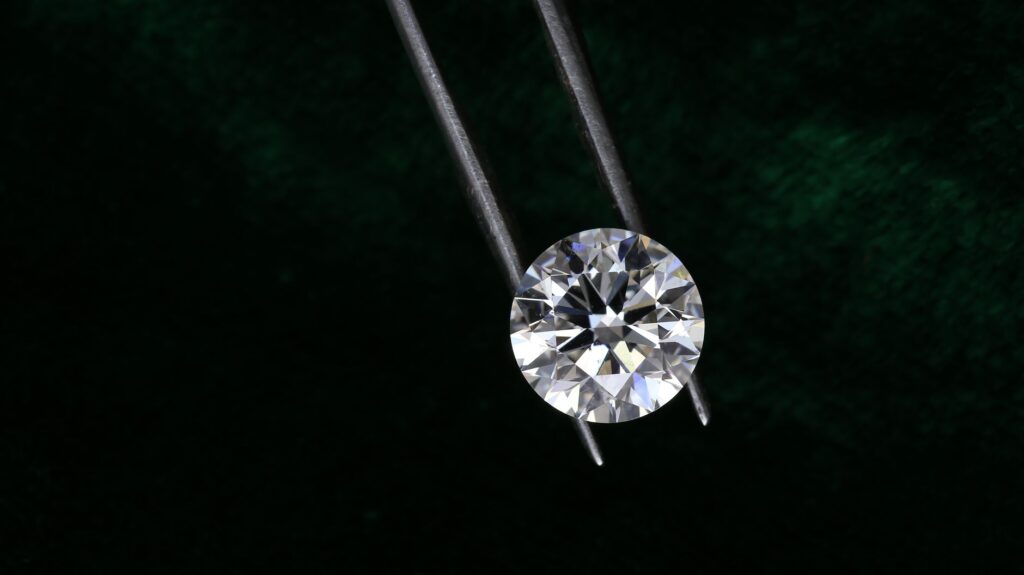
E and F color diamonds sit very close to the top of the diamond color scale, which is why the difference between them is often smaller than buyers expect. In real-world viewing, both grades usually appear very white, especially once the diamond is set and seen from a normal distance. The more important question is not which grade is technically better, but whether the extra cost for E is actually visible in the setting, metal color, and lighting you will live with every day.
For shoppers comparing E vs F Color Diamonds, the practical decision usually comes down to value rather than appearance. F is still in the colorless range on the GIA color scale, while E is one step higher and usually priced a bit more. In many cases, that premium buys a difference that is easiest to see only under controlled viewing conditions or by comparing loose stones side by side.
Quick Answer
E and F color diamonds are both colorless grades, and the difference is typically very subtle. Most buyers will not notice a meaningful visual difference in everyday wear, especially once the diamond is mounted in a ring.
If you are trying to balance beauty and budget, F color often offers stronger value because it still looks bright and colorless to most people. E can be worth the upgrade if you want a slightly higher grading report grade, are very sensitive to color, or want extra comfort knowing you chose one of the top color grades available.
What E and F Color Actually Mean
Diamond color grades measure how little natural body color a diamond shows when compared to a master set under controlled lighting. On the GIA scale, the colorless range runs from D to F. That means both E and F are considered colorless, not near-colorless.
E is one step below D, and F is one step below E. In practical terms, both grades are intended to look white and clean, with very little tint. The difference is subtle enough that it often matters more on paper than in real life.
E Color Diamond
An E color diamond is near the top of the color scale. It has extremely little detectable color, even when examined by trained graders. To most consumers, an E diamond looks bright, icy, and colorless.
Because E is so high on the scale, it can appeal to buyers who want a premium grade without going all the way to D. That said, the visual gap between E and F is small, and in many settings it will be difficult to tell them apart.
F Color Diamond
An F color diamond is also considered colorless. It is the lowest grade in the colorless range, but that does not mean it looks tinted in a normal ring setting. In most real-world situations, an F diamond still appears white and crisp.
For many buyers, F represents a smart balance. It usually costs less than E while still delivering a very high-end look, especially when paired with a quality cut.
What These Diamonds Actually Look Like
Color grading terms can sound more dramatic than the eye perceives. In practice, both E and F diamonds are usually described as white, bright, and colorless. The difference is not a shift from white to yellow. It is a very small degree of subtlety within the same premium category.
In loose-stone comparisons, an E may look a touch cooler or more neutral than an F, but that distinction is often hard to notice unless the diamonds are placed side by side under controlled light. Once set, the human eye tends to focus more on sparkle, size, and overall brilliance than on a one-grade color difference within the colorless range.
Perceived Whiteness
Both E and F grades generally appear very white. To most people, they look functionally the same in everyday conditions.
An E diamond may seem fractionally more color-neutral in certain comparisons, but the effect is so slight that it can disappear once the diamond is mounted or viewed from a normal distance.
Warmth or Tint
Warmth is the subtle yellow or brown tone that becomes more visible as color grade drops. At E and F, warmth is usually minimal to nonexistent to untrained eyes.
If you are worried that an F diamond will look noticeably tinted, that is usually not the case. F still falls within the colorless range, so visible warmth is generally not a concern unless other factors, such as a larger size or poor cut, make the stone easier to scrutinize.
Can Most People See the Difference Between E and F?
In normal wear, most people cannot reliably tell E and F apart. The difference is usually too small to notice without a direct comparison. Even then, many viewers need a trained eye and controlled lighting to identify which stone is which.
This is why the conversation around E vs F Color Diamonds is usually about value, not obvious beauty. Both are already high-quality color choices, so the question becomes whether the extra spend for E creates a meaningful real-world benefit.
Side-by-Side Visibility
Side-by-side, loose E and F diamonds may show a slight difference, especially if one is next to a master set or viewed by someone familiar with grading. Even then, the distinction is small.
If the stones are set in rings and viewed separately, most buyers would not identify which is E and which is F. This is important because a grading report can make the difference seem larger than it is once the diamond is worn.
Everyday Visibility
Everyday visibility is where the difference usually disappears. Under typical viewing distances, in office lighting, outdoor light, or at a dinner table, both grades usually look white.
Most people notice sparkle, shape, and size before they notice a one-grade color difference in the colorless range. That is one reason cut quality often has a much greater visual impact than the choice between E and F.
Professional vs Consumer Perception
A diamond grader or experienced jeweler may be more likely to detect the difference between E and F than a consumer. That does not mean the consumer will see it the same way in a ring.
Professionals often evaluate diamonds loose, face-up, and under controlled conditions. Buyers usually see set diamonds in changing light and from more natural distances. Those are very different viewing environments.
How E and F Look in Different Metals
Metal color can influence how white a diamond appears. This is one of the biggest practical factors buyers overlook when deciding between E and F.
In many cases, the ring setting affects color perception more than the one-grade difference between the stones themselves. That means the right metal choice can be just as important as the diamond color grade.
White Gold
White gold can enhance the clean look of both E and F diamonds. Because the metal itself is silvery-white, it supports the colorless appearance of the stone.
In white gold, the difference between E and F is generally very difficult to notice. If you plan to use a white metal, F often looks just as bright as E in normal wear.
Platinum
Platinum is another excellent match for both grades. Its naturally white tone pairs well with colorless diamonds and does not introduce warmth that could make a diamond look slightly less white.
For buyers seeking a sleek, high-end appearance, both E and F perform well in platinum. The decision again leans more toward budget and personal preference than visible difference.
Yellow Gold
Yellow gold changes the equation a little. The warm metal can make diamonds appear slightly whiter by contrast, which means even lower color grades often look very good in yellow gold.
In a yellow gold setting, the difference between E and F is usually even harder to detect. Some buyers can save money by choosing F or even a lower grade without sacrificing the look they want.
Rose Gold
Rose gold behaves similarly to yellow gold in the sense that the warm metal can mask small amounts of diamond color. Both E and F look attractive here, and the difference is usually minimal.
Because rose gold already has warmth, many buyers find that spending extra for E is unnecessary unless they want the highest possible color grade for personal reasons.
How E and F Look in Different Lighting
Lighting has a major effect on diamond appearance. A diamond can look slightly different under daylight, office lighting, warm home bulbs, and jewelry store spotlights.
When comparing E vs F Color Diamonds, lighting often matters more than the grade difference. A stone that looks identical in one environment might appear slightly different in another, but the variation is still usually subtle at these color levels.
Daylight
Daylight is one of the most honest lighting conditions for seeing a diamond’s appearance. In daylight, both E and F generally look crisp and white.
Any difference between them is usually very small. Daylight may show the natural character of the stone more clearly than store lighting, but even then, a properly cut F diamond will usually look very white.
Indoor Lighting
Standard indoor lighting often softens visible differences between close color grades. Both E and F can look highly similar in offices, homes, and restaurants.
Because indoor light is usually less intense than showroom lighting, subtle grading differences tend to blend together. This is one reason many buyers are happy with F once the stone is set.
Jewelry Store Lighting
Jewelry stores often use bright, focused lights that make diamonds sparkle and appear whiter. These lights can exaggerate brilliance and sometimes reduce the apparent difference between nearby color grades.
In this environment, E and F can both look excellent. However, shoppers should remember that store lighting is not the same as everyday wear lighting, so it should not be the only basis for choosing a color grade.
Warm Lighting
Warm bulbs can make diamonds and metals look slightly more yellow or creamy. This can be especially relevant in homes, dining spaces, and evening settings.
Even in warm light, E and F usually remain white enough that most buyers would not perceive a serious color issue. If the diamond is well cut, it will still return enough light to look lively and attractive.
Cool Lighting
Cool lighting often makes diamonds look very crisp and bright. Under these conditions, E and F can both appear especially colorless.
This is one reason buyers who spend time comparing diamonds in different environments may conclude that the practical difference between E and F is very small.
Price Premium vs Visual Benefit
The biggest question in the E versus F decision is whether the extra price for E creates enough visible improvement to justify the cost. In most cases, the answer is no for buyers focused on everyday appearance, and yes only if they place a high value on having the higher grade.
The price gap between E and F varies based on carat weight, shape, and market conditions. Still, the general pattern is consistent. E usually carries a premium, and that premium is often larger than the actual visual difference in normal wear.
Diminishing Returns at the Top of the Scale
Diamond color grading follows the principle of diminishing returns. The closer you get to the top, the more you pay for increasingly small visual changes.
That means the jump from F to E is much less noticeable than a jump from, say, J to H. Buyers often assume every grade change offers the same value, but that is not how diamond color works in practice.
Is E Worth the Extra Money?
E may be worth the premium for buyers who want a near-top grade and enjoy knowing they selected one of the finest color categories available. Some people simply prefer the confidence of choosing the slightly higher grade.
For buyers focused on visible value, though, F often makes more sense. It preserves the colorless look while freeing budget for better cut, a larger carat size, or a more durable setting.
Is F the Smarter Value Choice?
For many shoppers, yes. F color is often the better value because it remains colorless on the grading scale while avoiding some of the price premium attached to E.
If the diamond will be set in white gold or platinum and viewed in normal lighting, F usually looks fully white. That makes it a strong choice for buyers who want a premium appearance without paying for a grade difference they are unlikely to see.
Who Should Upgrade to E?
Choosing E over F can make sense in a few specific situations. The upgrade is less about visible necessity and more about personal priorities.
You Want the Higher Grading Report
Some buyers simply like knowing they have the slightly better color grade. For them, the emotional or psychological value of the grade matters, even if the visual difference is minimal.
If the grading report is important to you, E may feel more satisfying than F. This is a preference-based decision, not a visual requirement.
You Are Extremely Sensitive to Subtle Color Differences
A small number of buyers are unusually attentive to tint and want the most colorless appearance possible. In that case, E offers a little extra reassurance.
This is especially relevant if you plan to compare multiple loose stones closely before choosing one. If your eye is trained to notice tiny differences, the upgrade can feel more meaningful.
You Are Buying a Large Stone and Want Maximum Security
As diamonds get larger, some color differences can become easier to notice because there is more surface area for the eye to evaluate. Even then, E and F remain very close.
Still, buyers selecting larger diamonds sometimes prefer E simply to keep every visible aspect as close to colorless as possible. That can be a reasonable preference, particularly in a simple white metal setting.
Who Can Save Money with F?
F is often the practical choice for buyers who care about beauty but do not want to overpay for an invisible upgrade. It usually offers the right balance of appearance and value.
You Want a Bright, White Look Without Overpaying
F delivers a colorless appearance that satisfies most buyers in everyday wear. If your priority is how the diamond looks on the hand rather than what the report says, F is often enough.
This is especially true when the diamond has an excellent cut, because cut affects brightness, sparkle, and overall visual impact more than a one-step color difference at this level.
You Plan to Use Yellow or Rose Gold
Warm metal settings can make small color differences even less visible. In those settings, choosing E often produces little practical benefit.
F allows buyers to allocate budget toward other features while still maintaining a very white look in the finished piece.
You Prefer Better Overall Value
For many shoppers, value means paying for what can actually be seen. Since the E to F difference is subtle, the money saved on F can often be better spent elsewhere.
That could mean improving cut quality, selecting a slightly larger carat size, or choosing a setting that better suits the wearer’s lifestyle. These decisions may have more impact on the final ring than moving from F to E.
Common Buyer Mistakes with E vs F Color Diamonds
The biggest mistake is assuming that the grading report tells the whole story. Color grade is important, but it is only one part of the diamond’s visual performance.
Overpaying for an Invisible Upgrade
Some buyers choose E simply because it sounds better than F. In many cases, that extra spend produces little or no visible benefit in a finished ring.
That does not mean E is a bad choice. It means buyers should understand what they are paying for and whether they can actually see it.
Ignoring the Setting Metal
Color perception depends heavily on the metal color. A diamond that looks slightly different in a white metal may look nearly identical in yellow gold or rose gold.
Failing to factor in the setting can lead to overspending on color grade when the ring design itself is already flattering the stone.
Relying Only on the Report
A grading report is essential for quality assessment, but it does not tell you everything about how the diamond will look in person. Cut, shape, size, and setting all affect the final appearance.
Two diamonds with different grades can still look very similar if their other characteristics are well matched. Buyers should think about the whole ring, not just the color line on the report.
Assuming All Differences Are Obvious
Color charts can make grade changes seem dramatic. In reality, the difference between E and F is subtle and often invisible to the average viewer.
This is why it helps to focus on actual viewing conditions rather than on the labels alone.
E vs F Color Diamonds in Lab Grown Diamonds
Lab grown diamonds often appear in higher color grades more frequently than many natural diamonds, which is one reason buyers comparing E vs F Color Diamonds in lab grown stone categories may see a lot of inventory in the colorless range. The technology used to grow diamonds can produce stones with very little body color, though some still show trace tint depending on how they were made and how they were later cut.
Because lab grown diamonds can offer strong value in higher color grades, the decision between E and F often becomes even more about budget allocation. If the price difference is meaningful, F may free up money for a better cut or larger size without giving up the clean, white look most buyers want.
Do Color Grades Behave Differently in Lab Grown Diamonds?
The grading standards are the same, so E and F still mean the same thing. The visual behavior is also similar, meaning both grades should appear colorless under normal conditions.
What can differ is buyer expectation. Since lab grown diamonds often make higher grades more accessible, shoppers may be more likely to compare E and F as a value question rather than a luxury question.
Is Upgrading Color Worth It in Lab Grown Diamonds?
Sometimes, but not always. Because lab grown diamonds generally cost less than natural diamonds of similar size and quality, some buyers choose to spend a little more to get a higher color grade within the lab grown category.
Even so, F often remains a smart balance. If the visual difference is negligible, it may be more practical to focus on cut, clarity, and the overall ring design.
How Cut and Shape Affect Color Perception
Color does not exist in isolation. The cut and shape of the diamond can influence how white or tinted it appears.
A well-cut diamond reflects light efficiently, which can help mask subtle color and make the stone appear brighter overall. Poor cut quality can make even a high color grade look less attractive than expected.
Round Brilliant Diamonds
Round brilliant diamonds often hide small amounts of body color very well because of their strong light performance. In a round shape, both E and F usually look excellent.
This is one reason buyers comparing E vs F Color Diamonds in round brilliants often find the difference even harder to see.
Fancy Shapes
Shapes such as oval, cushion, radiant, pear, and emerald can show color a bit differently. Some fancy shapes concentrate color near the tips or corners, while others disguise it well.
In these shapes, E and F still both look very white, but the exact appearance may depend on the cut style. Buyers should view the specific diamond rather than relying only on color grade.
Comparison Table: E vs F Color Diamonds
| Factor | E Color | F Color |
|---|---|---|
| GIA color range | Colorless | Colorless |
| Visible difference | Very slight advantage on paper and in controlled comparisons | Very slightly lower grade, usually indistinguishable in normal wear |
| Whiteness | Very white, highly neutral | Very white, slightly less strict on grading but still colorless |
| White gold / platinum appearance | Excellent | Excellent |
| Yellow gold / rose gold appearance | Excellent | Excellent, with little practical difference from E |
| Visibility in normal viewing | Usually indistinguishable from F | Usually indistinguishable from E |
| Price premium | Higher | Lower |
| Best for | Buyers who want a slightly higher color grade and do not mind paying extra | Buyers who want strong value and a colorless look |
Frequently Asked Questions
Is E better than F color in diamonds?
Technically, yes, because E is a higher grade. Visually, the difference is very small and often hard to detect in a finished ring.
Whether E is “better” depends on what matters to you. If you want the higher grade, E wins. If you want better value, F often makes more sense.
Can most people tell the difference between E and F diamonds?
No, most people cannot tell the difference in normal wear. The distinction is subtle and usually only noticeable in direct side-by-side comparisons under controlled lighting.
Does an F color diamond look yellow?
No, an F color diamond is still in the colorless range. It should not look yellow in normal viewing conditions, especially if it is well cut and set in an appropriate metal.
Is E color worth the extra money?
It can be, but mostly for personal preference rather than visible improvement. If the premium is meaningful, many buyers are better off choosing F and using the savings on cut or size.
Which is better for a white gold ring, E or F?
Both work very well in white gold. In most cases, F is still an excellent choice because the white metal supports a bright, colorless appearance.
Which is better for a yellow gold ring, E or F?
In yellow gold, the difference between E and F becomes even less noticeable. F is often the more practical choice because the warm metal helps the diamond look white by contrast.
Are lab grown diamonds more often E or F?
Lab grown diamonds frequently appear in high color grades, including E and F. That makes these grades common choices for buyers who want a very white look without paying for top-tier rarity in the same way they might with natural diamonds.
Should I choose E if I am buying a larger diamond?
Sometimes larger diamonds can make subtle color differences easier to notice, but the effect is still usually small at E and F. If size is increasing your budget pressure, F may offer better overall balance.
Practical Buying Advice
If you are comparing E vs F Color Diamonds, start by asking how the diamond will actually be worn. Consider the shape, cut, metal color, and setting style before deciding that the higher color grade is necessary.
For many buyers, F is the better value because it remains colorless and attractive while avoiding a price jump that is hard to justify visually. For buyers who want the reassurance of a slightly higher grade and are comfortable paying more, E can still be a sensible choice.
The most important point is that both grades are excellent. Neither one is a compromise in the way lower color grades can sometimes be when matched poorly with the wrong setting. In the real world, the decision is usually about how much you want to pay for a difference that is smaller than the grade label suggests.
Conclusion
E and F color diamonds are both colorless, and both usually look very white in normal wear. The visual difference between them is subtle enough that most buyers will not notice it once the diamond is set, especially in everyday lighting.
If you want the highest of the two grades and do not mind paying a premium, E is a fine choice. If you want a more value-conscious option that still looks bright and colorless, F is often the smarter buy. For most shoppers, the best decision comes from balancing color with cut, carat, metal choice, and overall ring design rather than treating a one-grade difference as a major visual change.