A modest change in diameter can make a diamond look meaningfully larger, while a big jump in price may produce only a small change in what the eye actually sees. That is the central challenge in learning how to maximize diamond size on a budget. Buyers often focus on the carat number first, but the most budget-efficient diamond is usually the one that looks large for its price, not simply the one with the highest weight.
Visible size depends on more than carat weight. Shape, cut quality, depth, diameter, setting style, finger size, and whether the diamond is natural or lab grown all influence how large the stone appears once it is worn. A smart budget strategy is not about cutting corners. It is about directing money toward the features that most affect face-up appearance and being selective about the areas where small compromises are hard to notice.
This article explains how to think like an informed buyer. It covers where visible size really comes from, where people overspend, which trade-offs tend to preserve beauty, and how to decide whether a larger diamond is worth the extra cost.
Quick Answer
The best way to maximize diamond size on a budget is to focus on face-up appearance rather than carat weight alone. In practical terms, that usually means choosing a well-cut diamond, considering shapes that look larger per carat, avoiding expensive milestone weights such as 1.00 or 2.00 carats when a slightly lower weight looks nearly the same, being flexible on color and clarity within eye-clean and visually attractive ranges, and considering a lab grown diamond if larger size is a top priority.
For many buyers, the strongest value comes from combinations like these:
- A diamond just below a major carat threshold, such as 0.90 to 0.99 instead of 1.00
- An elongated shape, such as oval or pear, for more apparent spread
- A cut that is not too deep, so more weight is visible from the top
- Eye-clean clarity instead of paying heavily for microscopic purity
- Near-colorless grades instead of colorless grades, depending on shape and setting
- A lab grown diamond if you want maximum size for a fixed budget
The main takeaway is simple. Measurements and visual spread matter more than the carat number by itself.
Understanding the Carat Concept
What carat actually means
Diamond carat is a unit of weight, not a direct measurement of visible size. One carat equals 0.2 grams. Two diamonds can both weigh 1.00 carat but still look different in size if one is cut deeper and the other spreads more of its weight across the top.
This matters because shoppers naturally assume a higher carat number always means a much larger look. In reality, carat weight and face-up size are related, but they are not identical.
What face-up size means
Face-up size is how large the diamond looks when viewed from the top, which is the angle most people see in daily wear. For a round diamond, the key measurement is its diameter in millimeters. For fancy shapes such as oval, cushion, emerald, or pear, the key measurements are length and width.
A diamond with a larger face-up spread often looks bigger even if the carat weight is the same. That is why measurements are one of the most useful tools for buyers trying to stretch a budget.
Why millimeters matter more than most buyers expect
Carat weight is a hidden number once the diamond is set. Millimeters are what the eye responds to. A round diamond around 6.5 mm typically faces up like a classic 1 carat round, while one around 6.2 to 6.3 mm can look noticeably smaller despite being close in weight.
The visual difference between diameters can sound small on paper. However, the eye sees surface area, not just one straight-line measurement. Even a few tenths of a millimeter can affect how broad the diamond looks on the finger.
What “magic sizes” are
Magic sizes are major benchmark weights that attract strong buyer attention, such as 0.50, 1.00, 1.50, 2.00, and 3.00 carats. These weights often carry a price premium because demand is high. The issue is that a 0.95 carat diamond can look extremely close to a 1.00 carat diamond, especially once set, while costing less.
That makes just-below thresholds one of the most reliable budget strategies for maximizing visible size without paying for a psychological milestone.
What Buyers Usually Expect
Expecting the carat jump to look dramatic
Most buyers picture carat increases as larger visual leaps than they really are. Going from 1.00 to 1.20 carats is not a 20 percent increase in visible width. Since diamonds grow in three-dimensional weight, the face-up increase is more gradual than the weight increase suggests.
This is one reason shoppers are sometimes underwhelmed when they pay significantly more for a modest carat upgrade. The diamond is objectively larger, but the visual payoff may be smaller than expected.
Assuming all 1 carat diamonds look the same
They do not. A well-cut 1.00 carat round with strong proportions may face up larger and look brighter than a deep-cut 1.00 carat round that hides weight in the body of the stone. Fancy shapes can vary even more.
Two stones with the same lab report weight can create different impressions on the hand. One may look broad and lively. Another may look smaller, darker, or narrower than expected.
Comparing only certificate stats instead of appearance
Buyers often compare carat, color, clarity, and price in a grid and assume the highest carat count is best. But visible size should also be judged by dimensions, shape outline, and cut performance.
A cheaper diamond with a larger stated weight is not always the better value. It may be deeper, less lively, or less visually balanced.
Believing a lower color or clarity grade will always be obvious
In many real-world cases, the answer is no. Small differences in color and clarity can be difficult to detect once a diamond is mounted and viewed normally. That creates room to save money in categories that may have less impact on apparent size than buyers fear.
This is especially relevant when budget is fixed. Spending heavily on invisible purity can reduce the size you can afford without improving what most people notice first.
What It Actually Looks Like
Visible size is about spread on the finger
When people notice a diamond, they usually register how much space it covers across the finger, how bright it appears, and whether the shape has a strong outline. They do not know its exact carat weight unless they are told.
That means a diamond can create a strong size impression through good proportions, an elongating shape, and a supportive setting even if it falls below a benchmark carat number.
Finger size changes size perception
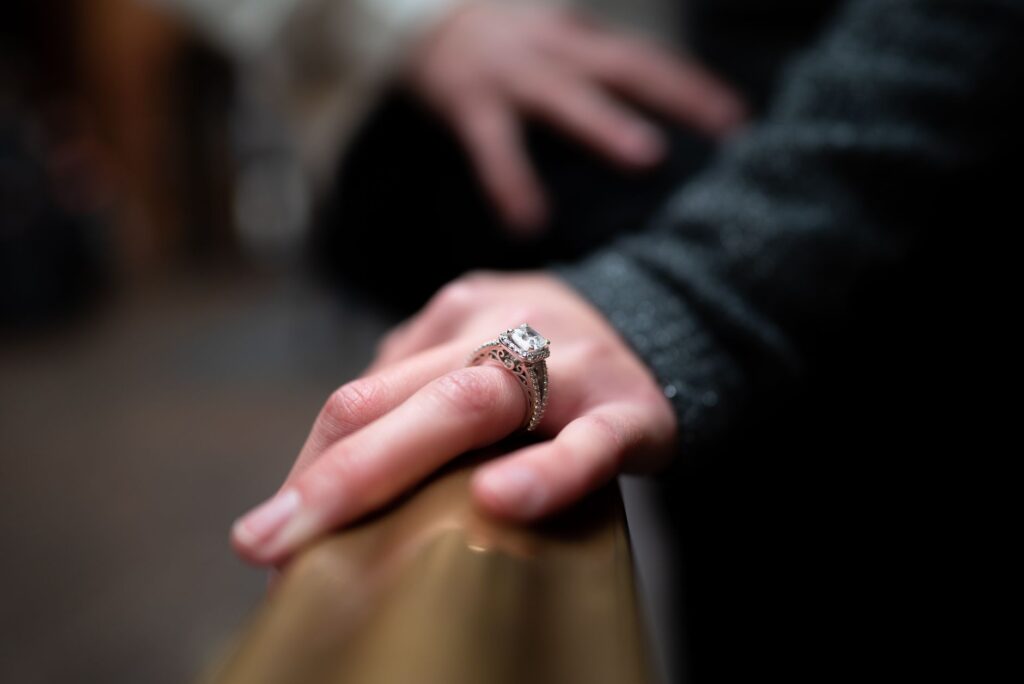
A 1 carat round can look substantial on a size 4 finger and more modest on a size 8 finger. The diamond itself has not changed. The visual context has.
This is one of the most overlooked parts of diamond shopping. The same stone can produce very different impressions depending on hand size, ring design, and how much band width surrounds it.
Sparkle affects perceived size
A bright, lively diamond often looks more noticeable than a dull diamond of slightly larger size. Strong light return can make a stone stand out and feel more present from a conversational distance.
This does not mean sparkle literally increases measurements. It means visual impact is not only about spread. A larger but poorly cut diamond may not give the bold look buyers expect.
Shape outline changes the impression
Round diamonds are the benchmark for comparison, but they are not always the most size-efficient shape. Elongated cuts such as oval, marquise, and pear can appear larger because their length creates more finger coverage. Emerald and radiant cuts can also look broad depending on their measurements.
Cushion cuts, by contrast, can face up smaller for their weight if they carry more depth or have rounded corners that reduce spread.
Factors That Change Apparent Size
Shape
Shape is one of the biggest drivers of apparent size. Some shapes naturally spread their weight over a larger visible surface.
| Shape | Typical Size Impression | Budget Notes |
|---|---|---|
| Round | Balanced and classic, but not usually the largest-looking per carat | Often the most expensive shape per carat due to demand and cutting loss |
| Oval | Often looks larger than round of same weight, longer outline adds coverage | Strong option for maximizing size, but watch for bow-tie effect and poor proportions |
| Pear | Elongated look can create strong size impression | Can offer good visual spread, but symmetry matters |
| Marquise | Usually one of the largest-looking shapes per carat | Excellent for finger coverage, though style is more specific |
| Emerald | Can look large due to open table and long lines | Clarity and color show more easily, so saving in those grades requires care |
| Radiant | Often offers good spread with a bright look | Can be a useful compromise between brilliance and rectangular shape |
| Cushion | Can look smaller for weight depending on cut style | Important to compare measurements carefully |
| Princess | Square outline can look modern, spread varies | Often less expensive than round, but corner protection matters |
Cut quality
Cut quality affects both sparkle and spread. In diamonds, cut refers to proportions and craftsmanship, not shape. A well-cut stone is arranged to return light effectively. That creates brightness, fire, and scintillation, which is the flashing sparkle people notice as the stone moves.
From a size perspective, cut also affects whether the weight is hidden. A diamond cut too deep may carry extra weight below the girdle, making it face up smaller for its carat. A very shallow diamond can look larger but may lose brightness or durability balance if the proportions are poor.
Depth percentage
Depth percentage compares the diamond’s depth to its width. Excessive depth is a common reason a diamond looks small for its weight. This is especially relevant in fancy shapes, where cut grading is not standardized the same way it is for round diamonds.
Buyers trying to maximize size should watch for stones that seem heavy in carat but have surprisingly small measurements. That can indicate hidden weight.
Length-to-width ratio
For elongated shapes, the length-to-width ratio influences how long and slender the diamond looks. Ovals, pears, marquises, and emerald cuts with pleasing ratios often give stronger finger coverage.
There is no universal perfect ratio because taste matters. A more elongated shape can appear larger, but if it becomes too narrow it may not look balanced to every buyer.
Setting design
The setting can dramatically affect apparent size. A halo surrounds the center stone with smaller diamonds, increasing the overall visual footprint. A thin band can make the center stone stand out more. A bezel may slightly reduce visible edge definition, while prongs can leave more of the outline exposed.
Well-chosen settings can make a modest center stone feel more prominent. They do not change carat weight, but they can improve presentation.
Metal color
White metal can help a near-colorless diamond blend and appear bright. Yellow or rose gold can sometimes make warmer diamonds more forgiving, especially if the head holding the stone is white metal. This can allow budget flexibility in color grade without making the diamond look obviously tinted face-up.
Real-World Size Examples
0.90 carat vs 1.00 carat round
This is one of the most important budget comparisons. A well-cut 0.90 carat round may measure around 6.2 to 6.3 mm, while a well-cut 1.00 carat round is often around 6.4 to 6.5 mm. That is a visible difference at close range, but usually not a dramatic one.
Price, however, can rise noticeably at the 1.00 carat mark. For buyers who want strong value, 0.90 to 0.95 carats is often a smart range. The diamond still looks substantial, and the savings can sometimes be redirected toward a better cut or setting.
1.00 carat round on a size 4 finger vs size 7 finger
On a size 4 finger, a 1.00 carat round can look bold and well-proportioned, covering a substantial part of the finger width. On a size 7 finger, the same stone still looks beautiful, but the impression is often more moderate and less dominant.
This is why online size opinions can be misleading. A diamond described as “large” or “small” often depends on the hand it is shown on.
1.50 carat oval vs 1.50 carat round
A 1.50 carat oval often appears larger than a 1.50 carat round because its elongated shape covers more finger length and frequently offers a broader face-up look. The oval can create a more dramatic size impression even when the carat weight is identical.
That does not automatically make oval better. Rounds usually have more standardized cut expectations and often stronger consistent brilliance. The choice depends on whether you prioritize a classic shape or a larger-looking outline.
2.00 carat cushion vs 2.00 carat oval
These can look surprisingly different. A 2.00 carat cushion may appear smaller than expected if it has a deep profile and rounded corners. A 2.00 carat oval often looks longer and may appear more prominent on the finger.
For buyers focused on visual size, this is a clear example of why shape and measurements matter at least as much as the carat figure.
Lab grown 2 carat vs natural 1 carat within a similar budget
In some budgets, a shopper choosing between natural and lab grown diamonds may find that a natural diamond around 1 carat costs a similar amount to a lab grown diamond around 2 carats, depending on quality factors and market conditions. Visually, the 2 carat stone will usually look much larger.
The trade-off is not in appearance, because both are real diamonds with the same basic physical and optical properties. The trade-offs are usually in budget allocation, personal preference, and resale expectations. Buyers prioritizing size often find lab grown diamonds to be the most direct path to larger visible spread.
Price vs Visual Benefit
Why price rises faster than visible size
Diamond prices do not increase in a straight line with visible size. Larger diamonds are rarer, and price jumps become steeper at benchmark carat weights and higher quality levels. The result is that the next size tier can cost much more while looking only moderately larger.
This is the principle of diminishing returns. It is one of the most important ideas for anyone trying to maximize size without overspending.
The value of buying just under milestone weights
Paying for 0.98 instead of 1.00, or 1.90 instead of 2.00, often produces better value because the visual difference is usually small while the pricing can be meaningfully lower. This strategy does not work in every individual listing, but it is consistently worth checking.
For practical buying, it is often wiser to compare measurements and total appearance than to insist on a psychologically satisfying round number.
When paying more is worth it
There are cases where spending more makes sense. Moving to a larger size can be worthwhile if the increase changes the overall look you want, especially on a larger finger or in a design that needs more center presence. Spending more can also be justified for cut quality, since a lively diamond often delivers more beauty and stronger visual presence than a heavier but poorly cut one.
The key question is not whether an upgrade is objectively bigger. It is whether the visible improvement is meaningful to you relative to the additional cost.
Natural vs lab grown value for size
For maximizing diamond size on a budget, lab grown diamonds are often the most efficient option. They are real diamonds and can offer substantially larger carat weights for the same budget compared with natural diamonds. That makes them especially relevant for shoppers who care most about face-up size.
Still, budget efficiency is only part of value. Some buyers prioritize natural origin, long-term perception, or personal significance. Others want the largest visually impressive diamond possible within a fixed spending limit. Neither priority is automatically right or wrong. They simply lead to different choices.
Who Should Size Up
Buyers with larger finger sizes
If the wearer has a larger finger size, a modest carat weight may not create the same presence it would on a smaller hand. Sizing up can help maintain the proportion you want, especially in solitaire settings where the center stone carries most of the visual impact.
Buyers choosing simpler settings
A solitaire ring exposes the center stone without extra diamond accents to increase footprint. That clean look is elegant, but it also means the center diamond has to do more visual work. In that situation, a slightly larger center may be worth the budget if size is important.
Buyers who strongly prefer round diamonds
Round diamonds are often less size-efficient than elongated shapes, but they remain the most popular shape for good reason. If your heart is set on round, you may need to allocate more budget to achieve the same face-up impression another shape could create for less.
That is not a mistake. It is simply a preference-driven choice. The key is understanding the cost of that preference in advance.
Buyers comparing natural and lab grown strictly on appearance
If your goal is to maximize visible size and overall visual impact, moving up in carat through a lab grown diamond may be the most rational path. A larger, well-cut lab grown diamond often creates a stronger size impression than a smaller natural diamond at the same budget.
Who Can Save Money
Buyers open to just-below benchmark weights
This group often captures some of the best value in the market. A diamond just under 1.00, 1.50, or 2.00 carats can look very similar to the benchmark while avoiding part of the price premium.
Buyers willing to choose an elongated shape
Oval, pear, marquise, and some emerald cuts can provide more apparent size than round diamonds of equal weight. That means you may not need to increase carat as much to get the look you want.
Buyers comfortable with near-colorless grades
In many settings, especially in round brilliants and well-chosen mountings, near-colorless grades can look very white to the eye. This depends on shape, setting, and personal sensitivity to color, but there is often room to save here without sacrificing noticeable beauty.
Buyers targeting eye-clean clarity
Eye-clean means inclusions are not visible to the naked eye in normal viewing conditions. Paying for very high clarity grades can make sense for some buyers, but it often does little for visible appearance compared with allocating that money toward size or cut.
Buyers open to halo settings or slimmer bands
A halo can make the center look larger overall, and a thinner band can help the center stone appear more prominent. Buyers who care about overall visual spread rather than center-stone purity alone can often create a larger look through design choices.
Practical Strategies for Maximizing Diamond Size on a Budget
Prioritize cut before chasing extra carat
A well-cut diamond usually gives a better overall result than a heavier stone with poor proportions. Brightness, sparkle, and balanced spread all contribute to presence. A badly cut diamond can feel disappointing even when the carat number looks attractive on paper.
Compare measurements, not just weight
Always check the millimeter dimensions. For round diamonds, compare diameter. For fancy shapes, compare length and width along with shape balance. A stone that seems cheap for the carat may have smaller-than-expected measurements.
Consider size-efficient shapes
If visible size is a major goal, look closely at oval, pear, marquise, radiant, and some emerald cuts. These shapes often create more coverage than round diamonds of the same weight. They are not automatically better, but they deserve serious consideration in a size-focused budget.
Stay below magic weights when possible
Search ranges like 0.90 to 0.99, 1.40 to 1.49, or 1.80 to 1.99 carats. In many cases, these stones offer better price efficiency while preserving most of the visual look of the next benchmark size.
Be selective with color and clarity
Rather than aiming for the highest grades, look for combinations that are visually attractive in real life. For many buyers, a near-colorless, eye-clean diamond offers a better balance than paying a premium for top-tier grades with little visible payoff.
Use the setting to support size perception
A thin shank, halo, tapered side stones, or an elongated center orientation can all influence how prominent the ring looks. The setting should support the center stone, not fight it.
Consider lab grown if size is the priority
For a fixed budget, lab grown diamonds often provide the largest size increase without requiring obvious sacrifices in appearance. They are especially relevant for buyers who want 1.5 carats, 2 carats, or larger while staying within a moderate spending range.
Common Buyer Mistakes
Chasing the highest carat number available
This can lead to poorly cut diamonds, hidden weight, or sacrifices in overall beauty. Bigger on paper is not always better on the hand.
Ignoring dimensions
Carat weight without measurements gives an incomplete picture. A diamond can be heavy and still look small face-up.
Overpaying for milestone weights
Insisting on 1.00 or 2.00 exactly often increases price more than appearance. A slightly lower weight may look nearly identical once mounted.
Paying too much for clarity that cannot be seen
Microscopic differences between higher clarity grades may not affect visible beauty. That budget can often be used more effectively elsewhere.
Assuming all fancy shapes look large
Some do. Some do not. Ovals and marquises often spread well, while certain cushions and deep princess cuts may face up smaller. Every shape still needs measurement review.
Using online photos without scale context
Magnified photos can distort expectations. Always translate what you see into millimeters and real-world finger coverage.
Choosing a setting that visually shrinks the center stone
A very thick band or heavy metal around a small center can reduce the apparent dominance of the diamond. Proportion between ring design and center size matters.
Budget-Focused Comparison Table
| Strategy | Effect on Visible Size | Effect on Budget | Main Watchout |
|---|---|---|---|
| Buy just under a benchmark weight | Usually very similar appearance | Often saves meaningful money | Do not assume all stones near the weight have equal spread |
| Choose oval, pear, or marquise | Often increases finger coverage | Can improve size efficiency | Need to assess symmetry and cut quality carefully |
| Lower clarity to eye-clean range | No size change, but frees budget for larger stone | Often strong savings | Eye-clean standard varies by shape and viewer |
| Lower color within attractive range | No size change, but may fund more carat | Can save substantially | Some shapes reveal color more easily |
| Choose a halo setting | Increases overall visual footprint | Can be cost-effective vs larger center | Does not increase center stone size itself |
| Choose lab grown diamond | Often allows much larger center stone | Highest size gain per dollar in many cases | Resale expectations differ from natural diamonds |
Frequently Asked Questions
Is a 0.90 carat diamond noticeably smaller than a 1 carat diamond?
Usually it is only slightly smaller, especially if both are well cut. At close inspection the difference can be visible, but once set and worn, many people find the visual gap modest compared with the price difference.
What diamond shape looks the biggest for the money?
Marquise, oval, and pear shapes often create some of the largest visual spread per carat. However, the best choice also depends on whether you like the shape and whether the specific stone has good proportions.
Does a halo make a diamond look bigger?
Yes, a halo increases the overall visual footprint of the ring and can make the center appear more prominent. It does not increase the center diamond’s actual size, but it can be an effective design strategy on a budget.
Should I sacrifice cut to get a larger carat size?
Usually no. Poor cut can reduce sparkle and even make the diamond face up smaller if too much weight is hidden in depth. A well-cut diamond often looks better and more impressive than a larger but poorly cut stone.
Are lab grown diamonds the best option for maximizing size on a budget?
They are often the most efficient option if visible size is your top goal. Lab grown diamonds can offer much larger carat weights for the same budget. The trade-offs relate more to personal preference and resale expectations than to appearance.
Does finger size really change how big a diamond looks?
Yes. The same diamond can look large on a smaller finger and more moderate on a larger finger. Finger coverage is a real part of size perception.
Can I go lower in color and clarity without it being obvious?
Often yes, but it depends on shape, setting, and your sensitivity to those traits. Round brilliants tend to hide body color and inclusions better than step cuts such as emerald cuts, which show more transparency and structure.
Is it better to buy a 1 carat natural diamond or a 2 carat lab grown diamond?
That depends on your priorities. If size and visual impact matter most, the 2 carat lab grown diamond will usually deliver a much larger look. If natural origin is important to you, the smaller natural diamond may be the better fit. The right choice is based on values, not just measurements.
Conclusion
Learning how to maximize diamond size on a budget starts with a shift in thinking. The goal is not simply to buy the most carat weight possible. The goal is to buy the best visible size and overall appearance your budget can support.
That usually means focusing on face-up measurements, choosing a shape with strong spread if you like it, avoiding steep premiums at benchmark weights, protecting cut quality, and making practical choices in color and clarity. It can also mean using the setting strategically or considering lab grown diamonds if a larger look matters more than natural origin.
The most informed buyers tend to ask a different question from the start. Not “How many carats can I get?” but “How large will it actually look, and is that visual difference worth the money?” That question leads to better decisions, better value, and fewer surprises once the ring is on the hand.