Diamond clarity is one of the four main quality factors used to evaluate a diamond, but for many buyers it is also one of the easiest to misunderstand. A clarity grade can sound important on paper while having very little effect on how the diamond actually looks once it is set in a ring. That is especially true for lab grown diamonds, where higher clarity grades are common and the pricing differences can be significant.
If you are trying to understand How to Read Diamond Clarity Grades, the most important idea is this: the grade tells you how many internal or surface features a diamond has, but it does not automatically tell you whether those features matter in real life. Some inclusions are visible only under magnification, some can be seen from a normal viewing distance, and some have little impact on appearance at all.
For buyers, the goal is not to memorize gemology terms. The goal is to learn how to judge whether a diamond looks clean, whether the clarity grade is good value, and whether paying more for a higher grade will actually change the appearance of the stone. Once you understand that, clarity becomes much easier to use as a buying tool rather than a confusing label.
Quick Answer
Diamond clarity grades describe how free a diamond is from internal inclusions and external blemishes. The higher the clarity grade, the fewer imperfections the diamond has, but that does not always mean the diamond looks noticeably better to the naked eye.
For many buyers, especially in lab grown diamonds, an eye-clean VS2 or SI1 can be a smart balance of appearance and value. In many cases, paying extra for VVS or FL clarity provides little visible benefit unless you specifically want a very high grade or are shopping for a particularly large diamond.
The best way to read clarity grades is to ask two questions: Can I see anything with my eyes? and Does the inclusion affect beauty or durability? If the answer is no, the higher clarity grade may be more about the report than the actual appearance.
What Diamond Clarity Means
Diamond clarity is the grading system used to describe how many inclusions and blemishes are present in a diamond. Inclusions are internal features, while blemishes are surface features. Both are usually natural results of the diamond formation or cutting process.
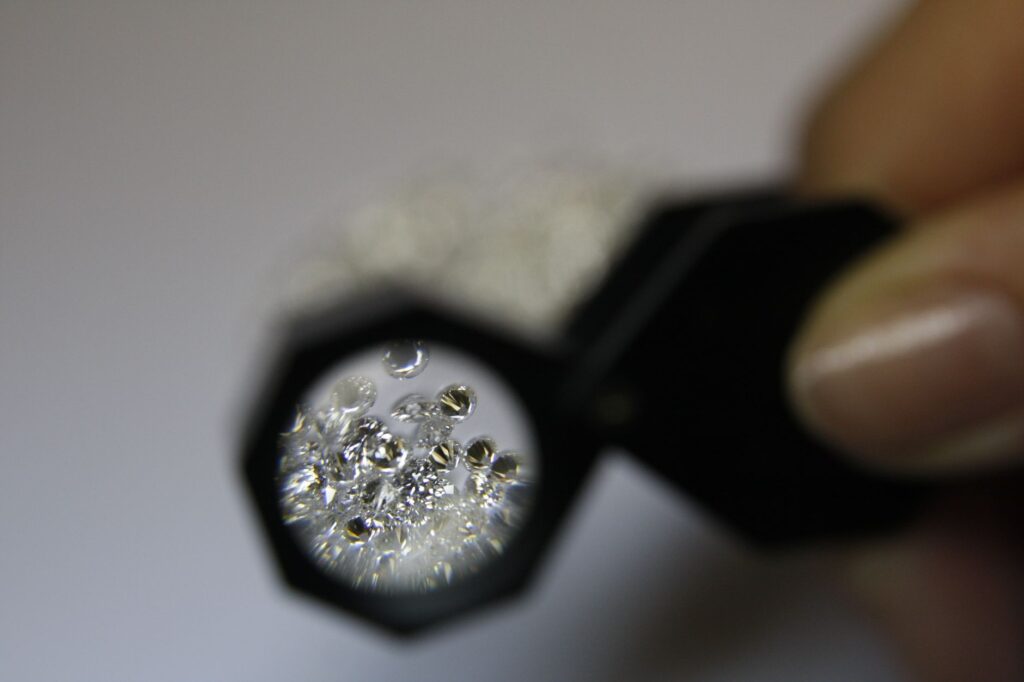
Clarity grades are assigned after a diamond is examined under magnification, usually 10x magnification, which is the standard used by major grading labs. That means the grade is not based on what the average person sees with the naked eye. It is based on what a trained grader sees under controlled viewing conditions.
This distinction matters. A diamond can have a lower clarity grade and still look bright and clean in everyday life. Another diamond can have a higher grade yet look almost identical in a ring because its inclusions are tiny, well hidden, or difficult to notice without magnification.
The Standard Clarity Scale
The common clarity scale moves from the least included diamonds to the most included ones as follows:
- FL or Flawless
- IF or Internally Flawless
- VVS1 and VVS2
- VS1 and VS2
- SI1 and SI2
- I1, I2, and I3
As you move down the scale, inclusions become more numerous or easier to see. In practical terms, that usually means the diamond may be less visually clean, although the exact effect depends on the type, size, location, and color of the inclusions.
Clarity Grades Do Not Tell the Whole Story
A clarity grade is only one part of the story. Two diamonds with the same grade can look very different. One SI1 may be eye-clean, while another SI1 may have a noticeable dark crystal near the center.
That is why experienced buyers and jewelers do not rely on the grade alone. They also look at the clarity plot on the grading report, study magnified images or videos when available, and check how the diamond looks in normal lighting.
How Diamond Clarity Is Graded
Clarity grading is done by looking at a diamond under magnification and evaluating the size, number, position, nature, and visibility of internal and external features. These are sometimes summarized as the type, size, number, position, and relief of the inclusions.
Position is especially important for buyers. An inclusion near the edge may be hidden by a setting, while a similar inclusion under the center table could be easier to notice. That is one reason the same clarity grade can lead to different real-world outcomes.
Relief refers to how much an inclusion stands out from the surrounding diamond. A white feather or transparent crystal may blend in more easily than a dark crystal or black pinpoint cluster.
Why Grading Labs Use Magnification
Most clarity grading is done at 10x magnification because that is the industry standard. At that level, even very small features can be seen and evaluated. The purpose is consistency, not to predict how a diamond will appear in everyday use.
This is an important point for buyers. A diamond that looks clean to your eyes may still receive a lower clarity grade because magnification reveals features that are invisible in real life. That does not make the grade wrong. It simply means the grading system measures a different level of detail than casual viewing.
What Buyers Actually See
For most people, the key question is not how many inclusions exist, but whether they can be seen without magnification. That is where the concept of eye-clean becomes useful.
What Does Eye-Clean Mean?
An eye-clean diamond is one that does not show visible inclusions to the naked eye under normal viewing conditions. This usually means looking at the diamond from a typical distance, such as 6 to 10 inches away, in regular lighting.
Eye-clean is not a formal grading term with one universal definition. Different jewelers may use it differently. Some mean the diamond is clean when viewed face-up, while others may include side views as well. Because of that, buyers should always ask how eye-clean was evaluated.
Face-Up View Versus Side View
A diamond may look clean from the top but reveal inclusions when viewed from the side. This is common and not necessarily a problem. Most people see engagement rings from above or at an angle, not by inspecting them with magnification.
Still, side visibility can matter if you are especially sensitive to visible inclusions or want a diamond that looks clean from all angles. This is one reason why inclusion location matters as much as the grade itself.
Lighting Matters
Inclusions can be easier or harder to notice depending on the light. Bright direct lighting may reveal more, while softer indoor lighting can hide many features. Sunlight, office lighting, and store lighting each show diamonds differently.
For buyers, this means a stone should be judged in more than one lighting environment if possible. A diamond that looks flawless under one light may show a crystal or feather in another, especially at lower clarity grades.
Common Clarity Grades Explained
When learning How to Read Diamond Clarity Grades, it helps to translate the grade into practical buying language. The table below gives a simple overview of what each range usually means in everyday terms.
| Clarity Grade | What It Means | What Buyers Usually See | Typical Buying Value |
|---|---|---|---|
| FL | No inclusions or blemishes visible under 10x magnification | No visible flaws, even under strong magnification | Highest grade, but often little visual advantage over IF or VVS |
| IF | No internal inclusions visible under 10x magnification | Appears extremely clean | Premium grade, mostly about rarity |
| VVS1 / VVS2 | Very, very slight inclusions, extremely hard to see under magnification | Usually eye-clean | High grade, often more than most buyers need |
| VS1 / VS2 | Very slight inclusions, difficult to see under magnification | Often eye-clean, especially in well-cut stones | Strong balance of quality and value |
| SI1 / SI2 | Slight inclusions, easier to see under magnification | May be eye-clean or may show visible inclusions | Can offer excellent value if chosen carefully |
| I1 / I2 / I3 | Inclusions are obvious under magnification and often visible without it | Visible flaws are likely | Lowest clarity range, usually chosen for budget reasons |
FL and IF
FL and IF diamonds are extremely rare in natural diamonds and more available in lab grown diamonds. They have no visible inclusions under 10x magnification, which sounds impressive, but the real-world difference compared with high-end VS or VVS stones is often minimal.
Buyers usually choose these grades for the status of having the top clarity label, not because the diamond will look dramatically better in daily wear. If budget is limited, the premium often makes more sense elsewhere, such as cut quality or carat size.
VVS1 and VVS2
Very, very slight inclusion grades are still considered high clarity. The inclusions are extremely difficult to see under magnification and usually impossible to spot without it.
For most buyers, VVS is more than enough from a visual standpoint. In many lab grown diamonds, this range is common, which can make it feel like a safe choice. The trade-off is that you may be paying for a label that looks no different from a well-chosen VS stone.
VS1 and VS2
VS clarity is often the sweet spot for shoppers who want a diamond that is likely to look clean without paying for ultra-high grades. The inclusions are small and usually hard to find even under magnification.
Many experienced buyers consider VS1 and VS2 the most practical clarity choices for everyday wear, especially when the diamond has a good cut and the inclusions are not centrally located. In lab grown diamonds, VS stones can be a very efficient value point.
SI1 and SI2
Slightly included diamonds can vary a lot. Some SI1 stones are eye-clean and excellent values. Others have inclusions that are easy to spot if you know where to look. SI2 stones are more likely to show visible features, but that is not guaranteed.
This is where careful evaluation matters. An SI diamond should never be judged by grade alone. Buyers should look at the exact inclusion type and placement before deciding whether it is suitable.
I1, I2, and I3
Diamonds in the lower clarity range often have visible inclusions that can affect appearance. In some cases, they may also affect durability if the inclusions are in a weak area or reach the surface.
These grades are usually chosen for price reasons. They can work for some budget-focused buyers, but they require more careful inspection than higher clarity grades.
Why Clarity Matters
Clarity matters because it affects how clean the diamond looks, how much you pay, and how satisfied you may feel after purchase. That said, it is not always the quality factor that has the biggest impact on appearance. Cut quality, for example, often has a stronger effect on sparkle and beauty.
Still, clarity deserves attention because visible inclusions can draw the eye away from the center of the stone. If a dark crystal or feather is obvious, the diamond may look less bright or less balanced, especially in larger stones.
Appearance
The first reason clarity matters is appearance. Some inclusions can be seen only at close range, while others may be visible immediately when you look at the diamond. A stone that is technically a higher grade may still look less appealing if the inclusion is dark and poorly placed.
Value
Clarity also affects price. As the grade rises, the price can increase significantly, especially in the top ranges. The challenge for buyers is that the price increase is often greater than the visible improvement.
Durability
Most inclusions do not affect durability. However, some features, such as feathers, cavities, or chips near the surface, can make a diamond more vulnerable if they are positioned in a weak area. This is worth paying attention to, especially in lower clarity grades.
How Clarity Affects Appearance
Clarity influences appearance mainly through visibility. A diamond with small, well-hidden inclusions may look crisp and transparent. A diamond with a larger, darker, or centrally located inclusion may look less clean, even if the grade is only moderately lower.
The location of the inclusion often matters as much as the grade itself. An inclusion under the table, which is the flat top section of the diamond, is more likely to catch the eye than one near the edge or under a prong.
Transparency and Sparkle
Some inclusions, especially clouds or dense clusters of pinpoints, can slightly affect transparency if they are concentrated enough. That may reduce the crispness of the diamond’s appearance. In well-cut diamonds, this is less common, but it is still something to check.
Most single, isolated inclusions do not affect sparkle in a meaningful way. Sparkle is much more strongly influenced by cut. A well-cut VS or SI diamond can look more lively than a poorly cut VVS diamond.
When You Can See an Inclusion
Buyers are most likely to notice inclusions when the diamond is large, when the inclusion is dark, and when it sits in the center of the stone. Visibility can also increase in step cuts like emerald cuts, because their large open facets make internal features easier to see than in brilliant cuts.
Round brilliants tend to hide inclusions better than many other shapes because their faceting pattern breaks up reflections. That is one reason a lower clarity grade may still look eye-clean in a round diamond.
How Clarity Affects Value
Clarity has a strong effect on price, but not always on beauty. That is the core value question for most buyers: How much more am I paying, and what am I actually getting?
In many cases, the biggest price jump happens between the clarity ranges that are already eye-clean and those that are technically cleaner under magnification. If a buyer cannot see the difference, the extra cost may not be a good use of budget.
When Paying More Makes Sense
Paying more for higher clarity can make sense if you want peace of mind, are purchasing a larger diamond, or are working with a shape that exposes inclusions more easily. It can also make sense if the diamond will be viewed very closely or if you simply prefer a higher-grade report.
Some buyers also value the rarity factor. In that case, the premium is being paid not only for visible appearance, but also for the comfort of owning a top-tier grade.
When the Premium Is Hard to Justify
If a VS2 or SI1 diamond looks clean in normal viewing conditions, moving up to VVS may not produce a visible difference. In that situation, the price increase is usually better spent on cut quality, a better setting, or a slightly larger carat size.
This is especially true in lab grown diamonds, where very high clarity grades are common. The market often offers more VVS and even higher-grade stones than buyers actually need from a visual standpoint.
Inclusions You Should Know
Understanding the types of inclusions helps you read clarity reports more intelligently. A grade alone tells only part of the story. The type of inclusion can influence visibility, durability, and overall buying confidence.
Feather
A feather is a small crack or fracture inside the diamond. It can look like a white, wispy line under magnification. Many feathers are harmless and too small to matter visually.
Buyers should pay more attention if the feather reaches the surface or sits near an edge, because that can create a slight durability concern. A protected feather in the middle of the stone is usually less worrisome than one at a vulnerable point.
Crystal
A crystal is another mineral trapped inside the diamond. It may appear white, transparent, or dark. Crystals are common and often have little effect on durability.
What matters most is color and placement. A dark crystal near the center is more likely to be visible than a pale one near the edge.
Cloud
A cloud is a group of tiny pinpoints that can appear as a hazy area under magnification. A small cloud usually does not affect appearance. A dense cloud, however, can reduce brightness or transparency if it is large enough.
Clouds deserve attention when they are listed prominently on a report, especially if the diamond has lower clarity or if the cloud appears near the center.
Needle
A needle is a long, thin inclusion that looks like a tiny rod under magnification. Needles are often not visible without magnification and usually do not affect durability.
They are more of a grading detail than a practical concern unless there are many of them or they contribute to a cloudy appearance.
Pinpoint
Pinpoints are extremely small dots inside the diamond. One or two pinpoints usually do not matter to the eye. A cluster of pinpoints can sometimes contribute to a cloud or slightly reduce transparency.
On their own, pinpoints are usually low concern for buyers.
Twinning Wisp
A twinning wisp is a line or ribbon-like feature that often appears in lab grown diamonds. It is related to how the crystal grew and is common in some growth processes.
Many twinning wisps are not visible in normal viewing conditions. Some can be seen under magnification, but they rarely cause a problem unless they create noticeable texture, haze, or concentration in the center of the stone.
Knot
A knot is a crystal that reaches the surface of the diamond. Because it is exposed, it may be more relevant to surface durability than an inclusion buried deep inside the stone.
Knot inclusions are less common in well-cut stones, but when present they deserve attention because they can be more visible and potentially more vulnerable.
Cavity
A cavity is a small opening or indentation on the diamond’s surface. It can form where a crystal broke away during cutting or polishing.
Cavities are usually more of a concern than internal inclusions because they are surface features. They may collect dirt and can be easier to see.
Chip
A chip is a small missing piece on the diamond’s surface, often at a facet edge or point. Chips can affect both appearance and durability, depending on size and location.
Buyers should be cautious with chips, especially if they are visible in a report or inspection image. A chip is more significant than a tiny internal pinpoint because it is part of the surface itself.
Practical Examples of Clarity in Real Life
Real-world examples are often the easiest way to understand clarity. The same grade can lead to different outcomes depending on cut, shape, size, and inclusion placement.
VS2 Versus SI1
This is one of the most common comparison points for buyers. In many cases, a well-chosen SI1 will look very similar to a VS2 when viewed face-up. If the SI1’s inclusion is small, white, and off to the side, it may be just as suitable for daily wear.
However, not every SI1 is eye-clean. If the inclusion is dark or near the center, the difference can be obvious. That is why it is better to compare the specific stone rather than assume all SI1 diamonds are the same.
Eye-Clean SI1 Versus Non-Eye-Clean SI1
An eye-clean SI1 can be an excellent value because the diamond looks better than the grade might suggest. A non-eye-clean SI1 may still be a valid budget choice, but the buyer should expect to see a flaw at normal viewing distance.
This difference is exactly why SI1 requires inspection. The grade alone does not tell you whether the diamond is a bargain or a compromise.
VVS Versus VS for Everyday Wear
For many shoppers, the visual difference between VVS and VS is negligible in daily use. Both often appear clean to the eye. The main difference is that VVS has inclusions that are harder to find under magnification.
If your priority is practical appearance, VS often provides better value. If your priority is a higher report grade or a strong sense of rarity, VVS may still appeal to you.
Round Brilliant Versus Emerald Cut
Clarity tends to matter more in step cuts, such as emerald cut or asscher cut diamonds, because their large open facets make the interior easier to see. In a round brilliant, many inclusions are hidden by the faceting pattern and sparkle.
This means a lower clarity grade may be more acceptable in a round diamond than in an emerald cut of the same size. Buyers should always consider shape when evaluating clarity.
Advantages of Higher Clarity Grades
Higher clarity grades do have real advantages, especially when viewed from a quality and peace-of-mind perspective. They are not only about bragging rights.
- Fewer inclusions are present under magnification.
- The diamond is less likely to show visible flaws.
- There is more confidence when inspecting the stone closely.
- Higher grades can be appealing in larger diamonds or open-facet shapes.
- They may be preferred by buyers who want a top-tier report.
In lab grown diamonds, high clarity is common, so a high-grade stone can feel like a safe and simple choice. The main advantage is certainty, not always visible beauty.
Disadvantages and Trade-Offs
The downside of higher clarity is that the price often rises faster than the visual benefit. Many buyers end up paying for a difference that only exists under magnification.
- Higher grades can cost significantly more.
- The visual improvement may be impossible to notice.
- Money spent on clarity may reduce budget for cut or size.
- Top grades can create unnecessary pressure to “buy the best” rather than the best value.
Another trade-off is emotional. Some buyers feel more secure with a higher grade and later realize the diamond looks no different from a less expensive option. That does not mean the purchase was wrong, but it does mean the premium was mostly about comfort rather than appearance.
Buying Considerations for Clarity
When evaluating clarity, it helps to think like a practical buyer rather than a grading report reader. The report matters, but the stone in front of you matters more.
Budget
If your budget is limited, clarity is often one of the easiest places to avoid overpaying. A well-chosen VS2 or SI1 can leave room in the budget for better cut, which usually has a bigger effect on beauty.
In lab grown diamonds, this strategy can be especially effective because higher clarity options are abundant. Buyers do not usually need to chase the highest grade to get a visually clean diamond.
Eye-Clean Priority
If your main goal is an eye-clean diamond, focus on the stone rather than the label. Ask whether the diamond is eye-clean face-up, at what distance, and in what lighting. If available, use magnified photos or videos to identify the inclusion’s placement.
This is especially important for SI1 and SI2 stones. Some are excellent values. Others are not.
Lab Grown Diamond Considerations
Lab grown diamonds often have very high clarity because of the controlled growth environment. That can make VVS and even higher grades more common than in natural diamonds.
For buyers, this means the practical value of an ultra-high clarity grade may be lower than expected. The market often offers plenty of visually clean options below the top tier.
Inclusion Placement
Placement is one of the most important details in clarity evaluation. A small inclusion in the corner may be easy to hide with prongs. A similar inclusion in the center may be much more noticeable.
Always check where the inclusion sits. A clarity grade without placement context can be misleading.
Shape and Faceting Style
Round brilliant diamonds generally hide inclusions better than step cuts. Oval, pear, and marquise shapes can also show inclusions differently depending on where the inclusion sits.
If you are researching diamond shapes, keep clarity in context. The same grade can perform differently across shapes.
Long-Term Satisfaction
Some buyers simply feel better owning a higher clarity diamond, even if the difference is not visible. That preference is valid if the budget allows it. Others care more about appearance and overall value, in which case a lower grade may be the smarter choice.
The best decision is the one that aligns with your priorities after you understand the trade-offs.
Common Buyer Mistakes
Clarity is easy to overthink, and that can lead to mistakes that cost money without improving the diamond’s appearance.
Overpaying for Invisible Improvements
One of the most common mistakes is paying a large premium for a grade change that will not be visible in everyday wear. A buyer may move from VS2 to VVS2 and get almost no practical benefit.
That money could often have gone toward a better setting, stronger cut quality, or a slightly larger center stone.
Ignoring Inclusion Location
Another mistake is focusing only on the grade and ignoring the inclusion plot. A diamond with a good grade can still have a bothersome inclusion if it is centrally located or dark in color.
Location can matter as much as size, sometimes more.
Assuming All SI Diamonds Look the Same
This is not true. One SI1 can be eye-clean and another can show an obvious flaw. The same is true for SI2, where some stones may still be acceptable while others are visibly included.
Buyers should never use the grade as a substitute for evaluation.
Choosing Based Only on the Report Label
A report label is helpful, but it is not a complete buying guide. The same clarity grade can hide very different visual outcomes. Experienced shoppers know that the report is the starting point, not the final answer.
How to Read a Clarity Report
A clarity report usually tells you the grade and may include a plot showing where the inclusions are located. This is valuable because it helps you understand whether the flaw is likely to be visible or hidden by a setting.
Look for three things on the report: the clarity grade, the inclusion types, and the inclusion positions. If possible, compare the report with a magnified image or video of the actual diamond.
What the Clarity Plot Can Tell You
The plot is a map of inclusion types and locations. It can show whether the inclusions are near the center, spread around the stone, or concentrated near the edges. This is especially useful when deciding between similar grades.
However, the plot is only part of the story. It does not always show how visible the inclusions are in normal viewing conditions.
Why Videos and Images Matter
In online shopping, magnified videos can be more useful than the report itself because they show how the diamond actually looks. A report might say SI1, but the video may reveal an eye-clean stone. Another may show a visibly dark crystal that you would want to avoid.
If you cannot see the diamond in person, images and videos are especially important for clarity evaluation.
How Clarity Interacts With Cut and Color
Clarity does not exist in isolation. The way a diamond is cut, and the color grade it has, both affect how noticeable inclusions appear.
A very bright, well-cut diamond can mask minor inclusions better because the sparkle draws the eye. A poorly cut diamond may make inclusions easier to notice because the stone lacks life and contrast.
Likewise, a lower color grade may make some inclusions more noticeable if the stone has a slight tint, while a high-color diamond may seem cleaner overall. That is why buyers should consider the full combination of quality factors, not clarity alone.
Frequently Asked Questions
Is VS2 good enough for a diamond ring?
For many buyers, yes. A VS2 diamond is often eye-clean and offers a strong balance of appearance and value. The exact answer depends on the inclusion type, size, and placement, but VS2 is commonly a practical choice.
Is SI1 bad quality?
No. SI1 means slight inclusions, not poor quality. Some SI1 diamonds are excellent values and look very clean. Others show visible flaws, so the individual stone matters more than the grade label.
Do lab grown diamonds need higher clarity grades?
Not necessarily. Lab grown diamonds often come with very high clarity by nature of the growth process, but that does not mean every buyer needs VVS or better. Many buyers can choose a lower grade and still get a clean-looking stone.
Can inclusions affect durability?
Sometimes, but not always. Most internal inclusions do not create a durability issue. Surface-reaching features like feathers, chips, cavities, or knots deserve more caution because they can be weaker points in the stone.
What clarity grade looks clean to the naked eye?
Often VS1, VS2, and some SI1 diamonds appear eye-clean, especially when well cut. Some VVS and above are also eye-clean, but the higher grade does not guarantee a visible difference. Eye-clean depends on the specific diamond, not only the grade.
Should I avoid SI2 diamonds?
Not automatically, but SI2 requires more careful inspection. Some SI2 diamonds may be acceptable for budget buyers, while others have obvious inclusions that are easy to see. If you are considering SI2, examine the stone closely before deciding.
Why do lab grown diamonds often have high clarity?
Because the growth process can produce diamonds with fewer of the kinds of inclusions commonly seen in natural stones. That said, lab grown diamonds can still have growth-related features such as twinning wisps, clouds, or crystals. High clarity is common, but not guaranteed.
Is a flawless diamond worth it?
For most buyers, the visible difference from a very high VS or VVS diamond is small or nonexistent. Flawless diamonds are rare and valuable, but the premium is usually driven more by rarity than by appearance. Whether it is worth it depends on your priorities and budget.
Practical Takeaways for Buyers
If you want the simplest approach to clarity, start with this: focus on whether the diamond is eye-clean, not just on whether it has a higher grade. That is the most useful real-world standard for most buyers.
For many shoppers, especially in lab grown diamonds, VS2 and selected SI1 diamonds offer an excellent balance of appearance and value. Higher grades can be worthwhile if you want the peace of mind of an ultra-clean report, but they are not always the best use of money.
When learning How to Read Diamond Clarity Grades, remember that inclusion type, placement, shape, and cut all influence what you actually see. A good buying decision comes from looking at the whole diamond, not just the label on the report.
The most practical next step is to compare the specific stone, ask whether it is eye-clean, and check where the inclusions are located. That approach gives you a much clearer picture of value than the grade alone.