When shoppers compare SI2 vs I1 diamonds, the real question is usually not which grade sounds better on paper. It is whether the difference can be seen in everyday wear, whether the inclusion affects durability, and whether the lower price of an I1 stone actually makes sense for the way the diamond will be used.
Clarity is one of the most misunderstood parts of diamond shopping because the grading scale can sound more precise than it often looks in real life. Two diamonds with the same clarity grade can look very different from one another depending on the size, type, color, and location of the inclusion. That is especially true when comparing SI2 and I1, where the gap in appearance can be meaningful, but not always predictable from the grade alone.
Quick Answer
SI2 diamonds are usually cleaner and more predictable than I1 diamonds. In many cases, an SI2 diamond has inclusions that are visible only under close inspection or from certain angles, while an I1 diamond is more likely to have inclusions that can be seen without magnification.
That does not mean every SI2 looks better than every I1, or that every I1 is visibly flawed. Some I1 diamonds can still be eye-clean in the setting, and some SI2 diamonds can have noticeable marks if the inclusion is large or poorly placed. The most important factor is not just the grade, but whether the diamond is eye-clean, how the inclusion affects the stone’s transparency and durability, and how much you are paying for the visible difference.
For many buyers, a well-chosen SI2 offers a better balance of appearance and value than an average I1. But if budget is the main concern and the diamond has been carefully inspected, an eye-clean I1 can be a practical option in some cases. The right choice depends on what you can actually see, not just the clarity label on the report.
Understanding Diamond Clarity
Diamond clarity is a measure of how free a diamond is from internal characteristics called inclusions and external characteristics called blemishes. Most clarity discussions focus on inclusions because they are usually what buyers are trying to understand when comparing stones.
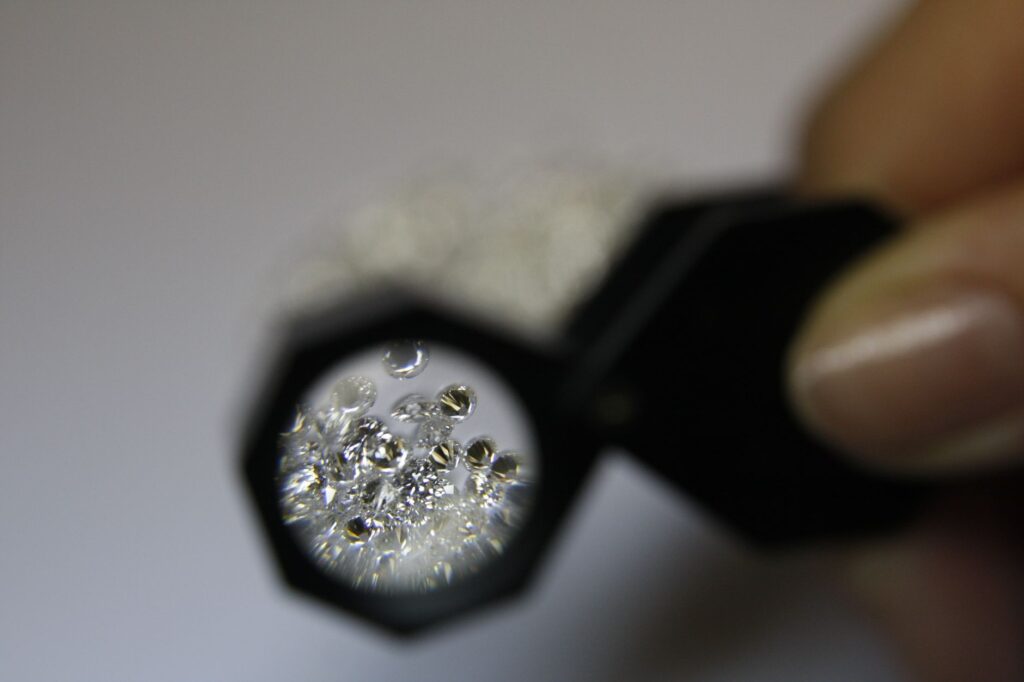
Clarity grades do not mean a diamond is “good” or “bad.” They describe how visible these characteristics are under a trained grader’s inspection, typically with 10x magnification. That is important because what counts on a grading report is not always the same as what a buyer notices on the hand, in normal lighting, or in a finished ring.
What SI2 Means
SI2 stands for Slightly Included 2. It is a clarity grade where inclusions are noticeable to a trained grader and may be visible without magnification, depending on the stone.
In practical terms, SI2 diamonds can range from stones that look quite clean face-up to stones with obvious inclusions that are easy to spot. This variation is why SI2 is often considered a “buyer must inspect carefully” grade. One SI2 might be close to eye-clean, while another may have inclusions right in the center of the table area.
What I1 Means
I1 stands for Included 1. This grade generally means the inclusions are more obvious and more likely to be visible without magnification. Compared with SI2, I1 diamonds usually have stronger visual impact from the inclusions, but not always in the same way.
Some I1 diamonds have one obvious inclusion. Others have several smaller inclusions that together create a cloudier appearance. An I1 can still be acceptable for some buyers, but it usually requires closer review because the appearance and durability risks are more variable.
What Eye-Clean Means
“Eye-clean” means a diamond does not show visible inclusions to the naked eye in normal viewing conditions. That usually means looking at the diamond from a typical distance, such as around 6 to 10 inches away, in regular indoor light.
This is one of the most useful buying terms, but it is also one of the least standardized. A diamond can be eye-clean from the top view and still show an inclusion from the side. It can also appear eye-clean in one setting but more noticeable in another. That is why clarity should always be considered together with shape, cut, and setting style, not by grade alone.
Why SI2 vs I1 Matters
Clarity matters because it influences three things buyers care about most: appearance, value, and confidence in the purchase. Most people do not buy a diamond hoping to study it under magnification. They want a stone that looks attractive in real life and feels worth the price paid.
When comparing SI2 vs I1 diamonds, the difference may be enough to affect how the diamond looks at first glance. In many cases, the SI2 will appear cleaner and more refined. But if the inclusions are hidden near the edge, or if the diamond is set in a way that masks them, the real-world difference may be smaller than the grade suggests.
Clarity also matters for resale expectations and long-term satisfaction. A buyer who chooses an I1 because of price should understand that the savings come with a higher chance of visible inclusions. A buyer who pays more for SI2 should understand that the premium is justified only if the added cleanliness is actually noticeable in everyday wear.
How SI2 and I1 Affect Appearance
The biggest practical difference between SI2 and I1 is usually how easy it is to see the inclusion. With SI2, many diamonds still look attractive face-up, especially when the cut is strong and the inclusion is off to the side. With I1, the inclusion is more likely to draw the eye if you know where to look, and sometimes even if you do not.
That said, appearance depends heavily on the type of inclusion. A tiny dark crystal in the center can be more noticeable than several small transparent pinpoints near the edge. A feather may look subtle in one diamond and disruptive in another. This is why experienced buyers often prefer to inspect actual photos or videos instead of relying on the grade alone.
Face-Up Appearance Versus Side View
Many shoppers focus only on the top view because that is how a diamond is usually seen when worn. That is a good starting point, but it is not the whole story. Some inclusions are difficult to see from the top yet obvious from the side, especially in settings that leave the pavilion or lower portions exposed.
For engagement rings and other everyday jewelry, the face-up appearance usually matters most. If you want a diamond that looks clean when worn, ask whether it is eye-clean from the top, not just whether it has an SI2 or I1 label. A good jeweler will often help identify whether the visible issue is likely to matter once the stone is mounted.
Transparency and Sparkle
Clarity can also affect how “open” or transparent a diamond appears. A few small inclusions rarely interfere with sparkle, but larger or denser inclusions may make the diamond look slightly hazier. This is more common in some I1 diamonds, especially when inclusions include clouds or groups of pinpoints that spread across the stone.
For most buyers, cut affects sparkle far more than clarity does. A well-cut SI2 diamond can look more lively than a poorly cut I1, even if the clarity grade is lower in the I1 stone. But if the clarity issue is severe enough, it can reduce the crispness of the stone and make the diamond feel less bright in direct comparison.
How SI2 and I1 Affect Value
Clarity pricing is often about diminishing returns. Once a diamond is clean enough to look attractive without magnification, paying more for higher clarity may not create a visible improvement. That is why many buyers find the best balance in the lower end of the eye-clean range, often around VS2, SI1, or in some cases SI2 depending on the specific stone.
With SI2 versus I1, the value question becomes whether the price difference matches the visible difference. If an SI2 looks almost clean and the I1 has a noticeable inclusion, the SI2 may justify the higher price. If both look similar in the setting and the I1 saves a meaningful amount, the lower grade could be the smarter value purchase.
When Paying More Makes Sense
Paying more for SI2 can make sense when:
- The inclusion is less visible and the stone looks cleaner face-up.
- You want fewer visual compromises in a center stone.
- The diamond will be viewed closely, such as in an engagement ring.
- The setting will not hide much of the stone.
In these cases, the extra cost may buy you a noticeable improvement in everyday appearance and peace of mind.
When an I1 May Be Acceptable
An I1 can make sense when:
- The budget is tight and clarity has to be traded off for size or cut.
- The diamond is eye-clean in the proposed setting.
- The inclusion is near the edge and not obvious from the top.
- You are comfortable accepting a more visible inclusion for a lower price.
This is especially relevant in larger diamonds, where buyers may prioritize carat size over higher clarity. Still, the stone should be inspected carefully because some I1 diamonds look fine online but less appealing in person.
Side-by-Side Comparison: SI2 vs I1 Diamonds
| Factor | SI2 | I1 |
|---|---|---|
| Typical visibility of inclusions | Often visible only on close inspection, but not always | More likely to be visible without magnification |
| Eye-clean potential | Moderate to good, depending on stone | Possible, but less common |
| Appearance in everyday wear | Can look clean and attractive if well chosen | More variable, with a higher chance of visible imperfections |
| Risk of obvious inclusions | Moderate | Higher |
| Value potential | Often strong if the stone is eye-clean | Can be good if the inclusion is minor and price is significantly lower |
| Buying confidence | Usually easier to buy with fewer surprises | Requires more careful inspection |
Practical Examples Buyers Can Relate To
Example 1: An Eye-Clean SI2 Versus a Visible I1
A buyer compares two round diamonds of similar size and cut. The SI2 has a small crystal near the edge that is not visible face-up, while the I1 has a dark inclusion near the center of the table. Even though the I1 is cheaper, the SI2 is likely the better visual choice because the inclusion is less noticeable in normal wear.
This is a common outcome. A slightly better clarity grade can be worth it when it removes a visible distraction from the center of the diamond.
Example 2: A Good I1 With a Hidden Inclusion
Another buyer finds an I1 diamond where the inclusion is tucked near the girdle and hidden under a prong. In the finished ring, it may look nearly as clean as a better-grade stone, especially from a top view.
In that case, the lower grade does not automatically mean lower visual quality. The key is that the inclusion is not in a place that draws attention or affects durability.
Example 3: A Cloudy I1 Versus a Crisp SI2
Two diamonds may have similar clarity labels but very different visual results. One I1 may contain a cloud or group of tiny inclusions that makes it appear slightly hazy. A nearby SI2 may have a single small crystal that is easier to ignore.
In everyday viewing, the SI2 can look better even though the difference on paper seems small. This is a reminder that inclusion type matters as much as inclusion grade.
Example 4: VVS Versus SI2 or I1 in Daily Wear
Many first-time buyers wonder whether paying for VVS clarity is worth it compared with SI2 or I1. In most everyday situations, the answer is that the difference is usually too subtle to justify a large price jump unless the buyer specifically wants a higher clarity grade for peace of mind or collecting reasons.
For most practical shoppers, the money saved by choosing a carefully screened SI2 may be better spent on cut quality, a more durable setting, or a larger carat size.
Common Inclusion Types and What They Mean
Not all inclusions affect appearance in the same way. Some are easy to see, some are almost impossible to notice, and some can create durability concerns. Understanding the type of inclusion helps explain why two diamonds with the same grade can look so different.
Crystal
A crystal is a tiny mineral trapped inside the diamond. It can be transparent, white, black, or colored, depending on the material. Crystals are one of the most common inclusions and are often the reason a diamond looks slightly speckled or contains a small visible dot.
Crystals are usually not a durability issue unless they are located in a vulnerable area or associated with other internal features. Their main concern is visibility, especially if they are dark and located near the center.
Feather
A feather is a small internal fracture that can sometimes resemble a tiny crack or wispy line. Many feathers are harmless and stable, but some can be concerning if they are large, surface-reaching, or placed near the edge of the stone.
Most buyers do not need to avoid every feather. The real question is whether the feather affects durability or creates a visible line that distracts from the diamond’s appearance.
Cloud
A cloud is a group of very small inclusions clustered together. A tiny cloud may have little effect on the appearance, but a dense cloud can make a diamond look slightly hazy or less crisp.
Clouds deserve more attention in lower clarity grades because they can reduce transparency even if they are not easy to identify individually.
Needle
A needle is a thin, elongated inclusion. It often looks like a fine line under magnification and may not be visible without close inspection. Needles are usually more of an appearance note than a durability concern.
Depending on placement, needles may be negligible or mildly visible. They are often less distracting than larger dark crystals.
Pinpoint
Pinpoints are extremely small dots. A few pinpoints usually do not matter at all to the naked eye. A dense collection, however, can contribute to a cloudy appearance or make the diamond look less crisp.
On grading reports, pinpoints alone are often not a major issue. Their impact depends on how concentrated they are and whether they are combined with other inclusions.
Twinning Wisp
A twinning wisp is a ribbon-like internal feature that can include a mix of tiny crystals, pinpoints, and other internal growth characteristics. It is more common in some lab grown diamonds than in many natural diamonds, though it can appear in both.
Twining wisps can be subtle or more noticeable depending on density. In some stones they have little visual impact. In others, they contribute to a faint hazy or streaky look.
Knot
A knot is an included crystal that reaches the surface of the diamond. Because it intersects the surface, it can be more noticeable and may be a small durability concern in some cases.
Knot inclusions are usually worth reviewing carefully, particularly if they sit in a place that could be exposed to wear or cleaning pressure.
Cavity
A cavity is a small opening or indentation in the diamond’s surface. It can collect dirt and may be visible under closer inspection. Cavities are generally more concerning than many internal inclusions because they are open to the surface.
While not always a deal-breaker, a cavity should be examined carefully, especially in an engagement ring that will be worn regularly.
Chip
A chip is a small piece missing from the surface. Unlike many other inclusions, chips are a true durability issue because they represent surface damage. They can worsen over time if they are in a vulnerable spot.
Buyers should be cautious with chips, especially if they are visible near the girdle or on exposed edges. A chipped diamond may require either a lower price or a different selection altogether.
Advantages of SI2 Diamonds
SI2 diamonds often sit in a useful middle ground for buyers who want better appearance than lower clarity grades without paying for higher-end clarity grades that may not show a visible benefit. A good SI2 can be eye-clean, especially in the right shape and setting.
Another advantage is value. If the inclusion is minor and not easy to see, the price difference compared with higher clarity grades may be meaningful. For many shoppers, that allows more budget to go toward better cut quality or a larger size.
SI2 diamonds are also more predictable than I1 diamonds in many buying situations. That does not make every SI2 a safe choice, but it often reduces the chance of getting a diamond with an obvious flaw.
Disadvantages of SI2 Diamonds
The main limitation of SI2 is that some stones are not eye-clean. Two SI2 diamonds may differ dramatically, so the grade alone does not guarantee a pleasing appearance. Buyers who shop by certificate only can easily overestimate how clean the stone will look.
Another drawback is that some SI2 inclusions are located in the center of the stone or are dark enough to draw attention. If the goal is a very clean-looking diamond, an SI2 may still require filtering and comparison.
Advantages of I1 Diamonds
The biggest advantage of I1 diamonds is price. In some cases, the savings can be substantial compared with SI2 or higher clarity stones. For buyers with strict budgets, that difference may make a larger diamond or better cut attainable.
Some I1 diamonds also surprise buyers by looking better than expected. If the inclusion is small, near the edge, or hidden by the setting, the stone may appear acceptable in normal wear. This is why careful individual review matters so much in this clarity range.
Disadvantages of I1 Diamonds
I1 diamonds carry a higher risk of visible inclusions. That is the main trade-off. The stone may look slightly less clean, especially when viewed up close, and the inclusion may be obvious enough to bother some buyers over time.
I1 stones also vary widely in appearance. One I1 may be an acceptable value, while another may look noticeably flawed or slightly hazy. Because of that variability, buying an I1 without visual inspection can be risky.
Some I1 inclusions can also raise durability questions if they are near the surface or in structurally vulnerable areas. That does not mean the diamond is fragile, but it does mean the inclusion should be checked carefully before purchase.
Buying Considerations That Matter Most
Budget
Budget is usually the starting point for clarity decisions. If spending more on clarity forces you to compromise heavily on cut or size, the trade-off may not be worth it. Cut quality has a major effect on beauty, so it is usually unwise to sacrifice it just to move from SI2 to a higher clarity grade.
If your budget is tight, a carefully chosen SI2 or I1 can be sensible, but only if the stone looks good in person or in reliable imaging.
Inclusion Location
Where the inclusion sits is often more important than the exact clarity grade. A small inclusion near the edge may disappear under a prong or blend into the setting. A similar inclusion in the center of the table can be much more obvious.
When reviewing SI2 vs I1 diamonds, always ask where the inclusion is and whether it will be visible from the top. This is one of the simplest ways to avoid disappointment.
Type of Shape
Diamond shape affects how noticeable inclusions are. Brilliant-style shapes such as round, oval, cushion, and radiant can hide inclusions better than step-cut shapes like emerald and asscher, which tend to show everything more clearly.
That means an SI2 or even an I1 may work better in a brilliant cut than in a step cut. Buyers comparing shapes should factor clarity visibility into the decision, not just the shape itself.
Lab Grown Diamond Considerations
Lab grown diamonds often offer more size for the money, which can make clarity decisions feel different from natural diamonds. Because the price per carat is generally lower, some buyers are tempted to push for higher clarity than they actually need. In many cases, that is unnecessary if the diamond is already eye-clean.
At the same time, lab grown diamonds can also show a variety of inclusion patterns, including clouds, twinning wisps, and other growth-related features. These are not automatically bad, but they should be reviewed carefully because clarity still affects appearance, even in lab grown stones. If you are comparing lab grown diamonds, the same eye-clean principle applies.
Certification
A grading report is helpful, but it is not a substitute for visual review. Certifications from major labs explain the clarity grade and plot some inclusions, but they do not tell the full story of how the diamond looks in normal wear.
When reviewing diamond certifications, treat the report as a starting point. The real buying question is whether the inclusions on the report correspond to visible issues in the actual stone.
Common Buyer Mistakes
Overpaying for Invisible Clarity Improvements
One common mistake is paying a significant premium to move from a good eye-clean SI2 to a higher grade that does not look meaningfully different. If the visible appearance is the same, the extra money may not be doing much for the buyer.
This is especially true when the stone is already well cut and visually pleasing. In those cases, clarity upgrades can deliver diminishing returns.
Ignoring Inclusion Type
Not all inclusions are equal. A tiny crystal is not the same as a cloud, a cavity, or a chip. Buyers who look only at the grade label can miss the real reason a diamond looks good or bad.
Learning a few basic inclusion types can prevent a lot of mistakes, especially in the SI2 and I1 range.
Assuming All SI2 Diamonds Look the Same
SI2 is a broad category. Some SI2 diamonds are surprisingly clean, while others have obvious flaws. The same is true, even more strongly, for I1. A grade is useful, but it should never be the only decision factor.
Experienced buyers often compare multiple stones within the same grade because the visual differences can be large.
Buying by Report Alone
A report tells you what the grader saw, not how the diamond looks to you. Two diamonds can share the same clarity grade and still offer very different value. Without photos, videos, or in-person inspection, buyers can easily choose the wrong stone.
Forgetting the Setting
The setting can hide or expose inclusions. A prong might conceal a small inclusion near the edge, while a bezel or halo might change how much of the stone is visible from the side. If the diamond will be set in a way that covers part of the stone, that may change how much clarity really matters.
This is why clarity should be evaluated in the context of the finished piece, not just as a loose stone.
What Experienced Buyers and Jewelers Often Notice
Experienced jewelers often focus on the overall look of the diamond before they obsess over the exact clarity grade. They look for whether the stone appears clean, whether any inclusion pulls the eye, and whether the visible flaw is likely to bother the wearer after a few weeks or months.
Many seasoned shoppers learn that an eye-clean SI2 can be a better purchase than a more expensive stone with a higher grade but little visual benefit. The reverse is also true. A cheap I1 is not a bargain if the inclusion is obvious every time the stone catches the light.
Another practical observation is that clarity matters less when the cut is strong and the diamond is viewed from normal distance. A well-cut stone tends to draw the eye with brightness and sparkle, which can make minor inclusions less noticeable. That does not erase clarity differences, but it does change how important they feel in real-world wear.
Frequently Asked Questions
Is SI2 better than I1?
Usually yes, but not always in every individual case. SI2 diamonds generally have less visible inclusions than I1 diamonds, but a specific I1 can sometimes look better than a specific SI2 if the inclusion is smaller, better placed, or easier to hide in the setting.
Can an I1 diamond be eye-clean?
Yes, some can be. Eye-clean I1 diamonds are less common than eye-clean SI2 diamonds, but they do exist. The key is to inspect the actual stone and confirm whether the inclusion can be seen in normal viewing conditions.
Will SI2 or I1 affect durability?
Usually not in a major way, but it depends on the inclusion type. Internal features like tiny crystals or pinpoints often have little durability impact. Surface-reaching features like feathers, cavities, chips, or knots deserve more caution.
Should I avoid I1 diamonds entirely?
Not necessarily. I1 diamonds can be useful for budget-focused buyers if the stone is carefully chosen and inspected. The risk is simply higher, so the buyer should be comfortable with more visible inclusions and should review the diamond closely before purchasing.
Is it worth paying more for SI2 over I1?
Sometimes. If the SI2 looks noticeably cleaner in person, the premium may be justified. If both stones look similar in the setting, or if the I1 is eye-clean and significantly cheaper, the lower grade may offer better value.
What is the safest clarity grade for someone who does not want visible flaws?
There is no single answer, because eye cleanliness depends on the individual diamond. Many buyers prefer to stay in the VS range for more consistency, but a carefully selected SI1 or SI2 can also be eye-clean. The best approach is to judge the actual stone, not just the grade.
Do lab grown diamonds need the same clarity standards?
Yes. Lab grown diamonds should still be evaluated for visible inclusions, transparency, and overall appearance. The fact that a diamond is lab grown does not make clarity irrelevant. It simply means buyers may have more size or quality flexibility for the same budget.
What should I prioritize if I am choosing between cut and clarity?
For most buyers, cut should come first because it has the biggest effect on sparkle and visual appeal. After that, choose the best clarity that looks clean to you in real-world viewing conditions. A slightly lower clarity grade with a better cut is often the stronger overall choice.
How to Judge SI2 vs I1 in Real Life
If you are comparing SI2 vs I1 diamonds, the simplest practical test is to ask three questions: Can I see the inclusion without magnification? Does it bother me when I look at the diamond face-up? Does the inclusion affect the durability or cleanliness of the stone?
If the answer to all three is no, the stone may be a good value regardless of the exact grade. If the answer to the first or second question is yes, the stone may still be usable, but you should understand that you are accepting a visible compromise.
For most buyers, this is the best way to think about clarity. The goal is not to buy the highest grade possible. The goal is to buy a diamond that looks good in the way it will actually be worn.
Conclusion
SI2 vs I1 diamonds are not just a technical grading comparison. They are a practical choice between a more consistent chance of eye-clean appearance and a lower price point with a higher risk of visible inclusions. The right answer depends on what you can actually see, where the inclusion is located, and how much difference the price makes in the broader purchase.
In many cases, a well-chosen SI2 delivers the better balance of appearance and value. In some cases, an eye-clean I1 can be a smart budget-conscious option. The most important step is to judge the individual diamond, not just the grade label, and to consider clarity alongside cut, shape, setting, and certification.
For buyers who want the clearest practical takeaway, it is this: choose the diamond that looks best in real life, not the one with the most impressive clarity grade on paper.