An F color diamond sits in an important part of the diamond color scale: it is still considered colorless, but it is the lowest grade in that top tier. For many buyers, that means F color offers a practical balance between a bright, icy appearance and a lower price than D or E color diamonds.
The real question is not whether F is “good.” It is whether the difference between F and the grades above or below it is something you can actually see in a ring, especially once the diamond is set in jewelry and viewed in everyday lighting. In most cases, the answer is that F color looks very white, and any difference from higher color grades is subtle rather than obvious.
Quick Answer: What Is F Color Diamond?
What is F color diamond? It is a diamond graded at the lowest end of the colorless range on the standard diamond color scale, which runs from D to Z. F diamonds are considered colorless, meaning they should appear white and show little to no noticeable tint to the naked eye.
In practical terms, an F color diamond is often a strong value choice for buyers who want a colorless look without paying the highest premium for D or E. For most people, the difference between F and higher colorless grades is extremely subtle, especially once the stone is mounted in an engagement ring or other jewelry.
Understanding the Diamond Color Scale
Diamond color grading measures the presence or absence of body color in a diamond. The standard scale used by major grading laboratories ranges from D to Z, with D being the most colorless and Z showing increasingly noticeable yellow or brown tint.
Grades D, E, and F are all classified as colorless. That classification matters because it tells buyers that the diamond should appear very white under normal viewing conditions. The differences within this group are real on paper, but they are usually subtle in everyday use.
Where F Color Sits on the Scale
F is the third grade in the colorless range. It is lower than D and E, but still above the near-colorless grades that begin at G, H, I, and J. Because it is at the edge of the colorless category, F color often appeals to buyers who want top-tier appearance without chasing the absolute highest grade.
This placement is important because diamond color is not just about the report. It is about how white the diamond appears when viewed in a ring, at a normal distance, and in different lighting conditions.
What F Color Diamond Actually Looks Like
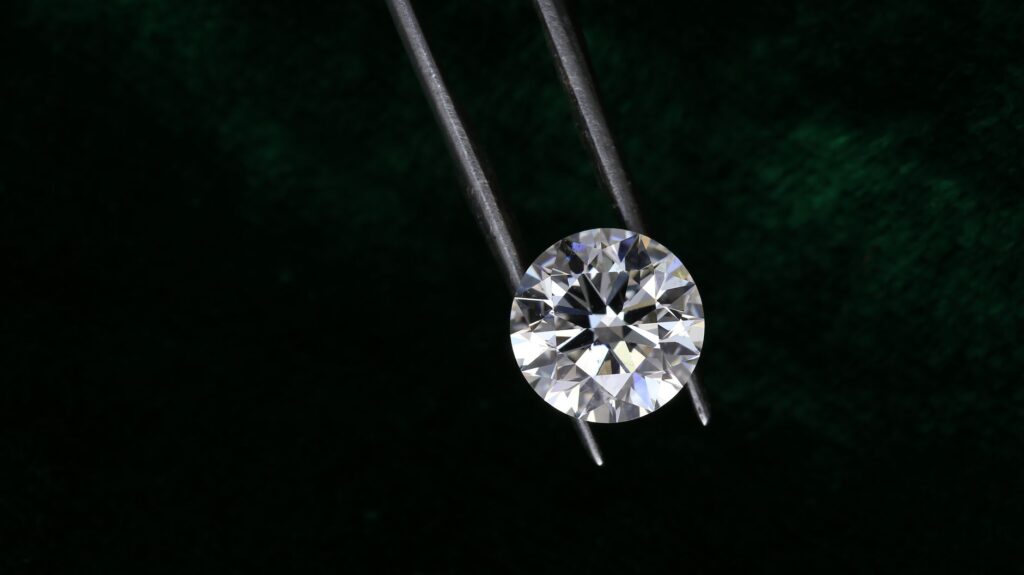
On a grading report, F color is described as colorless. In real life, that means the diamond generally appears white and bright, without an obvious yellow or brown cast. Most people would not look at an F diamond and think of it as having a visible tint.
That said, gemologists can detect slight differences between D, E, and F when comparing loose stones side by side under controlled lighting. F is still very high quality, but it may not look quite as icy or intense as a D diamond in a direct comparison.
White Appearance and Subtle Warmth
For a buyer, the most useful way to think about F color is this: it should look colorless in everyday use, but it may not be the absolute whitest option under close inspection. The difference is usually subtle enough that most consumers would not notice it unless a higher-grade diamond is placed directly next to it.
If you have a strong preference for a very bright, crisp look, F color is generally still in that zone. If you are extremely sensitive to color and want the most neutral appearance possible, you may prefer D or E, especially in a large stone or a setting that makes color more noticeable.
Can Most People See the Difference?
This is the most practical question for anyone comparing diamond color grades. In many cases, the difference between F and D or E is not obvious in a finished piece of jewelry. Once a diamond is set, viewed from normal distance, and seen in typical lighting, the gap becomes much harder to notice.
The human eye is far better at detecting larger jumps in color than very small ones. That means the difference between F and G is usually more noticeable than the difference between F and E, and the difference between F and D is often visible mainly in controlled comparisons rather than in everyday wear.
Side-by-Side Comparison Matters
Color differences are easiest to see when diamonds are compared side by side, loose, and against a white background. In those conditions, a trained eye can pick out subtle distinctions between colorless grades.
In real life, though, most buyers do not view diamonds that way. They see one stone in a ring, on a hand, under mixed lighting. Under those conditions, an F color diamond generally appears bright and colorless to most observers.
Professional Eyes vs Consumer Eyes
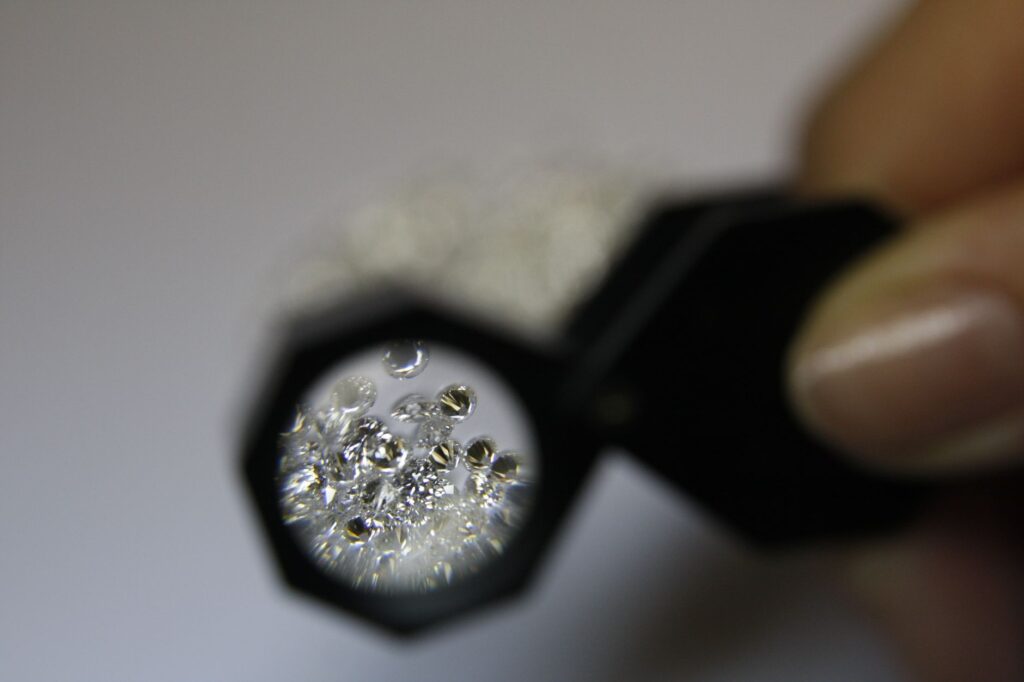
Gemologists and experienced jewelers can often identify very small differences within the colorless range. That does not mean a consumer will notice the same thing during normal wear.
For many first-time buyers, the important point is that grading precision does not always translate into visible improvement. A report may show that D is technically higher than F, but the real-world difference may be difficult to perceive unless the comparison is deliberate and controlled.
How F Color Looks in Different Metals
The metal used in a ring can change how a diamond color grade appears. This is one reason why a diamond that looks slightly different in the showroom may look different again once it is set.
F Color in White Gold and Platinum
F color generally looks excellent in white metals such as white gold and platinum. These metals tend to support a bright, colorless look, which makes F a strong match for classic engagement ring designs.
Because white metals do not add warmth around the stone, they can make subtle color differences more noticeable than yellow gold does. Even so, F still usually appears very white in these settings.
F Color in Yellow Gold
Yellow gold can make a diamond’s body color less noticeable because the metal itself is warm-toned. In this setting, F color often looks extremely white, and many buyers could choose a lower color grade without seeing a meaningful difference.
That said, F is still a premium choice in yellow gold. If you are already planning a yellow gold setting, part of the color premium may be harder to justify because the metal helps mask minor tint in nearby grades.
F Color in Rose Gold
Rose gold has a warm, pinkish tone that can also reduce sensitivity to subtle diamond color differences. An F diamond will usually appear white in rose gold, and many near-colorless grades can also perform well visually in this setting.
If you are choosing rose gold mainly for style, color grade becomes a slightly less critical factor than it would be in platinum or white gold.
How F Color Looks in Different Lighting
Diamond color is not fixed in the way people sometimes expect. Lighting affects how the stone is perceived, and that is one reason grading is done under controlled conditions rather than casual observation.
Daylight
In daylight, F color usually looks very clean and white. Natural light can reveal subtle differences between grades, but an F diamond should still appear colorless to most viewers.
Some buyers prefer to examine diamonds in daylight because it feels more realistic than jewelry store lighting. In this environment, F is typically still a strong performer.
Indoor Lighting
Indoor lighting can vary widely, which means appearance can shift from one room to another. Under standard indoor lighting, F color usually looks bright and neutral.
If the lighting is warm, even very high color grades can take on a slightly softer appearance. That does not mean the diamond is lower quality. It simply reflects how light interacts with the stone and the surrounding environment.
Jewelry Store Lighting
Jewelry stores often use strong lighting designed to maximize sparkle. This type of lighting can make diamonds look brighter and more dazzling, while also making small color differences harder to judge accurately.
As a result, an F color diamond may look extremely white in a store, sometimes making it difficult to distinguish from D or E without careful comparison.
Warm vs Cool Lighting
Cool lighting tends to emphasize whiteness and can make top color grades seem especially crisp. Warm lighting can slightly soften the visual impression of a diamond, but F color should still remain in the colorless category visually for most people.
If you frequently wear jewelry in warm indoor settings, the advantage of paying extra for D over F may be even less noticeable.
Price Premium vs Visual Benefit
One of the biggest reasons buyers consider F color is value. The colorless category is often priced with meaningful jumps between grades, even when the visible difference is small.
F often costs less than D and E while still delivering the colorless look that many buyers want. That makes it a sweet spot for shoppers who care about appearance but do not want to pay for the rarest top grade.
Why the Premium Exists
Higher color grades are scarcer, which contributes to higher prices. Diamonds graded D and E are less common than F, so the market often assigns them a premium.
The premium does not necessarily reflect a dramatic visual difference. It reflects rarity, grade prestige, and market demand. Buyers should keep that distinction in mind when comparing cost and appearance.
Diminishing Returns at the Top End
Diamond color is a classic example of diminishing returns. Going from a clearly tinted diamond to a near-colorless diamond can make a meaningful visual difference. Going from G to F, or from F to D, usually produces much smaller gains that are harder to see.
That is why F often appeals to practical buyers. It offers a high-end look without forcing you into the highest-priced tier of the scale.
Is F Color Worth It?
F color is worth it for buyers who want a colorless diamond and place value on having a top-tier grade without paying the absolute highest premium. It is especially appealing when the rest of the diamond, such as cut quality, is also strong.
It may be less worthwhile if your budget is tight and you would rather allocate more money to cut quality, carat size, or a better setting. In many cases, those factors have a bigger effect on visual impact than the difference between F and a nearby grade.
When F Color Makes Sense
F color can be a strong choice if:
- You want a diamond that sits firmly in the colorless category.
- You prefer a bright, white look in a white gold or platinum setting.
- You want a high grade without paying for D or E.
- You are comparing lab grown diamonds and want to take advantage of the wider availability of high color grades.
When You Might Not Need F
F may be more than you need if:
- You are buying in yellow gold or rose gold.
- You are comfortable with a near-colorless diamond that still looks white.
- You would rather increase size or improve cut quality.
- You are trying to maximize budget efficiency in an engagement ring purchase.
F Color in Lab Grown Diamonds
Lab grown diamonds often achieve high color grades more frequently than many natural diamonds because the growth process can produce stones with very low levels of visible color. That makes F color common and accessible in the lab grown market.
For buyers comparing lab grown diamonds, F is often part of a larger range of highly white options. In many cases, you may find excellent value at F, G, or H depending on the size, cut, and overall quality of the diamond.
Does Color Behave Differently in Lab Grown Diamonds?
No, color is judged by the same basic visual principles regardless of whether a diamond is natural or lab grown. The difference is more about how frequently certain color grades appear in the market and how pricing is structured.
Lab grown diamonds can be an attractive option for buyers who want a colorless appearance at a lower price point. Because higher color grades are often more readily available, the premium for F over nearby grades may sometimes feel less dramatic than it does in natural diamonds.
Should You Upgrade Color in Lab Grown?
Not always. Since many lab grown diamonds already appear very white, it can make sense to compare F against G or H rather than automatically choosing the highest grade available.
If the diamond is well cut, a near-colorless grade may still appear bright and appealing. That is why color should be evaluated alongside cut, not treated as the only measure of beauty.
F Color Compared With Other Diamond Color Grades
To understand F color properly, it helps to compare it directly with nearby grades. The differences are not always dramatic, but they matter when you are deciding where your budget is best spent.
F vs D Color
D is the highest color grade and sits at the very top of the colorless range. F is still colorless, but D is technically more rare and can appear slightly whiter under controlled comparison.
For most buyers, the visible difference between D and F is subtle. The price difference, however, can be noticeable. If your goal is maximum value rather than maximum grade prestige, F is often the more practical choice.
F vs E Color
E is the grade immediately above F and is also colorless. In side-by-side comparisons, E may appear marginally more neutral, but the difference is typically very small.
Many shoppers consider E and F to be nearly interchangeable in appearance. The decision often comes down to price, availability, and personal preference for having a slightly higher grade on the report.
F vs G Color
G begins the near-colorless range, which means it is the first step below the colorless category. In many real-world settings, G still looks white, especially in a well-cut diamond.
Compared with F, G may have a slightly warmer appearance in certain conditions, but the difference is often subtle. The price savings can be meaningful, which is why G is often seen as a value point for buyers who do not need a strictly colorless grade.
F vs H Color
H is also near-colorless and can look very white in many engagement rings, especially once set. In some diamonds, the difference between F and H is easy to overlook in daily wear.
If you are shopping for value, H can be a smart alternative. If you want the peace of mind of staying in the colorless range, F provides a stronger grading position without a huge visual shift.
Comparison Table: F Color vs Nearby Grades
| Grade | Color Category | Visible Whiteness | Typical Price Position | Best For |
|---|---|---|---|---|
| D | Colorless | Very white, most neutral | Highest | Buyers wanting the top grade |
| E | Colorless | Very white, extremely subtle difference from D | High | Shoppers wanting a premium colorless look |
| F | Colorless | Very white, slight difference only in close comparison | High, but often better value than D or E | Buyers wanting colorless appearance with better value |
| G | Near-colorless | Usually white in most settings, slight warmth possible | Moderate | Value-conscious buyers |
| H | Near-colorless | White in many rings, warmth may show in some conditions | Lower | Budget-focused buyers, especially in yellow gold |
How Diamond Shape Affects the Visibility of F Color
Diamond shape changes how color is perceived. Some shapes tend to reveal more color than others, which can influence whether F is a strong choice or more than you need.
Shapes That Hide Color Well
Round brilliant diamonds are often the most forgiving when it comes to color. Their faceting pattern creates strong sparkle, which can help mask very subtle tint.
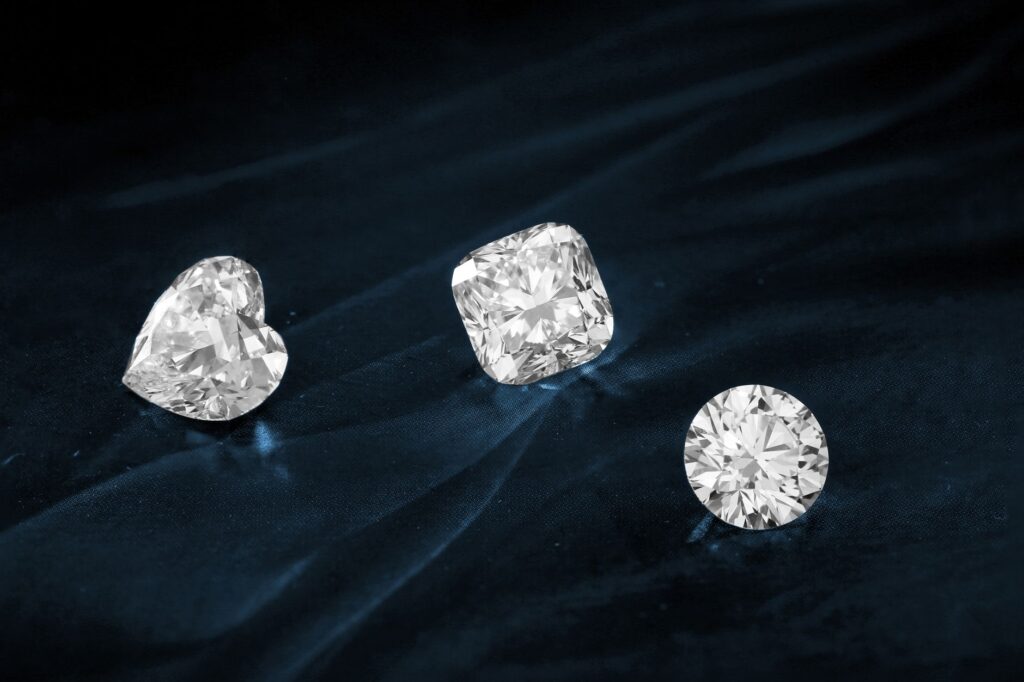
Shapes like oval, cushion, radiant, and princess can also perform well, though the exact result depends on cut quality and personal viewing preferences.
Shapes That May Show More Color
Elongated shapes and step cuts, such as emerald cuts, may show color more readily because they have larger open facets and less intense sparkle than brilliant cuts. In those shapes, buyers sometimes prefer to stay higher in the color scale.
If you are choosing an emerald cut, F can still be a strong option, but it becomes more important to evaluate the diamond in person or with high-quality images and videos.
How Cut Quality Influences Color Perception
Cut and color are closely connected in the eyes of a buyer. A well-cut diamond returns more light, and that brightness can make subtle color less noticeable.
In other words, an excellent cut can help an F color diamond look even whiter. A poorly cut diamond may allow more body color to be noticed, even if the color grade itself is relatively high.
This is one reason experienced buyers often prioritize cut first. If a diamond is well cut, the color grade becomes easier to evaluate in context.
Common Buyer Mistakes With F Color Diamonds
F color is a strong grade, but buyers still make avoidable mistakes when comparing diamonds. Understanding these can help you make a more balanced decision.
Overpaying for Invisible Upgrades
One common mistake is paying a large premium for D or E when F would look virtually the same in the finished ring. If the difference is not visible to you in the setting you chose, the extra money may not deliver meaningful value.
Ignoring the Metal Choice
Another mistake is comparing color grades without considering the ring metal. A diamond in yellow gold may not need the same color grade as one in platinum.
Judging Only by the Grading Report
A report is important, but it is not the whole story. Two diamonds with the same F grade can still look different because of cut, shape, size, and fluorescence.
Assuming F Means Perfect in Every Situation
F is colorless, but that does not mean it is visually identical to every other colorless diamond in every environment. Light, mounting style, and stone shape still matter.
F Color and Diamond Size
Diamond size can affect how visible color appears. As diamonds get larger, subtle tint may become easier to notice because there is more surface area for the eye to evaluate.
In smaller stones, F and nearby grades often look essentially identical to most buyers. In larger stones, the value of staying at F may increase if you want extra assurance that the diamond will still look very white.
This is why some shoppers feel more comfortable choosing F in one-carat-and-up stones, especially in white metal settings where color visibility can be slightly more pronounced.
Does F Color Hold Value Better?
Higher color grades are often associated with stronger resale perception, but resale value in diamonds is complicated and should not be the main reason to buy a higher grade. Market demand, overall quality, and type of diamond matter more than color grade alone.
F color may be easier to market than lower color grades because it sits in the colorless range. Still, buyers should be cautious about assuming that a higher color grade will automatically translate into strong resale returns.
For most consumers, the better question is not what a diamond will be worth later, but what level of color provides the best personal value today.
Who Should Consider F Color?
F color is a good fit for buyers who want a diamond that looks colorless without paying top-tier D prices. It is especially appealing for people who are sensitive to warmth but still want a smart balance between quality and budget.
You may be a good match for F color if:
- You are buying a white gold or platinum engagement ring.
- You want the reassurance of a colorless grade.
- You are comparing lab grown diamonds and want a premium-looking stone at a reasonable cost.
- You prefer a very white appearance but do not want to overpay for minimal visual gains.
Who Can Save Money by Choosing Lower Color Grades?
Not every buyer needs F color. In many cases, a near-colorless diamond will still appear beautifully white, especially if the cut is strong and the setting is chosen thoughtfully.
You may be able to save money with G or H if:
- The ring will be set in yellow or rose gold.
- You prefer a larger diamond over the highest color grade.
- You are comfortable with a very slight warmth that is usually hard to detect.
- You want to maximize value in a lab grown diamond purchase.
That trade-off can be especially useful for first-time buyers who are trying to balance size, sparkle, and budget.
Frequently Asked Questions About F Color Diamonds
Is F color a good diamond grade?
Yes. F is a colorless grade, which means it sits in the top tier of the diamond color scale. It is considered a high-quality choice for buyers who want a white-looking diamond.
Can you tell the difference between F and D color?
Usually only in close side-by-side comparison, especially with loose stones under controlled lighting. In everyday wear, most people will not notice a meaningful difference.
Is F color better than G color?
F is technically higher because it is colorless, while G is near-colorless. Visually, though, the difference can be very subtle in a well-cut diamond. Whether F is “better” depends on how much you value the grade versus the price difference.
Does F color look yellow?
No, F color should not appear yellow to most observers. It is classified as colorless and should look white in normal viewing conditions.
What metal is best for an F color diamond?
F color works especially well in white gold and platinum because those metals support a crisp white appearance. It also looks excellent in yellow gold and rose gold.
Is F color worth the extra money over G or H?
Sometimes. If you want the reassurance of a colorless grade, F can be worth the premium. If your priority is value, and the diamond will be in a warm-toned setting, G or H may be the smarter buy.
Do lab grown diamonds need higher color grades?
Not necessarily. Lab grown diamonds often come in high color grades more frequently, so buyers should compare value carefully. An F grade may be attractive, but lower grades can also look very white depending on the cut and setting.
Will F color look different in a large diamond?
It can. Larger diamonds may reveal subtle color more easily, which is one reason some buyers prefer F in bigger stones. Even then, F should still appear colorless in normal use for most people.
Practical Buying Takeaways
F color diamond is a strong choice for buyers who want a colorless appearance and a reliable high-grade option without automatically paying for the most expensive top tier. It is a grade that often makes sense in the real world because the visual difference from D or E is usually very small.
The most important point is that diamond color should be judged in context. Shape, cut quality, metal choice, and lighting all influence how white a diamond appears. A well-cut F diamond in the right setting can look excellent and offer meaningful value.
For many buyers, F represents a practical middle ground within the colorless category. It is high enough to provide confidence, but not so rare that the price premium becomes hard to justify for everyday wear.